What is a Teaching Cover Letter?
A teaching cover letter is a crucial document that accompanies your resume when applying for a teaching position. It serves as your personal introduction, allowing you to highlight your qualifications, experience, and passion for education. Unlike a resume, which provides a factual overview of your background, a cover letter gives you the opportunity to express your personality, elaborate on specific achievements, and demonstrate why you are the ideal candidate for the role. It’s your chance to make a memorable first impression and convince the hiring committee to consider you for an interview. Crafting a compelling cover letter is an essential step in the job application process, and it’s a skill worth mastering for any aspiring educator.
The Purpose of a Teaching Cover Letter
The primary purpose of a teaching cover letter is to persuade the hiring committee that you possess the necessary skills, experience, and enthusiasm to excel in the teaching position. It’s your chance to go beyond the facts presented in your resume and tell a story that showcases your unique strengths and what you can bring to the school. A well-written cover letter demonstrates your understanding of the school’s needs and values, and it allows you to explain how your qualifications align with those requirements. The cover letter should also express your genuine interest in the specific school and the opportunity, emphasizing why you’re particularly drawn to their environment and mission. Ultimately, its goal is to secure an interview by making a strong case for your candidacy.
Key Components of a Successful Teaching Cover Letter

A successful teaching cover letter comprises several key components, each contributing to its overall effectiveness. These elements work together to create a compelling and professional presentation. A well-structured cover letter not only showcases your qualifications but also demonstrates your attention to detail and communication skills, all of which are highly valued in the teaching profession. By carefully crafting each part of your cover letter, you significantly increase your chances of standing out from the competition and securing an interview. Ensuring that each section is clear, concise, and relevant will make a lasting positive impression on the hiring committee.
Header Section
The header section is the first element of your cover letter. It includes your contact information, the date, and the recipient’s information. Ensuring the header is accurate and professional is critical, setting the tone for the entire document. This section provides essential details that the hiring committee can readily use to contact you. A clean, well-formatted header indicates your attention to detail and professionalism, qualities that schools highly value in prospective teachers. Making sure this section is polished from the start helps establish a strong initial impression.
Your Contact Information
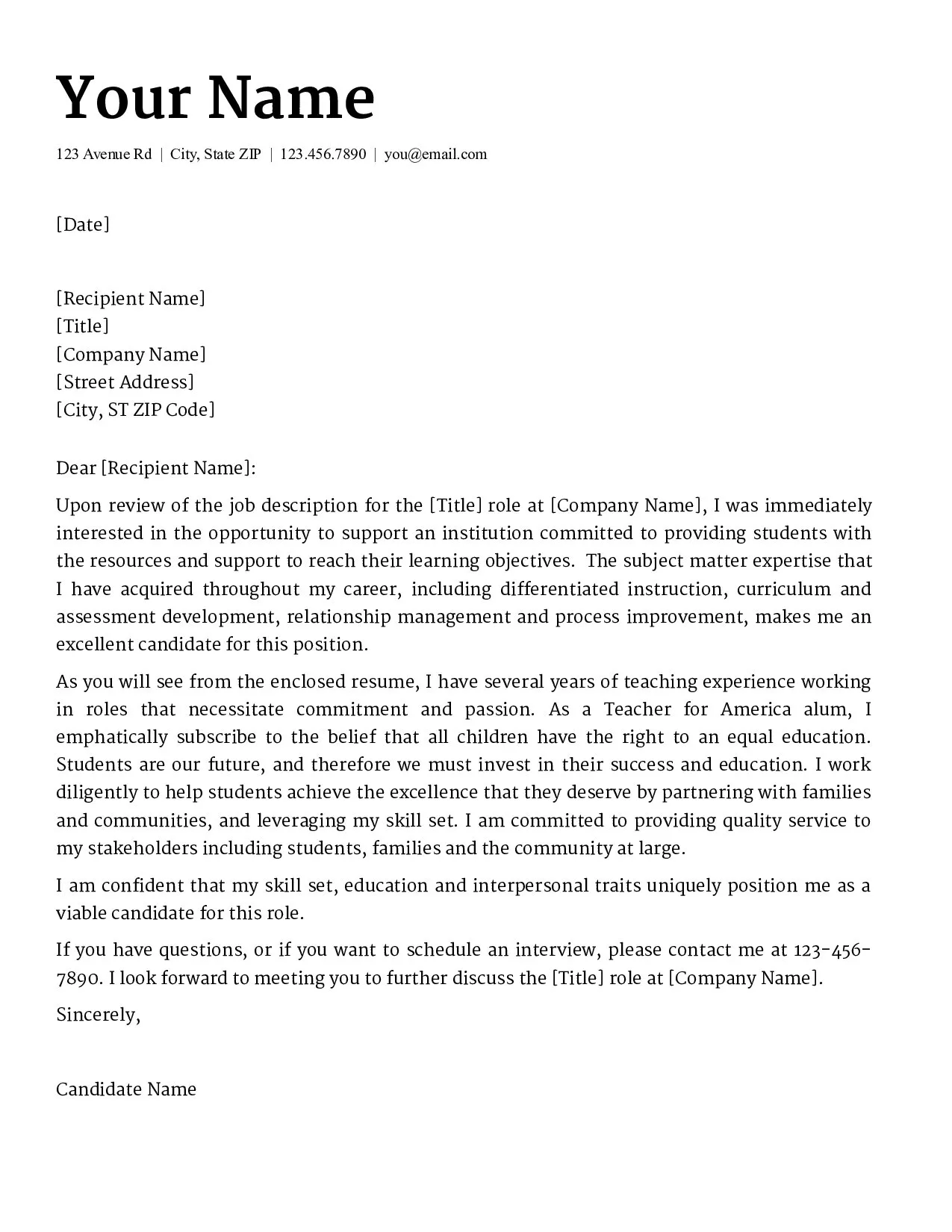
At the top of your cover letter, include your full name, address, phone number, and email address. Make sure the email address is professional (avoid nicknames or unprofessional handles). This information allows the hiring committee to easily reach you. Correct and up-to-date contact details are essential, as any errors could lead to missed opportunities. Verify that your phone number and email are active and monitored regularly, and always ensure your voicemail is set up with a professional greeting. A clear and accessible header simplifies the hiring process and helps ensure you don’t miss important communications from potential employers. (See image of a well designed header at the top of the page).
Date

Following your contact information, include the date you are submitting the cover letter. This helps establish the timing of your application. Typically, this should be placed directly below your contact details or slightly to the right. The date provides context for the hiring committee and offers a quick reference point for when the application was received. Ensure the date is correctly formatted according to the local convention of your region, demonstrating attention to detail.
Recipient’s Information
Include the name and title of the person you are addressing, the school’s name, and the school’s address. If possible, find out the name of the hiring manager or principal; addressing your letter to a specific person increases the likelihood of it being read and shows that you have taken the time to research the school. Information can usually be found on the school’s website or through a quick online search. Addressing the letter to a specific person demonstrates your initiative and attention to detail, making a positive first impression. Using the correct recipient’s name also shows that you value the school’s hiring process.
Salutation
Start your cover letter with a professional salutation. ‘Dear Mr./Ms./Dr. [Last Name]’ is appropriate if you know the name of the hiring manager. If the name is unavailable, use ‘Dear Hiring Committee’ or ‘Dear Principal.’ Avoid informal greetings like ‘To Whom It May Concern.’ A well-chosen salutation sets the tone for the rest of your letter. It shows respect for the recipient and indicates that you are familiar with professional communication. The salutation is the first interaction and shows that you are attentive and professional.
Opening Paragraph

The opening paragraph should immediately grab the reader’s attention. State the position you are applying for and where you found the job posting. Briefly mention your most relevant qualification or experience that aligns with the school’s needs. Express enthusiasm for the opportunity. The opening paragraph is your first chance to create a positive impression. It should be clear, concise, and immediately highlight why you are a good fit for the role. Make your opening statement memorable, making the reader want to learn more about you and read the rest of your letter.
Highlighting Your Passion for Teaching
Show your genuine enthusiasm for teaching. Share why you love teaching and what motivates you in the classroom. This can include your philosophy of education, your commitment to student success, or your passion for a specific subject. Passion is contagious, and expressing it in your cover letter can make you stand out. When the hiring committee can feel your enthusiasm for teaching, it makes them more excited about the possibility of you joining their school. (See image of a teacher helping students).
Showcasing Relevant Experience
Briefly describe your teaching experience or related work. Mention any relevant internships, student teaching experiences, or previous teaching roles. Highlight the skills and knowledge you have gained. Quantify your experience by providing specific examples and achievements. Showing relevant experience immediately demonstrates your ability to teach students and can significantly help your application. Always tailor this to match the school’s specific requirements. The more relevant experience you can display in this section, the better your chances of being considered.
Quantifying Achievements

Use numbers and data to showcase your achievements. Instead of saying ‘I improved student test scores,’ say ‘I increased student test scores by 15%.’ This makes your claims more credible and impactful. Quantifiable achievements demonstrate the real-world results of your teaching and show the hiring committee the impact you have made in previous roles. Numbers add credibility to your claims, making it easier for the hiring committee to visualize your successes. (See image of a teacher celebrating achievements.)
Mentioning Skills and Qualifications
List your relevant skills and qualifications. Mention your certifications, degrees, and any specialized training. Be sure to include skills that align with the job description. Highlight those which fit the requirements. This can include classroom management, curriculum development, differentiation, or technology integration skills. Ensure your skills match the requirements in the job description. Mentioning the right skills makes it easy for the hiring committee to understand your abilities. It helps them quickly assess if you meet the requirements for the role.
Addressing the Specific Job Requirements
Carefully review the job description and directly address each requirement. Explain how your experience and skills meet those needs. Provide specific examples to support your claims. Customizing your cover letter to the job requirements shows that you have carefully read the job description and that you understand the specific needs of the school. It demonstrates that you’ve thought about how your skills can benefit their institution. Address each requirement will increase your chances of getting an interview.
Middle Section

The middle section is where you elaborate on your experience, skills, and achievements. It’s your opportunity to provide specific examples that demonstrate your qualifications and showcase your teaching abilities. Use this section to tell a compelling story that illustrates why you are a great fit for the school. A well-crafted middle section can significantly increase your chances of getting an interview. Focusing on details that demonstrate your values to the school is key.
Body Paragraphs
Develop 2–3 body paragraphs that expand on your key qualifications and experiences. Each paragraph should focus on a specific aspect of your skills or achievements. Use the STAR method (Situation, Task, Action, Result) to provide detailed examples. Use clear and concise language and provide concrete examples to support your claims. Body paragraphs are your opportunity to demonstrate your skills and qualifications. Well-crafted body paragraphs show the hiring committee your teaching abilities and make you a more attractive candidate.
Tailoring Your Cover Letter to the School
Customize your cover letter to each school you apply to. Research the school’s mission, values, and programs. Tailor your letter to address their specific needs. Generic cover letters are easy to spot and may indicate a lack of genuine interest. Customizing your cover letter shows you have taken the time to understand the school and that you are invested in the opportunity. It also increases the likelihood that your application will be noticed.
Researching the School

Before writing your cover letter, research the school’s website, mission statement, and any recent news or initiatives. This will provide you with valuable information about their values, teaching philosophy, and specific needs. Demonstrate your knowledge and understanding of the school in your cover letter. Research shows that you care about the school and their needs. Addressing their specific requirements increases your chances of getting a job at that particular school. (See image of a person researching a school on a computer).
Addressing the School’s Values
In your cover letter, explicitly address the school’s values. Show how your teaching philosophy aligns with theirs. Highlight your commitment to their mission. Addressing the school’s values shows you’ve thought about how you can add to their existing efforts. Using their values in your letter shows the hiring committee that you share the same vision and can collaborate to achieve their goals. Mentioning the school’s values makes a good impression on the hiring committee.
Using Keywords from the Job Description
Carefully review the job description and incorporate relevant keywords into your cover letter. This helps your application get noticed by applicant tracking systems (ATS) and highlights your qualifications to the hiring committee. It’s essential to integrate keywords naturally, rather than stuffing them. The right keywords can help your application pass the initial screening and get you noticed. When your cover letter contains keywords, it shows the hiring committee that you possess the necessary qualifications. The use of keywords ensures your application can be easily reviewed by the hiring team.
Providing Examples
Support your claims with specific examples. Use the STAR method to provide details about how you have demonstrated the required skills and achieved positive results in the past. Concrete examples help the hiring committee see your skills in action. Using the STAR method will clearly show them your skills and the results you achieved. By providing specific examples, you create a stronger impression on the hiring committee. Specific examples show that you are a capable and effective teacher. This method makes your letter more compelling.
Closing Paragraph
The closing paragraph should reiterate your interest in the position and express your gratitude for the opportunity to be considered. End with a call to action, such as inviting the reader to contact you for an interview. Make a lasting impression by ending your letter with a strong closing. Your final paragraph should summarize your interest and summarize your skills. Make sure to keep it brief, professional, and polite. (See image of an enthusiastic teacher closing a lesson).
Reiterating Interest
Reiterate your enthusiasm for the position and the school. Briefly summarize why you are a good fit and what you hope to bring to the role. This demonstrates your continued interest and reinforces your commitment to the opportunity. Reinforce your interest by summarizing your most important points. This reinforces your interest in the position and leaves a positive impression on the hiring committee.
Call to Action
Include a call to action by inviting the reader to contact you for an interview. Provide your contact information again and express your availability. A call to action prompts the reader to take the next step, showing that you are eager to move forward in the hiring process. The call to action will help you land an interview and is an important step. Inviting a response helps to get the process moving quickly.
Expressing Gratitude
Express your gratitude for the reader’s time and consideration. Thank them for reviewing your application and reiterate your interest in the position. Thanking the reader for their time and consideration shows respect and professionalism. Your gratitude shows that you appreciate their effort and reinforces a positive impression. Expressing your gratitude is always a good practice and creates a positive image of you.
Formal Closing and Signature
End your cover letter with a professional closing, such as ‘Sincerely,’ ‘Respectfully,’ or ‘Thank you.’ Follow with your typed name and a signature (if submitting a physical copy). A formal closing and signature add a touch of professionalism to your cover letter. It signals respect and attention to detail, further enhancing the overall impression you make. Your signature shows the hiring committee that you are authentic and ensures your cover letter appears official.
Samples of Effective Teaching Cover Letters
Reviewing different cover letter samples can help you understand the various formats and styles that are effective. Each teaching role requires tailoring your cover letter. Seeing a variety of examples can inspire your cover letter and helps you decide what to highlight. Reviewing samples can help you to get a better sense of what makes a compelling cover letter. (See image of multiple sample cover letters on a table).
Elementary Teacher Cover Letter Sample
An elementary teacher cover letter should highlight your ability to create a nurturing and engaging learning environment for young children. The sample should showcase your understanding of child development and your skills in implementing age-appropriate curriculum. It’s essential to emphasize your passion for fostering a love of learning in young students. The letter should also describe your ability to work with parents and caregivers. It should demonstrate enthusiasm for early childhood education. These elements help the hiring committee quickly identify you as a potential fit for their school.
Middle School Teacher Cover Letter Sample
A middle school teacher cover letter should demonstrate your ability to connect with and engage adolescent students. The sample should highlight your skills in classroom management, your ability to create dynamic lesson plans, and your experience in differentiating instruction to meet the diverse needs of middle schoolers. Make sure you express your ability to foster a sense of community and respect. The cover letter should also highlight your commitment to helping students build skills for high school. It’s important to showcase your ability to inspire a love of learning during these critical years.
High School Teacher Cover Letter Sample
A high school teacher cover letter should emphasize your subject matter expertise, your skills in teaching advanced concepts, and your ability to prepare students for college or careers. The sample should show how you help students to enhance their critical thinking skills. This letter should highlight your commitment to student success and your ability to create a rigorous and supportive learning environment. Show your capacity for incorporating technology. Ensure you emphasize your ability to engage with high school students. By making sure your points are relevant to your specific subject, you increase your chances of gaining an interview.
Tips for Writing a Standout Cover Letter
Several key tips can help you write a standout cover letter that grabs the hiring committee’s attention. These tips include proofreading, formatting, and maintaining a professional tone. Each of these tips contributes to your goal of making a positive impression. By incorporating these tips, you will create a document that represents you as a professional and suitable candidate. These actions make the cover letter stand out. (See image of a person editing and proofreading a cover letter).
Proofreading and Editing
Proofread your cover letter carefully for any errors in grammar, spelling, and punctuation. Have a friend or colleague review your letter as well. Errors can undermine your credibility and create a negative impression. Proofreading is critical, and it is an easy way to demonstrate your attention to detail. Always make sure your letter is free of errors before submitting it. This action shows you are an attentive and professional candidate. This is your last chance to catch any mistakes, and it helps ensure your letter is polished.
Formatting
Use a professional and easy-to-read font, such as Times New Roman or Arial. Maintain consistent formatting throughout the document, including spacing, margins, and alignment. Formatting a cover letter properly increases readability. It provides a clean and professional appearance. Good formatting makes your letter easier to read and makes a better impression. Professional formatting makes a good impression on the hiring committee. (See image of a nicely formatted cover letter).
Maintaining a Professional Tone
Use a professional and formal tone throughout your cover letter. Avoid slang, jargon, and overly casual language. Your tone should reflect your professionalism and respect for the hiring committee. A professional tone demonstrates your ability to communicate effectively and your respect for the role. This is crucial for creating the right image. The right tone helps you to convey your professionalism, and shows the hiring committee that you know how to communicate properly.
Submitting Your Cover Letter
The way you submit your cover letter is as important as the content itself. Ensure you follow the application instructions precisely. Following application instructions demonstrates your attention to detail and respect for the hiring process. This helps you avoid being eliminated from consideration. Your submission method can impact your chances of being considered. These are important steps to getting your application seen by the right people.
Ensuring Proper File Format
Submit your cover letter in the requested file format, such as PDF or DOCX. If no format is specified, PDF is generally the safest option as it preserves formatting. Make sure the file name is professional. Following the instructions regarding file format demonstrates your attention to detail. The correct format helps to ensure your cover letter is easily readable. Using the correct file format will help your application be processed correctly.
Following Application Instructions
Carefully read and follow all application instructions, including any specific requirements for submitting your cover letter and resume. Not following instructions is a common mistake that can lead to your application being rejected. Following the instructions shows you can follow directions and are attentive to detail. By making sure that your application is sent according to the given instructions, you increase your chances of landing an interview. Following instructions demonstrates your willingness to adhere to the organization’s policies.
Common Mistakes to Avoid
Avoid common mistakes that can damage your chances of getting hired. The most common include generic letters, typos, exaggerating qualifications, and ignoring the school’s needs. Avoiding these mistakes will ensure that your cover letter makes a good impression. Avoiding these mistakes will improve your application. Taking the time to carefully craft your cover letter can make the difference. It will help you to avoid common errors. (See image of a person avoiding mistakes).
Generic Letters
Do not send a generic cover letter that is not tailored to the specific job and school. Customize each letter to reflect your interest in the specific opportunity and your understanding of the school’s needs. Generic cover letters show a lack of effort and can make you appear uninterested. Always customize your letter to showcase your genuine interest and suitability for the position. This shows that you’re eager to make a good impression. Customizing your letter increases your chances of landing an interview.
Typos and Grammatical Errors
Avoid typos and grammatical errors. Proofread your cover letter carefully before submitting it. Errors can make you appear unprofessional and careless. Proofreading is a key step in ensuring your cover letter is professional. Ensure it does not have mistakes. Typos and errors can undermine your credibility. Avoid them by always proofreading your cover letter.
Exaggerating Qualifications
Do not exaggerate your qualifications or experience. Be honest and accurate in your descriptions. Exaggerating can damage your credibility. It is better to be honest and accurate. This is important for long-term success. Honesty builds trust. Your reputation is essential in the teaching profession. Always maintain honesty and integrity in your cover letter.
Ignoring the School’s Needs
Do not ignore the school’s needs and values. Research the school and tailor your cover letter to address their specific requirements. Failing to address the school’s needs can make you seem uninterested and show that you lack preparation. Address the needs of the school by researching their mission, values, and current goals. Tailor your cover letter to show how you can help the school achieve their goals. This makes a good impression on the hiring committee. Your preparation will show the hiring committee you care about the school.