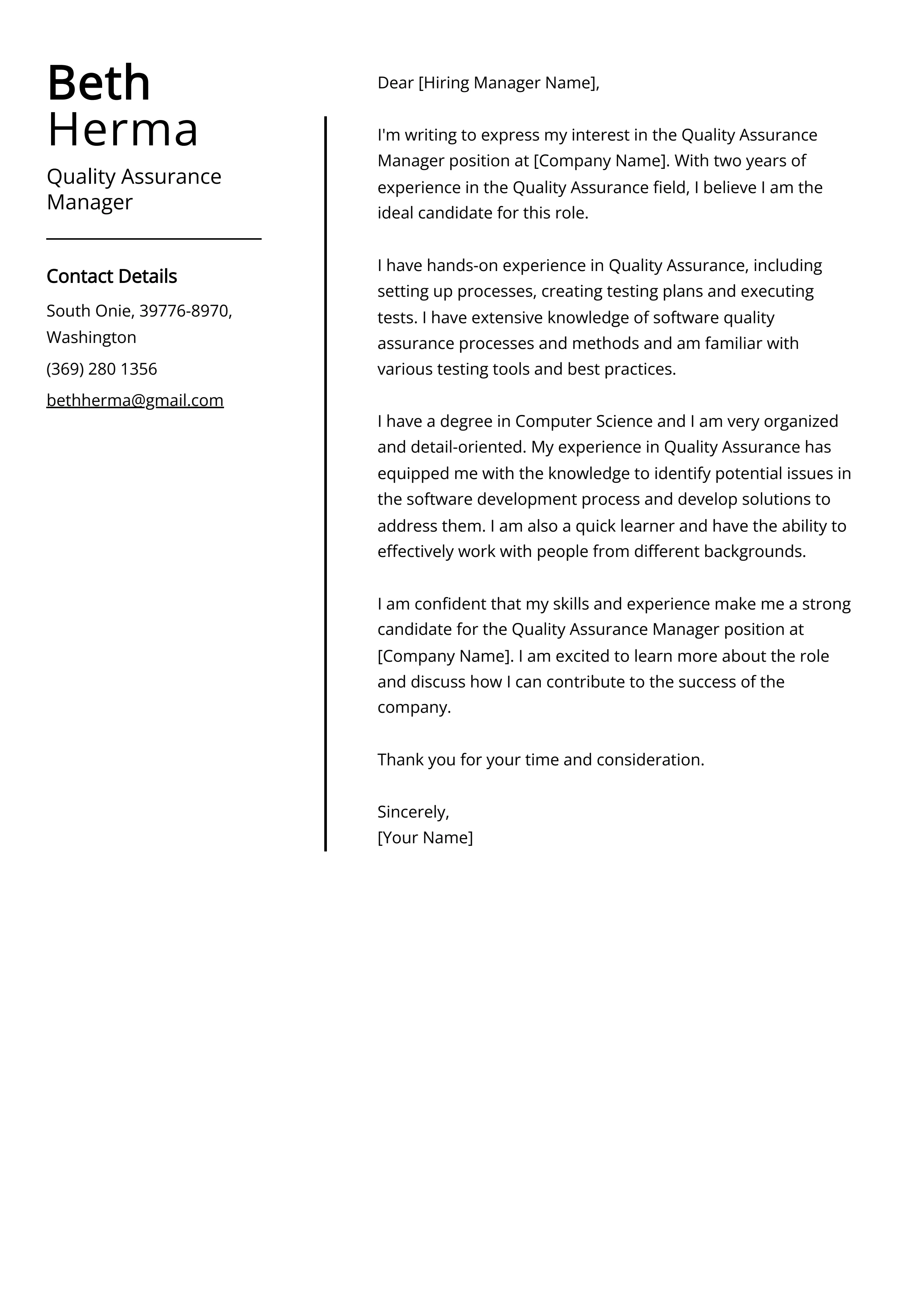
Crafting a Quality Manager Cover Letter
A well-crafted cover letter is your first opportunity to make a strong impression on a potential employer. For a Quality Manager, a cover letter isn’t just a formality; it’s a critical document that highlights your expertise, demonstrates your understanding of quality assurance principles, and showcases your ability to lead and manage quality-related processes. This guide will walk you through the essential components of a compelling Quality Manager cover letter, helping you to secure that all-important interview and advance your career.
Understanding the Role of a Quality Manager
Before you start writing, it is crucial to understand what a Quality Manager does. They are responsible for ensuring that products and services meet the standards and requirements set by the organization and industry. They develop and implement quality control systems, analyze data to identify areas for improvement, and lead teams to maintain and enhance quality standards. They are often the point person for audits, compliance, and continuous improvement initiatives. Showcasing your understanding of these responsibilities in your cover letter is essential.
Key Responsibilities of a Quality Manager

A Quality Manager’s key responsibilities typically include developing and implementing quality management systems, performing audits, analyzing data, and leading quality improvement initiatives. They collaborate with cross-functional teams, manage quality-related documentation, and ensure compliance with industry standards and regulations. Highlighting your experience in these areas will strengthen your cover letter and demonstrate your suitability for the role. Mentioning specific experiences, such as leading a team to reduce defects or implementing a new quality control process, can be particularly effective.
Highlighting Relevant Skills
Your cover letter should showcase a combination of technical and soft skills that make you an ideal candidate. Focus on how your skills align with the specific requirements of the job. Tailoring your skills section to the job description will make your application stand out. Always provide specific examples. Don’t just say you have great problem-solving skills; describe a time when you used them to resolve a critical quality issue and the positive outcome of your actions.
Technical Skills for Quality Managers
Technical skills are essential for any Quality Manager. Proficiency in quality management methodologies like Six Sigma, Lean, and ISO standards is usually a must. Data analysis skills, including experience with statistical process control (SPC) and other analytical tools, are also important. Demonstrate your knowledge of quality control processes, auditing, and risk management. If you have experience with specific software or tools, make sure to mention them. Highlighting these skills will demonstrate your technical competence and ability to drive quality improvements.
Soft Skills for Quality Managers

Soft skills are just as important as technical skills. Strong leadership and communication abilities are crucial for leading teams and effectively communicating quality-related information. Problem-solving and analytical skills are necessary for identifying and addressing quality issues. Excellent organizational skills will help you manage multiple projects and priorities. Include examples of how you’ve used these skills to achieve positive outcomes. For instance, describe how you resolved a conflict within your team or how you communicated complex data to a non-technical audience.
Structuring Your Cover Letter
A well-structured cover letter is easy to read and makes it easy for the hiring manager to quickly understand your qualifications. Focus on creating a clear, concise, and engaging letter that highlights your key strengths. Make sure to use proper formatting and language. Using a standard business letter format will show professionalism and attention to detail. Structure your cover letter with distinct sections, ensuring that each part serves a specific purpose in conveying your qualifications and enthusiasm for the position.
Header and Contact Information
Start with a professional header. Include your full name, address, phone number, and email address. Make sure this information is easy to find and clearly displayed. If you have a professional online presence, such as a LinkedIn profile, you can include the link. Always ensure your contact information is up-to-date, as it is the primary means by which a potential employer will reach you. Double-check this information before submitting your cover letter to avoid missing any opportunities.
Opening Paragraph The Hook

The opening paragraph is your opportunity to grab the reader’s attention. It should be concise, compelling, and immediately convey why you are a good fit for the job. Clearly state the position you are applying for and where you found the job listing. Briefly mention your most relevant qualifications and express your enthusiasm for the role and the company. This opening paragraph should make the hiring manager want to read more, showing that you understand the company’s needs and are excited about the opportunity.
Body Paragraphs Showcasing Experience
The body paragraphs should provide detailed information about your experience, skills, and accomplishments. Focus on how your experience aligns with the job requirements. Use specific examples to demonstrate your abilities and quantify your achievements whenever possible. For each job or project, provide a brief overview of your responsibilities and then highlight your key accomplishments. Explain how you improved processes, solved problems, or contributed to the overall success of previous employers. Use action verbs to describe your contributions.
Quantifying Achievements
Whenever possible, quantify your achievements with data and metrics. For example, instead of saying “Improved efficiency,” say “Improved production efficiency by 15%.” Quantifying your achievements demonstrates your impact and provides concrete evidence of your capabilities. Include metrics like cost savings, reduction in defects, or improved customer satisfaction scores. The more specific you are, the more persuasive your cover letter will be. Quantifiable results add credibility and make a stronger case for why you are the best candidate for the role.
Using Action Verbs

Action verbs bring your accomplishments to life and show you are an active, results-oriented professional. Start your bullet points or sentences with strong action verbs, such as “Managed,” “Implemented,” “Developed,” “Improved,” and “Led.” Action verbs help you to create a dynamic and engaging narrative that highlights your skills and experiences. For example, use “Led a team of 10 to reduce defects by 20% within six months” rather than “Responsible for reducing defects.” This will make your cover letter more memorable and impactful.
Tailoring Your Letter to the Job
Always tailor your cover letter to the specific job description and the company. Carefully read the job posting and identify the key requirements and qualifications. Then, customize your cover letter to address those requirements directly. This shows that you are serious about the role and have the relevant skills and experience. Avoid using a generic cover letter. Instead, demonstrate your understanding of the company’s needs and how your skills can help them achieve their goals. This level of personalization is critical.
Researching the Company
Before you write your cover letter, research the company. Learn about their products or services, their mission, and their values. Understanding the company culture will enable you to write a cover letter that resonates with the hiring manager. Mentioning specific company initiatives or goals in your letter demonstrates your genuine interest and shows that you have taken the time to understand the company’s needs. This research will also provide you with valuable insights that you can use to tailor your application.
Addressing Specific Requirements

If the job description lists specific requirements, make sure to address each one in your cover letter. Use the same language and terminology as the job description to demonstrate that you understand what the company is looking for. Provide examples of how your experience and skills match each requirement. This direct approach ensures that the hiring manager immediately sees that you meet their needs. When you meet their needs, you substantially improve your chances of getting an interview.
Closing Your Cover Letter
In the closing paragraph, reiterate your interest in the position and the company. Summarize your key qualifications and express your confidence in your ability to contribute to the company’s success. Include a call to action, such as stating that you are eager to discuss your qualifications further in an interview. Keep the tone professional and enthusiastic. End with a formal closing, such as “Sincerely” or “Best regards,” followed by your name and contact information.
Expressing Enthusiasm and Availability
Throughout your cover letter, convey enthusiasm for the role and the company. Show that you are genuinely interested in the opportunity. State your availability for an interview, and provide your contact information for easy follow-up. Expressing enthusiasm and making it easy for the employer to contact you increases your chances of moving forward in the hiring process. Being proactive demonstrates your eagerness to contribute to the company’s success.
Proofreading and Editing

Before submitting your cover letter, proofread it carefully for any errors in grammar, spelling, and punctuation. Errors can create a negative impression and make you look unprofessional. Read your letter aloud to catch any awkward phrasing. Get a second pair of eyes to review your letter. A fresh perspective can help you identify errors that you may have missed. Attention to detail demonstrates your commitment to quality and professionalism. This will greatly influence how the hiring manager views your capabilities.
Common Mistakes to Avoid
Avoiding common mistakes will significantly improve your cover letter. Always ensure your cover letter is error free. Simple errors like typos and poor grammar will reflect poorly on you. You will show the hiring manager that you are not attentive to detail. Your chances of getting the job will likely diminish. Be sure to check your cover letter for these commonly made errors.
Lack of Customization
Sending a generic cover letter without tailoring it to the specific job and company is one of the most common mistakes. Generic letters will not show that you have done your research. This will show a lack of interest in the opportunity. Customize your cover letter for each job application. Mention specific skills, experiences, and achievements relevant to the job description. Demonstrate that you understand the company’s needs and goals. You will greatly increase your chances of an interview.
Generic Language

Using generic language makes your cover letter forgettable. Avoid using vague phrases and clichés. Instead, use specific examples and data to demonstrate your qualifications. Quantify your achievements and highlight your unique contributions. Show the hiring manager what makes you different. Generic statements won’t help you get the job. Being specific and providing examples will show the hiring manager why you are the best fit for their needs.
Typos and Grammatical Errors
Typos and grammatical errors can undermine your credibility and create a negative impression. Always proofread your cover letter carefully. Get a second pair of eyes to review your letter. Errors can make you look unprofessional. This diminishes the chances of landing the job. Ensure your writing is clear, concise, and error-free. Double check your work. You can use tools like Grammarly to help ensure that you deliver the best product possible.
Cover Letter Examples
Reviewing examples can provide valuable insights into how to structure your cover letter. You can adapt these examples to highlight your own skills and experiences. The examples will allow you to take an approach that works best for you. You can highlight the aspects of your career that match the role’s needs.
Example 1 Quality Manager with Experience
This example would highlight a candidate with several years of experience in quality management. It would showcase a candidate’s ability to implement and manage quality systems, lead improvement initiatives, and drive results. A good example would list quantifiable achievements, demonstrate compliance, and align skills to specific job requirements.
Example 2 Entry-Level Quality Manager
This example would be for a candidate with less experience, perhaps an early-career professional or someone transitioning into a quality role. It would emphasize relevant coursework, internships, or projects that demonstrate the candidate’s understanding of quality management principles. It would also focus on transferable skills and a willingness to learn and grow. It’s about demonstrating potential and a strong foundation in quality management principles.
Resources and Further Reading
Several resources can help you further develop your cover letter. These include professional resume writing services, online templates, and career guidance websites. Take advantage of these resources to refine your cover letter and boost your chances of landing an interview. Consider these additional resources to help you write a quality cover letter.