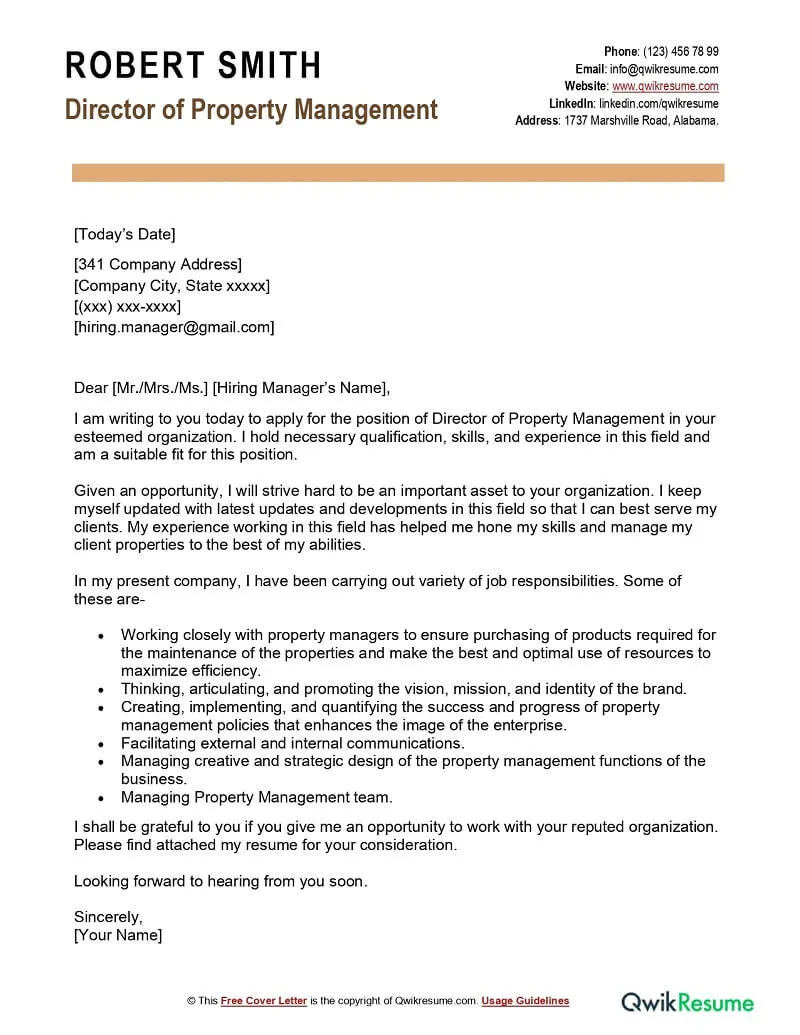
Why You Need a Property Management Cover Letter
A property management cover letter is more than just a formality; it’s your first chance to make a compelling impression on a potential employer. In the competitive field of property management, where roles demand a blend of organizational prowess, communication skills, and financial acumen, your cover letter is a vital tool. It offers a platform to showcase your unique skills, experiences, and aspirations, setting you apart from other applicants. The cover letter complements your resume, providing context and depth to your qualifications, allowing you to articulate your passion for property management and your suitability for the specific role.
Understanding the Importance of a Cover Letter
A well-crafted cover letter serves multiple purposes. Firstly, it introduces you to the hiring manager and offers a personalized touch to your application. It’s a chance to go beyond the bullet points of your resume and tell your story, explaining why you are the ideal candidate for the position. Furthermore, a cover letter demonstrates your communication skills, attention to detail, and professionalism. It shows that you have taken the time to understand the job requirements and are genuinely interested in the opportunity. The cover letter is where you can directly address how your skills align with the employer’s needs.
Showcasing Your Skills and Experience

Your cover letter is the perfect place to highlight the skills and experiences that make you a strong property management candidate. Focus on the most relevant aspects of your background. This includes experience managing properties, handling tenant relations, overseeing maintenance, managing budgets, and ensuring compliance with relevant laws and regulations. Use specific examples to demonstrate your accomplishments. For instance, describe how you successfully reduced vacancy rates, improved tenant satisfaction, or implemented cost-saving measures. Tailor your examples to the specific requirements outlined in the job description.
Key Components of a Property Management Cover Letter
Contact Information and Date
Begin your cover letter with your contact information including your name, address, phone number, and email address. Include the date you are submitting the application. Ensure that your contact information is accurate and up-to-date so the hiring manager can easily reach you.
Hiring Manager’s Name and Title

If possible, address your letter to the hiring manager by name. Research the company to find out who is responsible for reviewing applications. Addressing the letter to a specific person shows that you’ve taken the initiative to research the company and pay attention to detail. If the name of the hiring manager is not available, use a professional greeting such as ‘Dear Hiring Manager’.
Professional Greeting
Start your letter with a professional greeting such as “Dear Mr./Ms. [Last Name]” or “Dear Hiring Manager”. Avoid informal greetings like “Hello” or “Hi.” Make sure you are using the correct title and spelling of the hiring manager’s name.
Writing the Body of Your Cover Letter
Highlighting Relevant Skills and Experience

In the body of your cover letter, focus on the skills and experience that are most relevant to the job. Use the job description to guide you and identify the key requirements. Make sure you clearly state how you meet the requirements and use examples to support your claims. Be specific and avoid vague statements. Mention any specific software or certifications you have, such as experience with property management software.
Quantifying Achievements with Numbers
Whenever possible, quantify your achievements. Instead of saying “Improved tenant satisfaction”, say “Increased tenant satisfaction scores by 15% through improved communication and responsiveness”. Providing numbers adds credibility to your claims and makes it easier for the hiring manager to see the value you can bring to the company. Use data to demonstrate your impact on previous roles, whether it’s reducing costs, increasing occupancy rates, or improving tenant retention.
Addressing Specific Job Requirements
Carefully review the job description and address each of the key requirements. Explain how your skills, experience, and qualifications align with the needs of the role. Tailor your letter to match the specific needs of the position. This shows that you have taken the time to understand the role and are genuinely interested in the job. This is where you make the link between your abilities and the employer’s expectations.
Demonstrating Your Knowledge of the Property Management Industry

Show that you understand the property management industry. Mention any industry trends, challenges, or opportunities you are aware of. If you have knowledge of specific regulations or compliance requirements relevant to the property, include that information in your letter. This demonstrates your commitment to staying current with the industry and your understanding of the challenges involved.
Choosing the Right Tone and Language
Tips for a Professional and Engaging Tone
Maintain a professional, yet engaging tone throughout your cover letter. Use clear, concise language and avoid jargon. Be enthusiastic, but not overly familiar. Your goal is to create a strong first impression. Reflect your personality and passion for property management while maintaining a professional demeanor. Ensure your tone aligns with the company’s culture.
Avoiding Common Mistakes in Your Cover Letter

Avoid common mistakes that can undermine your application. Refrain from using generic templates that are not personalized for the specific job. Do not make grammatical errors or typos. Avoid repeating information that is already in your resume. Do not use overly casual language or slang. Ensure your letter is free of errors and tailored to the role.
Proofreading and Editing Your Cover Letter
Proofread your cover letter carefully to catch any errors. Misspellings and grammatical errors reflect poorly on your attention to detail. Use grammar and spell-check tools, but also read the letter aloud to catch any awkward phrasing or flow issues. Ask a friend or colleague to review your cover letter as a fresh pair of eyes can often spot mistakes that you might have missed.
Formatting Your Cover Letter for Readability
Ensuring a Clean and Professional Layout

Format your cover letter for readability. Use a clean, professional font such as Arial, Calibri, or Times New Roman. Use a font size between 10 and 12 points. Use single-spacing and a standard one-inch margin on all sides. Use headings and bullet points to break up large blocks of text and make it easier to read. Your cover letter should be well-organized and easy to scan.
Examples of Effective Property Management Cover Letters
Reviewing examples of effective cover letters can help you create your own. Look for examples tailored to specific property management roles. Pay attention to how the applicants highlight their skills, experiences, and achievements. Learn how to tailor your letter to the specific job description, showing the hiring manager that you’re a strong fit for the role and ready to hit the ground running. See the example below for more inspiration.
Cover Letter Example for a Property Manager Position
Dear [Hiring Manager name],
I am writing to express my keen interest in the Property Manager position at [Company Name], as advertised on [Platform]. With over [Number] years of experience in property management, I have consistently exceeded expectations in managing and maintaining residential properties. In my previous role at [Previous Company], I was responsible for a portfolio of [Number] units, where I successfully improved tenant retention by [Percentage]% through proactive communication and efficient maintenance management. I am proficient in using property management software, including [Software names], and have a strong understanding of all relevant housing laws and regulations. I am passionate about providing excellent tenant service and maintaining properties to the highest standards. My resume provides further details of my skills and experience. Thank you for your time and consideration. I look forward to hearing from you.
Sincerely, [Your Name]
Cover Letter Example for an Assistant Property Manager

Dear [Hiring Manager name],
I am writing to apply for the Assistant Property Manager position at [Company Name], advertised on [Platform]. As a highly organized and detail-oriented individual with a strong background in property administration, I am confident that I can make a valuable contribution to your team. In my previous role as a leasing agent at [Previous Company], I supported the property management team by handling tenant inquiries, processing applications, and coordinating maintenance requests. I have experience with [Number] units and have demonstrated a commitment to ensuring positive tenant relations. I am eager to learn and grow in a property management role and am excited about the opportunity to contribute to [Company Name]. I am proficient in property management software such as [Software names]. Thank you for considering my application. I look forward to the opportunity to discuss my qualifications in an interview.
Sincerely, [Your Name]
Adapting Your Cover Letter for Different Job Types
Tailor your cover letter to match the specific requirements of the job. Whether you are applying for a property manager, assistant property manager, or leasing agent position, make sure your letter highlights the skills and experience that align with the job description. For instance, if the job emphasizes tenant relations, highlight your communication and conflict resolution skills. If the job requires financial management, provide examples of your budgeting and financial reporting experience.
Customizing Your Cover Letter for Each Application
Customize each cover letter you send. Avoid sending the same generic cover letter to multiple companies. Take the time to research the company, understand their values, and tailor your letter to reflect your interest in their specific company culture. Mention the company by name and explain why you are interested in working for them. Show that you have done your homework and are committed to the opportunity.
Including Keywords from the Job Description
Incorporate relevant keywords from the job description into your cover letter. This will help the hiring manager quickly see that you meet the requirements for the position. Use the same terms and phrases that are used in the job description. If the job description mentions specific skills, such as experience with a particular software, be sure to mention that skill in your cover letter.
Making a Strong First Impression
The Importance of a Strong Opening
Your opening paragraph is crucial for making a strong first impression. Capture the hiring manager’s attention from the start. State clearly the position you are applying for and how you learned about the opportunity. Show your enthusiasm for the role and company in the opening paragraph. Keep your opening brief and engaging.
Concluding Your Cover Letter
Expressing Your Enthusiasm and Availability
In your concluding paragraph, reiterate your interest in the position and company. Show that you are excited about the opportunity to contribute your skills and experience. Express your availability for an interview and mention when you are available to start. This will show the hiring manager that you are eager and ready to join the team.
Thanking the Reader and Providing Contact Details
Thank the hiring manager for their time and consideration. Provide your contact information again, including your phone number and email address. End your cover letter with a professional closing, such as “Sincerely” or “Respectfully”, followed by your name.
Additional Tips for a Successful Cover Letter
Always tailor your cover letter to each job, show enthusiasm, highlight your most relevant skills, and use a professional tone. Proofread and edit meticulously, and ensure your cover letter is easy to read. Make sure your layout is clean and professional.
Following Up After Submitting Your Cover Letter
Follow up on your application to show your continued interest. Send a brief email or make a phone call to inquire about the status of your application. Keep the email or call concise and professional. If you don’t receive a response within a reasonable timeframe, consider sending another follow-up.
Preparing for the Interview
If you receive an interview, prepare thoroughly. Research the company and the role. Review your cover letter and resume. Practice answering common interview questions, and prepare some questions to ask the interviewer. Be ready to provide specific examples of your experience and skills.