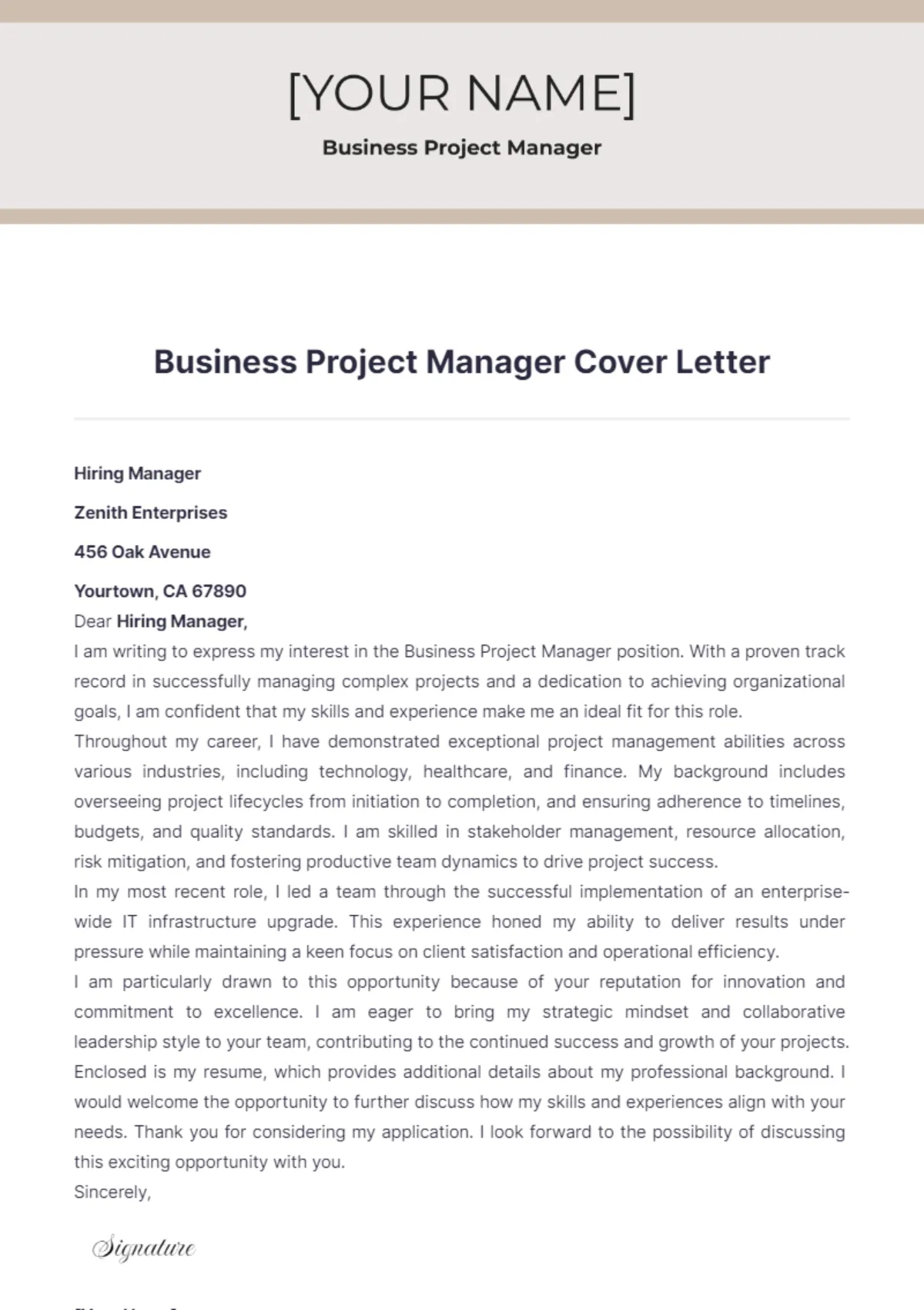
Understanding the Importance of a Project Manager Cover Letter
In the competitive world of project management, a well-crafted cover letter can be the key to unlocking your next career opportunity. It serves as your first introduction to a potential employer, providing an opportunity to showcase your personality, passion, and suitability for the role. Unlike a resume, which provides a factual overview of your experience, a cover letter allows you to tell your story, explain your motivations, and highlight the specific skills and experiences that make you the perfect fit for the job. It demonstrates your communication skills, attention to detail, and genuine interest in the company and the position. Without a compelling cover letter, your resume might get lost in the stack, so don’t underestimate its power.
What to Include in Your Project Manager Cover Letter
A project manager cover letter should be a concise and compelling document that effectively communicates your value proposition. Start with a strong opening paragraph that grabs the reader’s attention and clearly states the position you’re applying for and where you saw the job posting. The body of your letter should highlight your relevant skills and experience, providing specific examples of your accomplishments. This is where you demonstrate how you’ve successfully managed projects, solved problems, and delivered results. Always tailor your letter to the specific requirements of the job description, demonstrating that you’ve done your research and understand the company’s needs. Conclude with a call to action, expressing your enthusiasm for the opportunity and a confident statement about your ability to contribute to their team.
Highlighting Project Management Skills

Project management requires a diverse set of skills, and your cover letter is the perfect place to showcase them. Think about the core competencies most relevant to the job: leadership, communication, organization, risk management, and problem-solving. Provide specific examples of how you’ve demonstrated these skills in previous roles. For instance, describe a situation where you successfully led a project team, overcame a significant obstacle, or implemented a new process that improved efficiency. Use action verbs to describe your accomplishments, such as ‘managed,’ ‘coordinated,’ ‘implemented,’ ‘analyzed,’ and ‘delivered.’ Remember, employers are looking for candidates who can not only plan and execute projects but also effectively communicate, manage risks, and adapt to change. Your cover letter should leave no doubt that you possess these essential skills.
Showcasing Relevant Experience
Your experience is the cornerstone of your project management career. When writing your cover letter, focus on the experiences that are most relevant to the specific job you’re applying for. Analyze the job description carefully and identify the key requirements and preferred qualifications. Then, select the experiences from your resume that best align with those requirements. Describe your role in each project, the specific tasks you were responsible for, and the outcomes you achieved. If possible, quantify your achievements with data (see the next section). Highlight any industry-specific experience or certifications that are relevant to the role. Use this opportunity to paint a picture of your career progression and demonstrate your ability to handle the types of projects the employer manages. Tailoring this to each application is key to stand out.
Quantifying Achievements with Data
Numbers speak louder than words, especially when it comes to demonstrating your value as a project manager. Whenever possible, quantify your achievements with data to provide concrete evidence of your success. Instead of saying you ‘improved project efficiency,’ state that you ‘reduced project completion time by 15%.’ Instead of saying you ‘managed a budget,’ specify the budget amount and any savings you achieved. Quantifying your accomplishments not only demonstrates your ability to deliver results but also makes your cover letter more compelling and memorable. Consider using metrics such as project cost savings, on-time project delivery rates, stakeholder satisfaction scores, or revenue generated. By presenting data, you’re showcasing your impact and credibility, setting yourself apart from other candidates.
Tailoring Your Cover Letter to the Job

One of the most important secrets to a successful project manager cover letter is tailoring it to the specific job and company. Generic cover letters rarely make a strong impression. Take the time to research the company, understand their mission, values, and current projects. Carefully read the job description and identify the key skills and qualifications the employer is seeking. Then, customize your cover letter to address those specific requirements. Highlight the experiences and skills that are most relevant to the role, and explain how your qualifications align with the company’s needs. Show that you’ve done your homework and genuinely want to work for that organization. This level of personalization demonstrates your attention to detail, genuine interest, and makes your application far more compelling.
The Best Cover Letter Format for Project Managers
The format of your project manager cover letter should be professional, easy to read, and visually appealing. Use a standard business letter format, including your contact information, the date, and the hiring manager’s contact information. Start with a compelling opening paragraph that grabs the reader’s attention and states the position you’re applying for. The body of the letter should be structured logically, with clear paragraphs and headings that highlight your key skills and experiences. Use a professional font, such as Times New Roman, Arial, or Calibri, and maintain consistent formatting throughout the document. Keep the letter concise, ideally no more than one page, and avoid using jargon or overly complex language. A clean and well-organized format makes your letter more readable and helps to ensure that your message is effectively conveyed.
Common Mistakes to Avoid in Your Cover Letter
Several common mistakes can undermine the effectiveness of your project manager cover letter. Avoid generic language and phrases, such as ‘I am a highly motivated individual’ or ‘I am a team player.’ Instead, use specific examples to demonstrate your skills and experience. Don’t simply restate your resume; use the cover letter to tell your story and provide additional context. Avoid spelling and grammar errors, as these can create a negative impression. Make sure to tailor your letter to each job, avoiding the use of a generic template. Don’t exceed the one-page limit. Proofread your letter carefully before submitting it to ensure it is error-free. Finally, don’t be afraid to showcase your personality and enthusiasm; your cover letter is an opportunity to stand out from the crowd.
Proofreading and Polishing Your Cover Letter

Before submitting your cover letter, proofreading and polishing are essential steps. Errors, whether grammatical, spelling, or formatting, can damage your credibility. Read the letter multiple times, looking for any mistakes. Consider using a grammar checker tool, but don’t rely on it entirely. Ask a friend, family member, or career counselor to review your cover letter for feedback. Ensure the language is clear, concise, and professional. Make sure the formatting is consistent and the letter is visually appealing. Pay close attention to the tone, ensuring that it is enthusiastic but not overly informal. A polished cover letter demonstrates your attention to detail and professionalism and significantly increases your chances of making a positive impression.
Making a Strong Impression with Your Cover Letter
Ultimately, your project manager cover letter’s goal is to create a strong impression and secure an interview. To achieve this, focus on showcasing your skills, experience, and accomplishments in a compelling and engaging way. Tailor the letter to each job, highlighting the specific requirements and demonstrating your understanding of the company. Quantify your achievements with data whenever possible, and use action verbs to describe your contributions. Proofread and polish your letter to ensure it is error-free. By following these secrets and best practices, you can craft a cover letter that grabs the attention of hiring managers, increases your chances of getting an interview, and ultimately, helps you land your dream job in project management. Remember that your cover letter is your advocate and your first chance to shine.