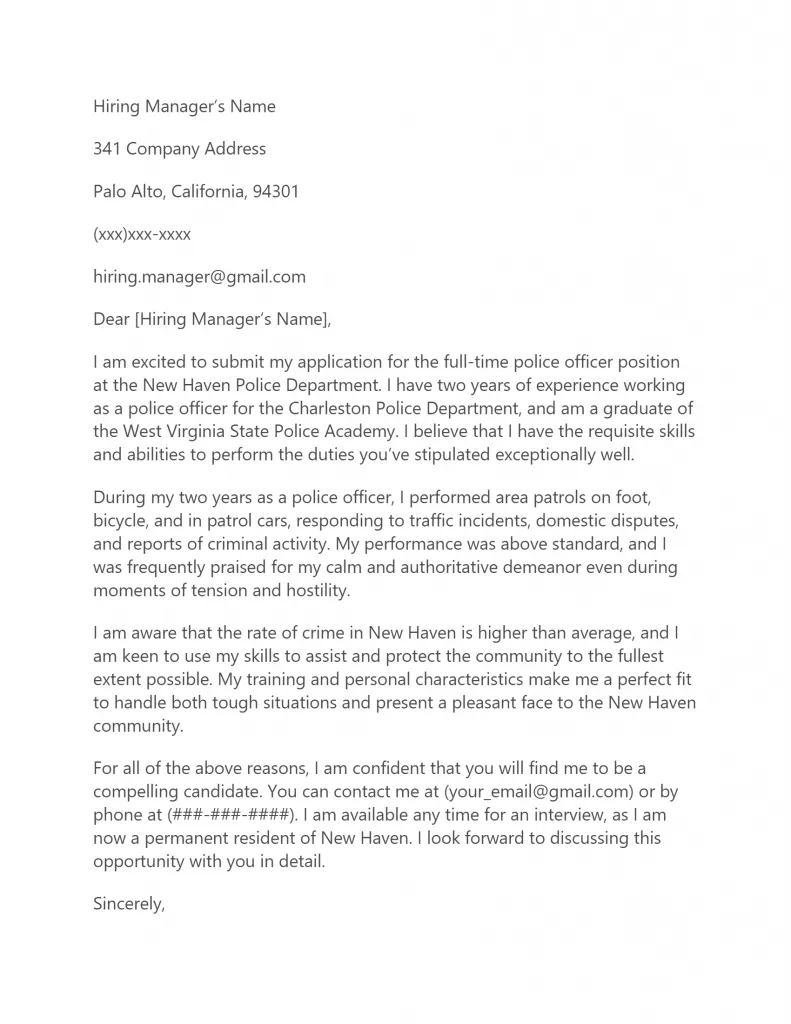
Understanding the Importance of a Police Cover Letter
A police cover letter is your initial introduction to a potential employer, and in the competitive field of law enforcement, it’s a critical document. It serves as your opportunity to make a positive first impression and to highlight your unique qualifications and suitability for the role. A well-crafted cover letter can significantly increase your chances of being selected for an interview, while a poorly written one can immediately lead to rejection. Think of it as your personal sales pitch, designed to convince the hiring manager that you possess the skills, experience, and personality traits necessary to excel as a police officer. It is not just a formality; it’s a strategic tool in your job application arsenal.
Why a Cover Letter Matters
A cover letter allows you to provide context to your resume. It’s where you can elaborate on specific achievements, explain any gaps in your employment history, and showcase your passion for law enforcement. It goes beyond a list of skills and experience by demonstrating your communication skills, attention to detail, and understanding of the police force’s mission. A well-written cover letter shows that you’ve put in the effort to tailor your application to the specific requirements of the department, setting you apart from candidates who submit generic applications. A tailored approach will significantly improve your chances of getting hired.
Highlighting Your Qualifications

The cover letter is your chance to connect your qualifications to the specific requirements of the job. By analyzing the job description, you can determine the key skills and qualities the department is seeking. Then, you can use your cover letter to explicitly show how your experience, education, and personal attributes align with those needs. This proactive approach demonstrates your understanding of the role and your ability to meet the challenges of police work. Provide concrete examples of situations where you have demonstrated these qualities. This is not just about listing what you can do, but showing what you have done.
Key Components of a Police Cover Letter
A well-structured police cover letter includes several essential components that together present a comprehensive picture of your suitability for the role. Each part plays a specific role in conveying your message effectively and creating a professional impression. The key components will showcase your organization and attention to detail, which are critical for a career in law enforcement. Omission of any of these components might lead to a lack of clarity in your application, which is something you want to avoid. A strong cover letter is more than just a formality; it’s a strategic tool that can significantly enhance your chances of landing an interview and ultimately, securing your dream job.
Contact Information and Date
Start with your full name, address, phone number, and email address at the top of the page. This information ensures the hiring manager can easily contact you. Include the date you are sending the letter. Using a professional email address is important; avoid using nicknames or informal addresses. Presenting your contact information clearly and concisely is a basic, yet essential element, to ensure you are accessible to the department if they wish to contact you. Make sure all your information is up to date and accurate to avoid any possible delays in the recruitment process.
Recipient’s Details

Address your letter to the hiring manager or the specific person in charge of recruitment, if possible. Research the department’s website or call to find out the correct person’s name and title. If you are unable to find a specific name, you can use a general title such as “Hiring Manager” or “Recruitment Team”. Addressing the letter to a specific person demonstrates your attention to detail and initiative. It also shows that you’ve taken the time to tailor your application to the department’s specific needs. If you are unsure of who to address the letter to, it is always better to reach out to the department to get the right information.
Professional Salutation
Use a professional salutation such as “Dear Mr./Ms. [Last Name]” or “Dear Hiring Manager”. Avoid overly casual greetings. Always err on the side of formality, especially in a cover letter for a law enforcement position. Your salutation sets the tone for the rest of your letter, so make sure it conveys respect and professionalism. Using the correct form of address shows respect for the recipient and a level of attention to detail. This initial greeting offers a window into your professionalism and ability to communicate respectfully, which are essential qualities for a career in law enforcement.
Crafting a Compelling Opening
Your opening paragraph is the first impression, so make it count. Capture the reader’s attention immediately by clearly stating the position you’re applying for and where you saw the job posting. Avoid generic openings; instead, express your genuine interest in the department and the specific role. Briefly mention your key qualifications or a compelling achievement that aligns with the job requirements. The opening should spark the hiring manager’s interest and encourage them to read on. This crucial first paragraph is your opportunity to demonstrate your communication skills and passion for law enforcement.
Expressing Your Interest

Clearly and enthusiastically state your interest in the police officer position. Explain why you are drawn to this specific department. This could be due to its reputation, community involvement, or values. Your cover letter gives you the perfect space to display your personal connection to law enforcement. Make your interest genuine and specific. The more personal your statement, the more likely the hiring manager will take note and appreciate your investment in the field. Your enthusiasm for the role is a key factor in showcasing your suitability.
Mentioning the Position
Specify the exact position you’re applying for, referencing the job title and any associated job number or posting ID. Mentioning the position early in your cover letter ensures clarity and helps the hiring manager quickly identify your application’s purpose. It also helps the recruiter to match your application with the right file, which helps ensure the recruiter does not miss your application. By clearly stating the position, you provide immediate context, ensuring the reader understands the focus of your application right from the start.
Showcasing Your Relevant Skills and Experience
This section is the heart of your cover letter. Use it to highlight your skills and experience. Focus on the qualities that align with the job description. It is not enough to just list your skills; you must show how you have used them in previous roles. Provide specific examples that demonstrate your abilities. The ability to articulate your past achievements is a crucial skill for an applicant. This section will allow you to convey how your background makes you a good fit for the police officer position. Your success in the recruitment process depends on your ability to clearly and persuasively showcase your skills and experiences.
Highlighting Skills for Police Work

Identify the key skills required for police work. Some examples include communication, problem-solving, conflict resolution, critical thinking, teamwork, integrity, and physical fitness. For each skill, provide a specific example of how you have demonstrated that skill in the past. It’s not enough to say you have good communication skills; you must show it. The demonstration of your skills is even more important than the listing. Your ability to provide specific examples of your skills will significantly increase the impact of your cover letter. Make sure you align your skills with what the department is looking for.
Describing Your Experience
Detail your work experience, emphasizing roles that demonstrate relevant skills such as leadership, responsibility, and the ability to work under pressure. Even if your experience isn’t directly related to law enforcement, highlight transferable skills like customer service, decision-making, and conflict resolution. Use the STAR method (Situation, Task, Action, Result) to structure your examples. Show the specific actions you took and the positive outcomes you achieved. Your experience section is your opportunity to shine, so be clear, specific, and compelling. It’s your chance to display all the things you have achieved throughout your career, which will help the recruiter determine if you are a great fit.
Providing Specific Examples
Avoid vague statements and provide concrete examples to back up your claims. Instead of saying “I am a good problem solver,” describe a specific situation where you identified a problem, developed a solution, and achieved a positive result. Using the STAR method helps you structure your examples. For instance, in a previous role, a customer service challenge came up, describe the steps you took to resolve the conflict, highlighting the successful resolution. This approach provides strong evidence of your capabilities. Specific examples give substance to your claims and give the recruiter insight into your abilities. Clear and compelling examples will show that you are capable of the job.
Demonstrating Your Understanding of the Role

Demonstrate your understanding of the responsibilities, challenges, and rewards of being a police officer. Show that you are aware of the demands of the job and the importance of integrity, ethics, and community service. Mention the importance of community policing and any volunteer work or community involvement you’ve done. The ability to provide this information shows that you are prepared for the job and fully understand the nuances of what it entails. Showing your understanding of the role shows that you are more than just interested, you are fully invested in the career.
Researching the Police Department
Before writing your cover letter, research the police department thoroughly. Familiarize yourself with their mission, values, and recent initiatives. Tailor your cover letter to reflect your knowledge of the department. Mention any specific programs or initiatives that resonate with you. This shows your genuine interest and demonstrates that you’ve taken the time to understand the department’s culture. The ability to show your understanding is vital. Researching the department will enable you to tailor your cover letter to match their specific needs, showing that you are highly interested in their particular services.
Showing Your Commitment
Express your long-term commitment to a career in law enforcement. Reiterate your dedication to serving and protecting the community. Highlight your understanding of the sacrifices involved in this profession. Convey your desire to contribute positively to the department. This conveys to the hiring manager that you are serious about a career in law enforcement and are not just looking for a temporary job. Your long-term commitment shows that you are ready to take on the responsibilities that come with the job.
Closing Your Cover Letter

Your closing paragraph is your final opportunity to leave a positive impression. Keep it concise and professional. Express your gratitude for the hiring manager’s time and consideration. Reiterate your interest in the position and your availability for an interview. End with a strong, confident statement that reinforces your suitability for the role. Your conclusion should be a final opportunity to recap your key points. The conclusion of your cover letter is important to ensure you end the letter on a high note.
Expressing Gratitude
Thank the hiring manager for their time and consideration. Show that you appreciate their effort in reviewing your application. Expressing gratitude is a professional courtesy that leaves a positive impression. A simple “Thank you for your time and consideration” is sufficient. Thanking the hiring manager is a sign of respect and shows your professionalism and understanding of the recruitment process. It’s a subtle way of reminding the hiring manager that you value their time and are grateful for the opportunity.
Formal Closing and Signature
Use a professional closing such as “Sincerely” or “Respectfully.” Then, type your full name. If you are submitting a hard copy, leave space for your signature above your typed name. Your closing should be formal and professional, aligning with the overall tone of your cover letter. Your signature, if applicable, adds a personal touch and a degree of formality. This is also important for showing your attention to detail.
Reviewing and Editing Your Cover Letter
Before submitting your cover letter, review and edit it carefully. Pay close attention to grammar, spelling, and punctuation. Ensure your writing is clear, concise, and free of errors. Ask a friend or career advisor to review your cover letter for feedback. Your application should be of the highest possible quality. The cover letter is one of the most crucial parts of your application, and it will need to be of the highest possible quality. Editing and reviewing your cover letter ensures you are able to display yourself in the best possible light.
Proofreading for Errors
Proofread your cover letter meticulously for any errors in spelling, grammar, and punctuation. Even small mistakes can damage your credibility and make you appear unprofessional. Read your cover letter aloud to catch any awkward phrasing or unclear sentences. Using a grammar checker is also very useful to catch errors that you may have missed. A few errors can significantly diminish your application, so make sure your cover letter is free of errors. Always take the time to review and correct any and all errors.
Ensuring Clarity and Conciseness
Make sure your cover letter is clear, concise, and easy to read. Use strong verbs and avoid jargon or overly complex language. Each sentence should serve a clear purpose and contribute to your overall message. Keep your paragraphs short and well-organized. A cover letter that is difficult to read can easily lead to rejection. Clarity and conciseness in your writing will help the hiring manager quickly grasp your qualifications. Ensure that every part of the cover letter is easy to read and to the point to enhance the quality of your application.
Formatting Your Cover Letter
Use a professional and easy-to-read font such as Times New Roman, Arial, or Calibri. Use a standard font size of 11 or 12 points. Make sure your margins are consistent, and the letter is well-spaced. Maintain a consistent format throughout the document. Your cover letter should be visually appealing and easy to navigate. A clean and professional format will make a positive impression. These points will help you in creating a cover letter that will easily convey your message.
Police Cover Letter Sample
This section would contain a police cover letter sample for your reference. Remember to customize it to fit your own experience and the specific job you are applying for. Always personalize your cover letter to show your understanding of the role and commitment to the specific police department. Make sure you are not just copying, but tailoring the sample to your needs.