Why You Need a Stellar Office Manager Cover Letter
In the competitive landscape of job hunting, an outstanding office manager cover letter is not just an option; it’s a necessity. It’s your first, often only, chance to make a lasting impression on potential employers. A well-crafted cover letter goes beyond simply listing your skills; it demonstrates your understanding of the role, your enthusiasm for the company, and your unique ability to contribute to their success. It’s a crucial tool that separates you from the multitude of applicants vying for the same position. A compelling cover letter shows that you’ve taken the time to understand the company’s needs and tailor your application to meet them. This personalized approach indicates your genuine interest and professional dedication, making you a standout candidate. By effectively showcasing your qualifications and personality, your cover letter significantly increases your chances of landing an interview and ultimately securing the job.
Understanding the Office Manager Role
The role of an office manager is multifaceted, requiring a diverse skillset and a high degree of adaptability. Office managers are the linchpins of an organization’s operational efficiency, responsible for a wide array of tasks that ensure the smooth functioning of the workplace. Their ability to manage multiple priorities, maintain a positive work environment, and support both employees and management is critical. Understanding the nuances of this role allows you to emphasize the most relevant skills and experiences in your cover letter, thereby demonstrating your competence and suitability for the position. A solid grasp of the responsibilities involved is essential for articulating your value proposition to a potential employer.
Key Responsibilities of an Office Manager

Office managers wear many hats, but some of the core responsibilities include managing office supplies and equipment, coordinating administrative tasks, overseeing office budgets, and supervising administrative staff. They often handle communication, both internal and external, and are key in maintaining office organization and efficiency. They may also be involved in facilities management, ensuring the workplace is safe, functional, and conducive to productivity. Additionally, office managers frequently assist in human resources tasks, such as onboarding new employees or organizing company events. Their diverse responsibilities mean a successful office manager must be organized, detail-oriented, and possess strong interpersonal skills to foster a positive and productive work environment.
Essential Components of an Effective Cover Letter
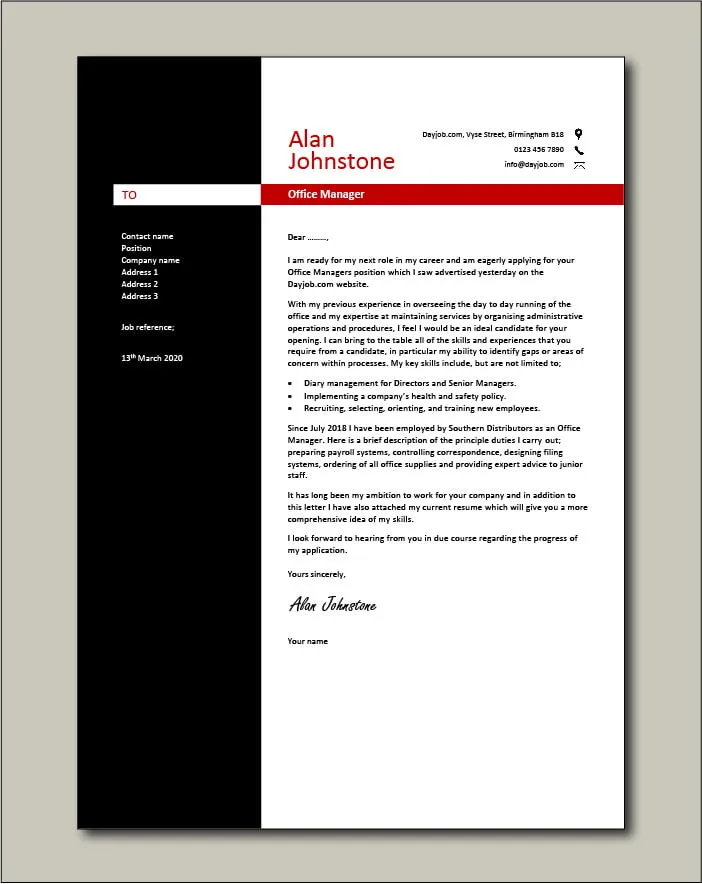
A well-structured cover letter is your opportunity to make a strong first impression. It needs to be clear, concise, and tailored to the specific job you’re applying for. Each element contributes to the overall effectiveness of your letter and significantly impacts how the hiring manager perceives you. The way you present yourself in writing must convey professionalism, competence, and enthusiasm. Ignoring even one of these elements could be detrimental to your candidacy. Creating a cover letter is an art form and a science. It is essential to have an organized and professional format to enhance your chances of standing out from the competition.
Your Contact Information
Start your cover letter with your full name, address, phone number, and professional email address. Ensure your email address is professional and reflects your name or initials; avoid using informal or outdated addresses. This information should be at the top, typically aligned left or right, so the recruiter can easily contact you. Accuracy is crucial; a misspelled address or incorrect phone number could cause you to miss out on an interview opportunity. Make sure that your contact details are up-to-date and that you regularly check the associated voicemail and email accounts for any communications from potential employers. This is your initial point of contact with the recruiter, so it must be clear, professional, and easily accessible.
Date and Employer Information

Following your contact information, include the date you are writing the letter. Then, address the hiring manager and include the company name, and the company’s address. This shows that you are meticulous and attentive to detail. Correctly formatting this section demonstrates your attention to detail and your respect for the potential employer. Use the company’s official address and the hiring manager’s correct title. If you can’t find the hiring manager’s name, try to find it on LinkedIn or the company website. If all else fails, you can address the letter to the ‘Hiring Manager’. This shows professionalism and a commitment to the application process.
The Salutation
Always start with a professional salutation. If you know the hiring manager’s name, use ‘Dear Mr./Ms./Mx. [Last Name]’. This personalizes the letter and shows you’ve done your research. If the hiring manager’s name is unavailable, ‘Dear Hiring Manager’ is acceptable, but try to find a name if possible. Avoid generic greetings like ‘To Whom It May Concern’ as they lack the personal touch. Your salutation sets the tone for the entire letter, so choosing the right one is important. Make sure you spell the name right and use the correct title to demonstrate respect and attention to detail. This small detail significantly improves your chances of capturing the hiring manager’s attention from the start.
Crafting the Opening Paragraph
The opening paragraph should immediately grab the reader’s attention and state your purpose for writing. Clearly state the position you are applying for and how you found out about the opportunity. Briefly mention your relevant skills and experience, showing your enthusiasm for the role. Don’t just repeat information from your resume; instead, provide a concise overview of your qualifications. A strong opening sets the stage for the rest of your letter and encourages the hiring manager to continue reading. It should be well-crafted and show how you match the job requirements. Make it interesting and engaging to leave a positive impact.
Highlighting Your Relevant Skills and Experience

This is the most important part of your cover letter, where you show how your skills and experiences align with the job requirements. Focus on the core competencies mentioned in the job description and tailor your examples to match. Use specific examples to illustrate your achievements and quantify your results whenever possible. This section should convince the hiring manager that you are a perfect fit for the role. Focus on the most important skills and experiences required. Always connect your accomplishments to the needs of the company and the requirements of the office manager position. Showing what you’ve accomplished, rather than simply listing your duties, is the key to standing out.
Administrative Skills
Office managers must have strong administrative skills, including organization, attention to detail, and the ability to manage multiple tasks simultaneously. Provide specific examples of how you’ve successfully managed administrative duties, such as maintaining records, managing schedules, and handling correspondence. Show how you can organize and prioritize tasks effectively. Quantify your achievements whenever possible. For instance, you might say, ‘Successfully streamlined the office filing system, resulting in a 20% reduction in document retrieval time.’ This demonstrates your practical abilities and indicates that you can make significant improvements to the efficiency of the office. Emphasize any software proficiency like Microsoft Office or other relevant tools.
Communication and Interpersonal Skills
Office managers need exceptional communication and interpersonal skills to interact with employees, clients, and vendors. Highlight your abilities to communicate clearly, both verbally and in writing, and to build strong relationships. Provide examples of how you’ve successfully handled difficult situations, resolved conflicts, or communicated important information. For instance, ‘Successfully mediated a conflict between team members, which resulted in improved collaboration and a more positive work environment.’ Show your ability to listen actively, empathize, and communicate professionally. Interpersonal skills are crucial for creating a positive office atmosphere and fostering effective teamwork, which significantly impact productivity. Your ability to connect and work well with others should be evident.
Organizational and Time Management Skills

Office managers must excel at organizational and time management skills to keep the office running smoothly. Provide examples of how you’ve managed projects, met deadlines, and prioritized tasks effectively. Demonstrate your ability to create and maintain organized systems, such as using project management tools. For instance, ‘Implemented a new project management system that improved project completion rates by 15% and reduced project delays.’ Demonstrate your ability to plan, prioritize, and handle multiple tasks efficiently. This ensures that projects are completed on time and within budget, and that the office runs effectively. Show that you are detail-oriented and can stay focused under pressure.
Mentioning Achievements and Quantifiable Results
Instead of just listing your responsibilities, highlight your achievements and the positive outcomes of your actions. Use numbers and data to quantify your accomplishments and show your impact. For instance, ‘Increased office efficiency by 18% by implementing a new inventory management system,’ or ‘Reduced office supply costs by 12% through strategic vendor negotiations.’ Providing specific results gives the hiring manager a clear understanding of your value. Show how you’ve made a difference in previous roles. Using quantifiable metrics will demonstrate your effectiveness, making your cover letter more compelling and persuasive. These details showcase your ability to deliver tangible value to the organization.
Writing the Closing Paragraph
The closing paragraph should summarize your key qualifications and reiterate your enthusiasm for the position. Thank the hiring manager for their time and consideration, and clearly state your availability for an interview. Reiterate your interest in the position and express your eagerness to discuss your qualifications further. Make it easy for them to contact you, and leave a lasting positive impression. A strong closing paragraph reinforces your suitability for the role and increases the chances of getting the interview. It should also leave the reader with a clear understanding of why you are the ideal candidate for the job.
Expressing Enthusiasm and Availability

Reiterate your enthusiasm for the position and the company. Show that you are genuinely excited about the opportunity to contribute to their team. Mention your availability for an interview and how the hiring manager can reach you. Be clear and concise about how they can contact you, and express your eagerness to discuss the role. This will increase the likelihood of a follow-up call or email. Show your commitment by indicating that you are eager to discuss the role and how you can contribute. This positive and proactive approach can leave a strong final impression.
The Formal Closing and Signature
End your cover letter with a professional closing, such as ‘Sincerely,’ ‘Best regards,’ or ‘Thank you.’ Then, sign your name if you are submitting a hard copy or type your full name if submitting digitally. Ensure your signature is neat and professional. If you’re submitting electronically, you can use a typed signature. This simple formality reinforces the professional nature of your application and leaves a lasting impression of your attention to detail. A well-written closing shows respect and professionalism.
Formatting and Proofreading Your Cover Letter
The way your cover letter looks is just as important as what it says. It should be easy to read and visually appealing. Errors in formatting can be distracting and can give the impression that you don’t pay attention to detail. Therefore, make sure that the cover letter is well-formatted, proofread, and presentable. By paying close attention to detail, you significantly increase your chances of making a positive impression.
Choosing a Professional Font and Layout

Use a professional font such as Times New Roman, Arial, or Calibri in a standard size (11-12 points). Choose a layout that is clean and easy to read, with clear margins and spacing. Avoid using excessively decorative fonts or a cramped layout. Proper formatting makes your cover letter more readable and allows the hiring manager to focus on your content. A well-designed layout indicates professionalism and attention to detail. Keep your text consistent, and use proper formatting, such as bolding important headings, to make it easy to scan. Aim for a professional and polished appearance.
Proofreading for Errors
Always proofread your cover letter multiple times for spelling, grammar, and punctuation errors. Errors can damage your credibility and make you look careless. Read the letter aloud, use spell check, and have someone else review it. A cover letter free of errors is a sign of professionalism and attention to detail. Typos and grammatical errors are the most common mistakes that can undermine your application, so always double-check every detail. Proofreading is an essential part of the writing process; a mistake-free cover letter is a reflection of your ability to do the same in a professional capacity. Correcting errors ensures your message is clear, and you present yourself well.
Tailoring Your Cover Letter to the Specific Job
A generic cover letter is often ignored. To get noticed, tailor your cover letter to each specific job you apply for. Read the job description carefully and identify the key skills and requirements. Customize your cover letter to highlight how your skills and experiences align with those requirements. Tailoring your letter demonstrates that you understand the role and are invested in the opportunity. Tailoring your cover letter shows you have invested the time to do your research, which makes you a stronger candidate.
Researching the Company
Before you start writing your cover letter, research the company and understand its mission, values, and culture. This will help you tailor your letter to address their specific needs and show that you are genuinely interested in working for them. This allows you to make a more personal connection. Find out about their recent projects, news, and achievements. Demonstrate that you understand the company’s values. Highlighting this makes you stand out as a thoughtful candidate who understands the company’s mission.
Addressing the Hiring Manager by Name
Whenever possible, address your cover letter to the hiring manager by name. This personalized approach shows that you have taken the time to research the company and the role. It also helps you make a more personal connection, which can make your cover letter more memorable. If you can’t find the hiring manager’s name, try searching on LinkedIn or the company website. If that does not work, you can address the letter to the hiring manager. This personal touch makes your cover letter more engaging and demonstrates your commitment to the application.
Submitting Your Cover Letter
Once you’ve created your cover letter, save it as a PDF file to preserve the formatting. Follow the application instructions carefully, and submit your cover letter and resume together. Ensuring that you include all the necessary documents and submit them properly can boost your chances of landing the job. Be certain to follow their specific instructions for submission; otherwise, your application might be overlooked. Double-check all your details before submitting. This final step demonstrates your professionalism and attention to detail.