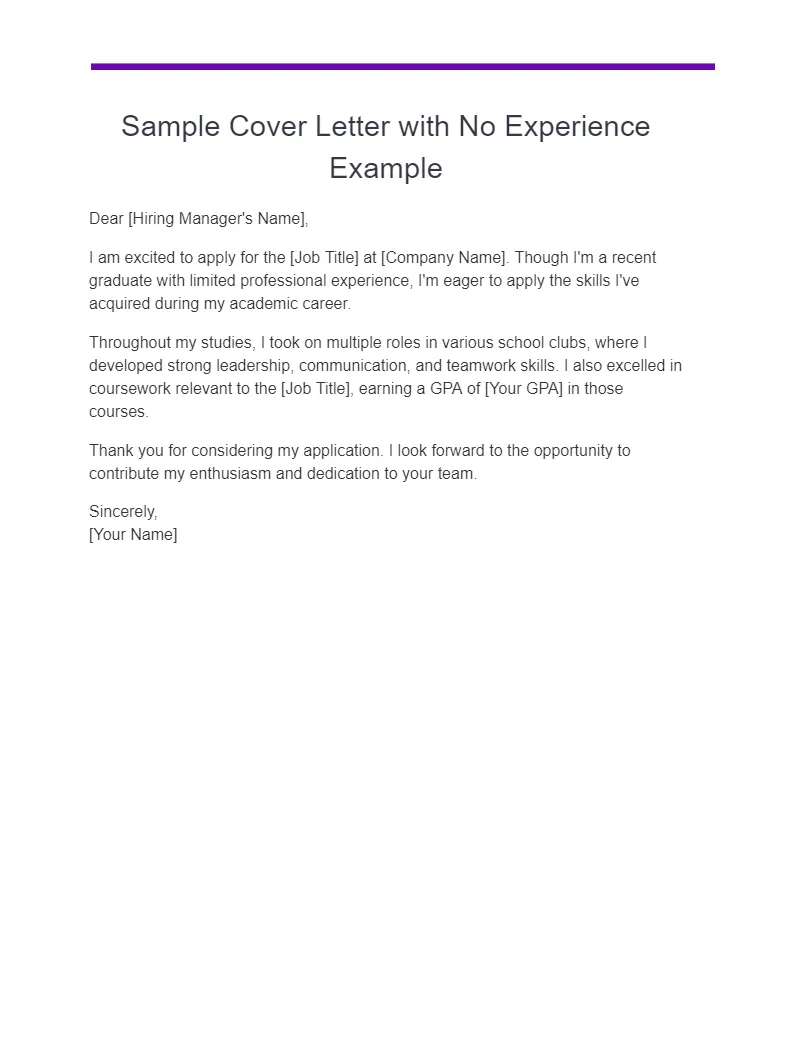
Understanding the Purpose of a No Experience Cover Letter
Crafting a compelling cover letter is crucial, particularly when you lack direct job experience. A cover letter serves as your introduction to a potential employer and provides an opportunity to showcase your personality, skills, and enthusiasm. It complements your resume by offering a narrative that highlights your qualifications and explains why you’re a suitable candidate, even without a lengthy work history. Think of it as your chance to make a strong first impression and persuade the hiring manager to learn more about you. A well-written cover letter can significantly increase your chances of getting noticed, especially in competitive job markets where many applicants may have similar academic backgrounds or skill sets. This document gives you the platform to differentiate yourself from other candidates, highlighting your potential and eagerness to contribute to the organization.
Why a Cover Letter Matters for Entry-Level Positions
For entry-level positions, a cover letter is not just recommended; it’s often essential. Without a wealth of professional experience to lean on, your cover letter becomes the primary vehicle for demonstrating your suitability for the role. It enables you to articulate your career goals, express your genuine interest in the company, and provide context for your skills and experiences. It’s also a perfect space to address any gaps in your resume or explain why you’re transitioning into a new field. A well-crafted cover letter highlights your motivation, work ethic, and potential for growth, all of which are highly valued by employers when evaluating entry-level candidates. By skillfully using your cover letter, you prove your eagerness to contribute.
Highlighting Transferable Skills

When you lack traditional work experience, the ability to identify and emphasize your transferable skills becomes paramount. These are skills and abilities that you’ve developed in one setting (like school, volunteer work, or personal projects) that can be applied to a professional environment. Your cover letter should be the place where you showcase these skills and demonstrate how they align with the job’s requirements. This approach allows you to highlight your potential and demonstrate to employers that you possess the necessary capabilities to excel in the role, even if you’ve never done a similar job before. It’s about showing, not just telling, and backing up your claims with relevant examples from your past experiences. Showcasing your transferable skills will help you to get hired.
What are Transferable Skills
Transferable skills are versatile abilities you’ve gained in various aspects of your life, from academics and extracurricular activities to volunteer work and personal projects. These skills include communication, teamwork, problem-solving, time management, leadership, and adaptability. The beauty of transferable skills is their applicability across diverse industries and job roles. For instance, skills acquired in a student leadership position can be equally valuable in a corporate setting. These skills are essential for any type of job and they are easily transferable from one job to another. Employers value these skills because they indicate your ability to learn, adapt, and contribute effectively to the workplace.
Identifying Your Transferable Skills
Identifying your transferable skills requires self-reflection and an honest assessment of your experiences. Start by listing your past activities, roles, and accomplishments. Then, analyze each experience to pinpoint the skills you used or developed. For instance, if you volunteered to organize an event, you likely demonstrated organizational, communication, and project management skills. If you were a team member in a group project, you probably honed your collaboration and problem-solving abilities. Be specific and provide concrete examples to support your claims. Create a table or a list that maps your experiences to the corresponding transferable skills, making it easier to reference and incorporate them into your cover letter. You can also use online resources or career assessments to help identify your skills.
Structuring Your No Experience Cover Letter

Structuring your no-experience cover letter effectively is key to conveying your qualifications and enthusiasm. Begin with a strong header containing your contact information, followed by a professional greeting addressed to the hiring manager or the specific department. The body of your letter should be concise, divided into well-defined paragraphs that highlight your transferable skills, express your interest in the company, and demonstrate your knowledge of the role. Conclude with a clear call to action, requesting an interview and expressing your eagerness to discuss your application further. The goal is to create a document that’s easy to read, informative, and personalized, leaving a lasting positive impression on the reader. Use the structure to guide the reader on why you should be hired.
Header and Contact Information
Your header should be clear, professional, and easily accessible. Include your full name, phone number, email address, and a link to your professional online profile, such as LinkedIn. Ensure your contact information is current and accurate. Place this section at the top of the document, either aligned to the left or centered, ensuring it’s visually distinct from the rest of the content. This information is critical for the employer to reach you. Using a clean and professional header ensures that the hiring manager can easily contact you. A professional header creates a favorable first impression and shows your attention to detail, which is essential in any job application.
Professional Greeting
A professional greeting sets the tone for your entire letter. Avoid generic greetings like “To Whom It May Concern.” Instead, strive to address the hiring manager by name if possible. Research the company’s website or use LinkedIn to find the hiring manager’s name. If you are unable to find the hiring manager’s name, use a general greeting such as “Dear Hiring Team” or “Dear [Department Name] Hiring Manager.” Ensure that your greeting is formal and respectful, demonstrating your attention to detail and your desire to make a personal connection. Personalizing your greeting shows that you’ve taken the time to research the company and the role, which can help you make a positive first impression.
Body Paragraph 1 Grabbing Attention

The first paragraph is your opportunity to grab the reader’s attention. Start with a strong hook that immediately captures the reader’s interest. Express your enthusiasm for the position and the company, and make a clear statement of why you’re applying. Show your passion for the role and your understanding of the company’s values or mission. Mention where you saw the job posting to give the reader context. If you have a specific skill or experience that directly aligns with a key requirement, mention it briefly to pique their curiosity. This initial paragraph should encourage the reader to continue reading by making them want to learn more about your qualifications. Make a positive first impression.
Body Paragraph 2 Showcasing Skills and Enthusiasm
The second paragraph is where you highlight your transferable skills and demonstrate how they align with the job requirements. Use the job description as your guide, identifying the key skills and qualifications the employer is seeking. Provide specific examples from your past experiences (academic projects, volunteer work, extracurricular activities) to illustrate how you’ve developed and applied these skills. Quantify your achievements whenever possible. For example, instead of saying you “managed a team,” say you “managed a team of five individuals, resulting in a 15% increase in project efficiency.” Express your genuine enthusiasm for the role and the company, showcasing your eagerness to learn and contribute. This paragraph allows you to connect your skills to the employers needs.
Body Paragraph 3 Demonstrating Knowledge of the Company
In the third paragraph, demonstrate your knowledge of the company and your understanding of its mission, values, and goals. Research the company’s website, social media profiles, and recent news articles to gain insights into its culture and operations. Explain why you’re interested in the company specifically, mentioning any aspects that resonate with you. Show that you’ve given serious thought to the position and how you can contribute to the company’s success. This level of research and personalization demonstrates your initiative and commitment. By referencing specific projects, values, or initiatives, you show that you’re not just sending a generic cover letter; instead, you’re demonstrating genuine interest in working for that particular company. Make sure to do your research beforehand.
The Closing and Call to Action

Conclude your cover letter with a clear call to action, restating your interest in the position and expressing your eagerness to discuss your application further. Thank the hiring manager for their time and consideration. Include a statement about your availability for an interview and the best way to contact you. Make it easy for the hiring manager to take the next step. A strong call to action increases your chances of moving forward in the application process and helps your cover letter to be effective. It should be direct, polite, and leave no doubt about your enthusiasm for the role.
Tailoring Your Cover Letter
Tailoring your cover letter to each specific job is essential for demonstrating your genuine interest and suitability. Generic cover letters rarely make a strong impact. Take the time to carefully review the job description and identify the key requirements and skills. Customize your cover letter to highlight how your transferable skills and experiences align with the role’s needs. Personalize your letter by mentioning the company’s values, culture, or recent projects that resonate with you. This individualized approach demonstrates that you are genuinely interested in the position and are not simply sending out a mass application. Tailoring will help you to get to the next step in the hiring process.
Researching the Company
Thorough research is the cornerstone of a well-tailored cover letter. Before you start writing, investigate the company’s website, social media profiles, and press releases to learn about its mission, values, culture, and recent achievements. Identify the company’s key goals and challenges, and consider how your skills and experience can contribute to their success. Understanding the company will help you write a compelling cover letter. This information will enable you to tailor your cover letter, demonstrate your knowledge of the company, and showcase how your skills align with the organization’s needs. Use this research to tailor your skills and accomplishments.
Matching Skills to Job Requirements

Carefully review the job description and identify the key skills and qualifications the employer is seeking. Make a list of these requirements and then compare them to your own skills and experiences. Focus on the transferable skills and experiences that are most relevant to the role. Provide specific examples from your past activities to illustrate how you’ve developed and applied these skills. Use keywords from the job description in your cover letter to demonstrate that you understand the role’s requirements. By directly matching your skills to the job requirements, you make a clear case for your suitability and increase your chances of getting noticed. Emphasize your skills and experience as it matches the employer’s need.
Proofreading and Editing
Proofreading and editing are crucial steps that should never be skipped. Errors in grammar, spelling, and punctuation can create a negative impression and detract from your message. After you’ve completed your cover letter, take the time to carefully review it for any mistakes. Read it aloud to catch awkward phrasing or run-on sentences. Use grammar and spell-checking tools, but don’t rely on them entirely. Ask a friend, family member, or career counselor to read your letter and provide feedback. Proofread and edit your letter multiple times and at different times to ensure accuracy and clarity. The goal is to submit a polished and professional document that reflects your attention to detail and commitment to excellence.
Common Mistakes to Avoid
Avoid common mistakes that can undermine the effectiveness of your cover letter. These include using generic phrases, focusing solely on a lack of experience, and failing to tailor the letter to the specific job. Make sure your letter is unique and original to you. Generic phrases fail to capture the reader’s attention. Focusing solely on your lack of experience can create a negative impression. A generic cover letter can give the impression that the candidate has sent the same letter to numerous companies. The goal is to make a strong, positive, and accurate first impression. Being able to highlight your skills and strengths is essential.
Overuse of Generic Phrases

Generic phrases are often uninspired and fail to make a lasting impression. Avoid using clichés like “I am a team player” or “I am a hard worker” without providing supporting evidence. Instead, use specific examples to demonstrate these qualities. For example, you could say, “In my role as a student leader, I successfully coordinated a team of ten volunteers to organize a fundraising event.” The goal is to make your cover letter stand out. By avoiding generic phrases and using specific examples, you can make your cover letter more engaging and memorable, increasing your chances of getting noticed.
Focusing Solely on Lack of Experience
Dwelling on your lack of experience can be counterproductive. While it’s important to acknowledge that you’re an entry-level candidate, don’t let the absence of traditional work experience dominate your cover letter. Instead, focus on your transferable skills, enthusiasm, and potential. Emphasize what you can bring to the table and how you’re eager to learn and contribute. This positive and proactive approach will help you make a more favorable impression. Highlight your accomplishments and skills, rather than the fact that you have no experience. By shifting your focus from the lack of experience to your potential, you demonstrate your commitment to success.
Final Thoughts on No Experience Cover Letters
Crafting a compelling no-experience cover letter may seem daunting, but by following these guidelines, you can create a document that effectively showcases your potential and increases your chances of landing an interview. Remember to highlight your transferable skills, express your enthusiasm for the role and company, and tailor your letter to each specific job. Proofread and edit your letter carefully to ensure that it is polished and professional. Take the time to write an excellent cover letter. By investing the effort, you can make a strong first impression and take a significant step towards starting your career journey. Your cover letter is your voice, so make it count.