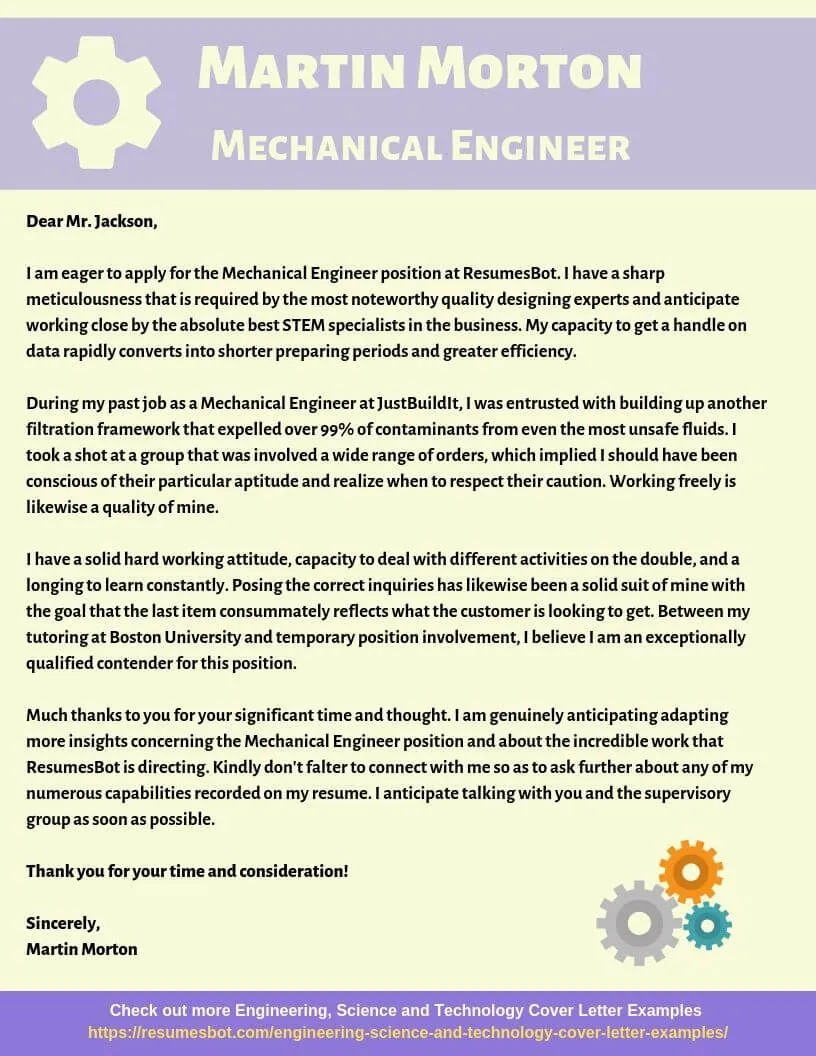
Why a Strong Mechanical Engineering Cover Letter Matters
In the competitive field of mechanical engineering, a well-crafted cover letter can be the key that unlocks your dream job. More than just a formality, your cover letter is your first opportunity to make a strong impression on a potential employer. It allows you to go beyond the confines of your resume and provide a narrative that showcases your skills, experience, and personality. A compelling cover letter can differentiate you from other qualified candidates and demonstrate your genuine interest in the specific role and company. It’s a chance to highlight your key accomplishments, explain your career goals, and persuade the hiring manager that you are the perfect fit for the position.
First Impressions & Applicant Tracking Systems (ATS)
The first impression is critical, and in today’s job market, that impression is often made by an Applicant Tracking System (ATS). These systems scan cover letters and resumes for keywords and phrases that match the job description. A cover letter optimized for ATS helps ensure your application makes it past the initial screening process. Therefore, strategically incorporating relevant keywords throughout your cover letter is essential. Also, the format of your cover letter matters. Ensure your document is easy to read with clear headings, concise paragraphs, and a professional layout. Avoiding complex formatting and unusual fonts helps ATS to parse your information correctly, increasing your chances of getting noticed by human eyes. Proper formatting and the use of the right keywords will help your cover letter get past the ATS, increasing your chances of landing an interview.
Crafting Your Mechanical Engineering Cover Letter

Header and Contact Information
Start with a professional header that includes your full name, contact information (phone number, email address, and LinkedIn profile URL). Also include the date and the recipient’s contact information (if known). Ensure that your header is clearly formatted and easy to read. Using a professional font and a clean layout demonstrates attention to detail. Double-check all contact details for accuracy to ensure potential employers can easily reach you. A well-formatted header sets a professional tone and allows recruiters to quickly access your contact information should they be interested in contacting you. Make sure the header is consistent with your resume’s header. Keep the format clean and simple, ensuring that all the information is easily accessible and presented in an organized way.
Addressing the Hiring Manager
Addressing the hiring manager by name is a great way to make a personal connection. Researching the name of the hiring manager on LinkedIn or the company website can make a big difference. If you can’t find a specific name, using a general greeting like ‘Dear Hiring Team’ or ‘Dear [Department Name] Hiring Manager’ is acceptable. Avoid generic greetings like ‘To Whom It May Concern,’ as it can appear impersonal. Showing that you’ve taken the time to identify the person reading your cover letter demonstrates that you’re taking the application process seriously and that you’re genuinely interested in the opportunity. This small detail shows that you are invested in the role and the company, setting a positive tone from the beginning and making your cover letter stand out from the crowd.
The Opening Paragraph

The opening paragraph is your chance to grab the reader’s attention. State the position you’re applying for and how you learned about the opportunity. Briefly mention your most relevant skills or experiences and express your enthusiasm for the role and the company. Avoid generic introductions. Instead, tailor your opening to the specific job and company. Consider mentioning a specific project you’ve worked on, a skill relevant to the role, or an aspect of the company that interests you. Keep it concise and to the point, aiming to capture the reader’s interest within the first few sentences. Your opening paragraph should immediately convey your value proposition and why you are a good fit for the position, setting the stage for the rest of your cover letter.
Highlighting Your Skills and Experience
Quantifying Achievements with Numbers
Instead of just listing your skills and experience, quantify your achievements with numbers whenever possible. For instance, instead of saying ‘Managed engineering projects,’ write ‘Managed engineering projects, resulting in a 15% reduction in project costs and a 10% increase in efficiency.’ Use data, metrics, and statistics to demonstrate the impact of your work. This provides concrete evidence of your abilities and showcases your value to potential employers. Examples include the number of projects completed, the amount of money saved, or the percentage of process improvements. Quantifiable results add credibility to your claims and give the hiring manager a clear understanding of your past successes. Using numbers also makes your achievements more memorable and impactful.
Showcasing Relevant Projects

Choose a few relevant projects from your portfolio and describe your role, the challenges you faced, and the solutions you implemented. Highlight the technical skills and knowledge you used in these projects. Focus on projects that align with the job description and demonstrate your abilities in areas relevant to the position. Mention any specific software, tools, or methodologies you used. Explain the results of the project and how your contribution benefited the team or the company. This section provides potential employers with a direct glimpse into your capabilities, showing not just what you’ve done, but how you’ve done it. Make sure each project description is clear, concise, and easy to understand for a non-technical audience.
Tailoring Your Cover Letter to the Job Description
Researching the Company Culture
Before writing your cover letter, research the company’s mission, values, and culture. Visit their website, read their social media profiles, and search for news articles or press releases about the company. Understand what the company values and how its culture is defined. Then, tailor your cover letter to align with the company’s values and culture. This could include mentioning specific aspects of the company that appeal to you, or explaining how your skills and experiences align with their values. Demonstrating that you understand the company’s culture and share its values increases your chances of being seen as a good fit. This will make you more likely to be offered an interview, showing that you’ve taken the time to understand the company’s needs and values.
Emphasizing Your Passion for Mechanical Engineering

Showcase your passion for mechanical engineering by mentioning why you’re drawn to the field. This could be because you love solving complex problems, designing innovative solutions, or contributing to technological advancements. Provide specific examples to back up your enthusiasm. You can mention your favorite projects, areas of interest within mechanical engineering, or any achievements that reflect your commitment. Show that you are genuinely interested in the field and the specific role by discussing how this opportunity aligns with your career goals. Make your passion evident through your writing style and the details you choose to share. A genuine expression of enthusiasm will demonstrate your dedication to the profession and your desire to excel in the role, which is attractive to potential employers.
Closing Your Cover Letter
Expressing Gratitude and Next Steps
Conclude your cover letter by expressing your gratitude for the opportunity to apply. Reiterate your interest in the position and thank the hiring manager for their time and consideration. Include a call to action, such as stating that you look forward to hearing from them or that you are available for an interview. Restate your contact information and offer to provide additional information if needed. Ensure the closing is professional, courteous, and leaves a positive lasting impression. Avoid generic phrases and use a specific closing that reflects your enthusiasm for the position. A strong conclusion reiterates your interest, demonstrates your professionalism, and encourages the hiring manager to take the next step.