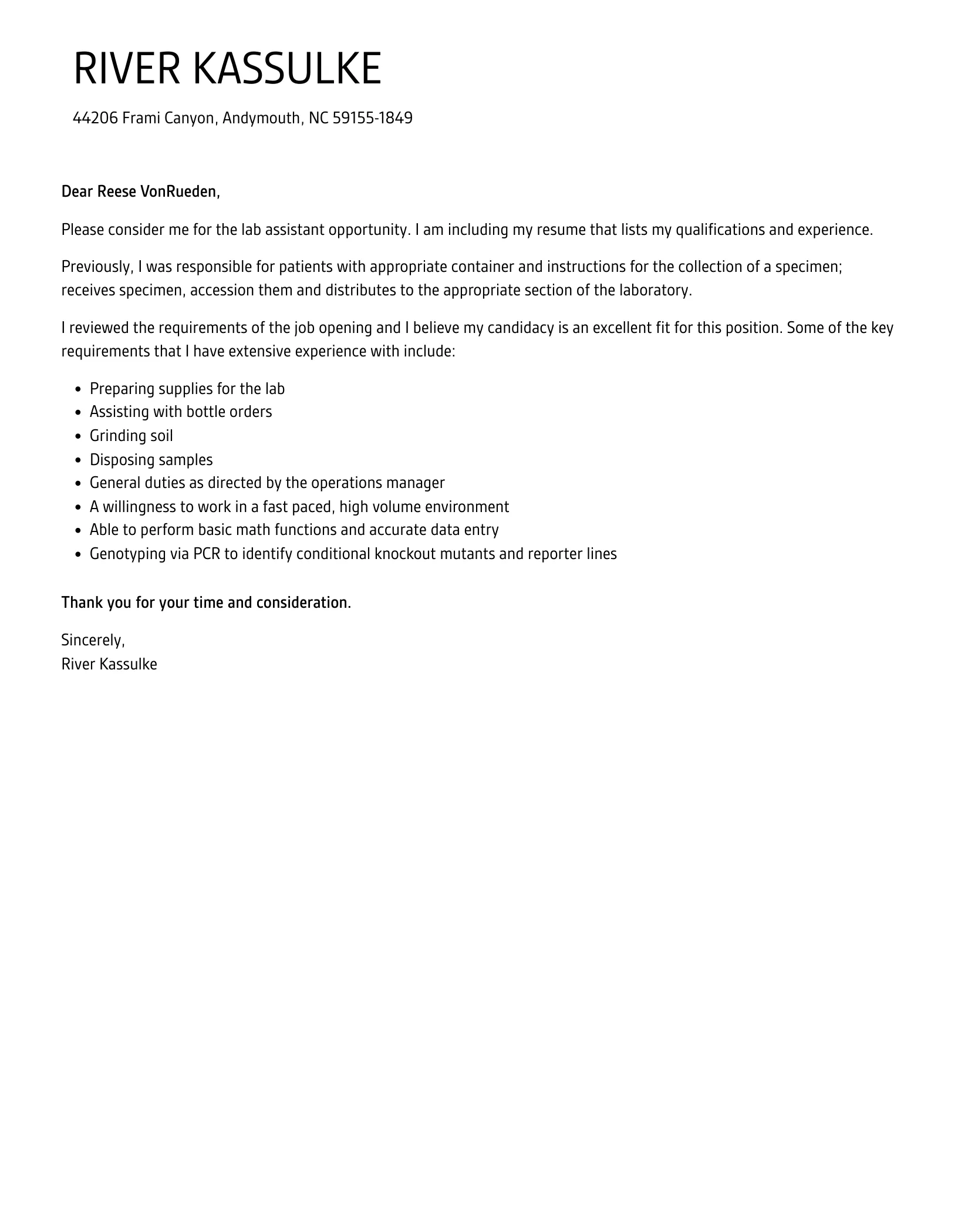
Crafting a Lab Assistant Cover Letter
A well-crafted cover letter is your first opportunity to make a positive impression on a potential employer. For a lab assistant position, this letter serves as a crucial introduction, showcasing your suitability for the role. It’s more than just a formality; it’s a chance to highlight your relevant skills, experience, and passion for scientific work. A strong cover letter should not only summarize your qualifications but also demonstrate your understanding of the specific laboratory’s needs and the job’s requirements. Remember, this document should complement your resume, providing context and a more personalized narrative. Your goal is to convince the hiring manager that you are not only qualified but also an enthusiastic candidate who is genuinely interested in the position and the organization.
Highlighting Your Skills and Experience
Effectively showcasing your skills and experience is paramount. This section should be tailored to the job description. Identify the key skills and experiences the employer is looking for and emphasize those in your cover letter. This targeted approach shows that you have read the job posting carefully and are a good fit. Use concrete examples from your past experiences to illustrate your capabilities. Instead of simply stating that you have ’experience with lab equipment,’ provide specific examples such as, ‘Proficient in operating and maintaining spectrophotometers and centrifuges used in various biochemical assays.’ This level of detail provides credibility and makes your claims more convincing. Always quantify your achievements whenever possible. For instance, mention how your contributions resulted in improved efficiency or better outcomes in previous roles.
Research Experience

If you have research experience, this is a significant asset that you should highlight in your cover letter. Describe the research projects you have been involved in, focusing on your specific roles and responsibilities. Mention the methodologies you used, the data analysis techniques you employed, and any significant findings or contributions you made. Your cover letter is an opportunity to explain how your research experience aligns with the requirements of the lab assistant role. Demonstrate an understanding of research protocols, data collection, and experimental design. Even if your research experience is limited, you can still mention any related coursework or projects that demonstrate your basic understanding of research principles. This can help to show your readiness to learn and grow in the role.
Technical Skills
Technical skills are crucial for a lab assistant. Your cover letter should explicitly mention the technical skills you possess that are relevant to the job description. Be specific about the techniques you have mastered or are familiar with. This might include experience in areas like cell culture, PCR, microscopy, chromatography, or any other relevant laboratory procedures. If the job description specifies certain equipment or software, make sure to mention your proficiency with them. For instance, if the lab uses a specific type of software for data analysis, mention your experience with it. It’s important to balance the technical jargon with clarity, ensuring that your skills are easily understood by the hiring manager, who may not have extensive technical expertise. Use action verbs to describe your skills, such as ‘performed,’ ‘analyzed,’ ‘operated,’ and ‘maintained,’ to make your statements more dynamic and impactful.
Soft Skills
Soft skills are just as important as technical skills in a lab environment. Mentioning your soft skills can significantly enhance your candidacy. Highlight your abilities in areas like communication, teamwork, problem-solving, and time management. Laboratory work often involves collaborating with others, so emphasize your ability to work well in a team, communicate effectively, and follow instructions precisely. For instance, describe situations where you had to solve a technical problem, manage multiple tasks simultaneously, or communicate complex information to others. Provide specific examples to demonstrate these skills. Consider mentioning any experiences you’ve had in presenting data or contributing to scientific discussions. These soft skills are essential for a lab assistant’s success and contribute significantly to the overall productivity of the lab.
Tailoring Your Cover Letter

A generic cover letter will likely be overlooked. The most effective cover letters are tailored to the specific job and the specific lab. This requires thorough research and a keen understanding of what the employer is looking for. Review the job description carefully and make sure to address each of the key requirements. Demonstrate that you understand the lab’s mission, the research it conducts, and the specific challenges it faces. Mentioning the lab’s publications, its current research projects, or its specific areas of expertise demonstrates your interest and initiative. This targeted approach signals to the hiring manager that you have taken the time to understand their needs, making your application stand out from the crowd. Always customize your cover letter to align with the specific requirements and priorities of the role.
Company Research
Before writing your cover letter, conduct thorough research on the company or institution and the specific lab you are applying to. Understand their mission, values, and research interests. Visit their website, read their publications, and learn about the researchers and their current projects. This research will provide you with insights that will help you tailor your cover letter. You can then refer to specific research projects, publications, or lab equipment to show that you have a genuine interest in the lab’s work. This will also help you identify any skills or experiences that are particularly relevant to the position. By demonstrating that you understand the lab’s needs, you show that you are not just sending out a generic application, but that you are genuinely interested in contributing to their scientific endeavors. This research also lets you identify specific keywords and phrases from their publications to include in your cover letter.
Job Description Analysis
Carefully analyze the job description to identify the key requirements, skills, and qualifications that the employer is seeking. Highlight these points in your cover letter and provide specific examples from your experience that demonstrate your ability to meet these requirements. Create a list of the essential and desired qualifications and use this list as a checklist when drafting your cover letter. For each requirement, provide a specific example of how you have demonstrated that skill or experience in the past. Tailor your language to mirror the language used in the job description. This shows that you understand the needs of the role and that you can meet the employer’s expectations. This detailed analysis will help you create a targeted and compelling cover letter that grabs the hiring manager’s attention.
Format and Structure

The format and structure of your cover letter are crucial for readability and professionalism. A well-structured cover letter is easy to read and allows the hiring manager to quickly grasp your qualifications and enthusiasm. Ensure your letter is formatted clearly with a professional font (like Times New Roman, Arial, or Calibri) and standard margins (1 inch). Use concise paragraphs and clear headings to guide the reader. Avoid lengthy blocks of text that can be difficult to read. Keep your letter to one page, as this demonstrates respect for the hiring manager’s time and highlights your ability to convey essential information succinctly. Proper formatting, including appropriate spacing and paragraphing, contributes to the overall professionalism and effectiveness of your cover letter. Use bullet points when listing skills or accomplishments to enhance readability and clarity.
Header and Contact Information
Start your cover letter with a professional header that includes your contact information. This should include your full name, address, phone number, and email address. Make sure your email address is professional-sounding; avoid using nicknames or unprofessional language. If you have a LinkedIn profile, consider including the URL in your header. Include the date and the hiring manager’s name (if you know it) and the lab’s address. Proper contact information allows the hiring manager to quickly reach you and also conveys professionalism and attention to detail. Verify that all contact information is current and accurate to ensure that the hiring manager can easily reach you to schedule an interview. When addressing the letter, use the hiring manager’s name if possible, as this shows that you’ve done your research and personalized your application.
Opening Paragraph
The opening paragraph is your chance to make a strong first impression. Start with a clear statement of your purpose—specifically, the lab assistant position you are applying for. Mention where you saw the job posting (e.g., ‘I am writing to express my interest in the Lab Assistant position advertised on [website]’). Briefly state your enthusiasm and why you are interested in the position and the organization. Indicate what initially drew your attention to the opportunity. Highlight your most relevant skills or experiences that align with the job requirements. Your goal is to immediately capture the hiring manager’s attention and encourage them to read further. This initial paragraph sets the tone for the entire letter, making it crucial to be clear, concise, and engaging. This paragraph must quickly convey your interest, qualifications, and your understanding of the role.
Body Paragraphs

The body paragraphs are where you showcase your skills, experiences, and qualifications in detail. Each paragraph should focus on a specific aspect of your suitability for the role. Use the job description as a guide to structure your paragraphs, ensuring you address the key requirements and qualifications. Provide concrete examples to support your claims. For instance, if the job requires experience with a specific technique, describe a time you used that technique, what you achieved, and any challenges you overcame. Quantify your accomplishments whenever possible. For example, if you improved efficiency, provide the percentage increase. Use action verbs to start your sentences, and tailor the language to match the tone of the job description. The body of the cover letter is your most important opportunity to demonstrate why you are a good fit for the role.
Closing Paragraph
Your closing paragraph should reiterate your interest in the position and express your eagerness to learn more. Thank the hiring manager for their time and consideration. Include a call to action, such as requesting an interview. Provide your contact information again, or re-emphasize the easiest way for them to reach you. Maintain a positive and confident tone throughout the closing paragraph. The closing is also an opportunity to reinforce the key themes of your cover letter. Reiterate your enthusiasm for the role and highlight why you are the best candidate. Make sure your closing paragraph leaves a lasting positive impression.
Proofreading and Editing
Proofreading and editing are crucial steps in the cover letter writing process. A cover letter filled with grammatical errors or typos can undermine your credibility and diminish your chances of getting an interview. Before submitting your cover letter, carefully proofread it for any spelling, grammar, punctuation, or formatting errors. Consider using grammar checking tools, but always review the suggestions and make your own judgments. It is also useful to ask a friend, family member, or career counselor to review your cover letter. Fresh eyes can often catch errors that you might have missed. Ensure consistency in your formatting, such as font, spacing, and bullet points. Double-check all contact information. Proper proofreading and editing demonstrate your attention to detail and commitment to presenting yourself professionally.
Common Mistakes to Avoid

Avoid common mistakes that can hurt your application. These include using a generic cover letter, failing to tailor it to the specific job, and providing vague descriptions of your skills and experiences. Another mistake is using overly casual language or an unprofessional tone. Avoid jargon or technical terms that the hiring manager may not understand. Don’t simply repeat your resume; instead, provide additional context and elaboration. Do not exceed the one-page limit, and always proofread carefully. Avoid negative language and instead focus on your positive attributes and your suitability for the position. Ensure you adhere to the instructions provided in the job description, and address any specific requirements mentioned by the employer.