Why a Job Relocation Cover Letter is Crucial
Relocating for a new job presents unique challenges and opportunities. A job relocation cover letter is your chance to address the elephant in the room: your need to move. It allows you to proactively explain your situation, express your genuine interest, and demonstrate your commitment to the role. Without a well-crafted cover letter, your application might be overlooked because the hiring manager could assume you’re not serious about the position. This letter serves as a bridge, connecting your qualifications with your relocation plans and solidifying your candidacy. It’s not just about stating you’ll move; it’s about showing how your skills align with the company’s needs and how eager you are to contribute.
Highlighting Your Skills for Relocation
When crafting your job relocation cover letter, emphasize the skills and experiences most relevant to the job description. Don’t just list your skills; demonstrate how you’ve used them to achieve specific results in previous roles. Use action verbs to paint a vivid picture of your accomplishments. For example, instead of saying ‘Managed projects,’ you could write ‘Led cross-functional teams, resulting in a 15% reduction in project completion time.’ Tailoring your skills to the specific requirements of the job makes your letter more compelling and increases your chances of getting noticed. Remember, the goal is to show the hiring manager that your skills are transferable and that you can make an immediate impact in the new role.
Researching the New Location

Before writing your job relocation cover letter, research the new location. This research isn’t just about finding the nearest coffee shop; it’s about understanding the local job market, the company’s competitors, and the overall culture of the city or town. Mentioning something specific about the location in your cover letter shows that you’re serious about the move and have taken the initiative to learn more. This could include a reference to a recent company event, a local industry trend, or a community initiative the company supports. Showing you’ve done your homework demonstrates your genuine interest and strengthens your application. Show that you are enthusiastic to work on that company on that city.
Showcasing Your Enthusiasm for the Opportunity
Enthusiasm is contagious. Your job relocation cover letter should radiate your excitement about the opportunity. Express your interest in the company’s mission, values, and the specific role. Explain what attracts you to the position and how you see yourself contributing to the team. Be specific; generic statements won’t make a lasting impression. Highlight aspects of the role that particularly excite you, and explain how your skills and experience align with those aspects. End with a strong statement that reiterates your interest and commitment to the role. Your eagerness to relocate and embrace a new environment should be evident throughout your letter.
Formatting Your Job Relocation Cover Letter
The format of your job relocation cover letter is just as important as its content. Use a professional and easy-to-read format. Choose a standard font like Arial or Times New Roman, and maintain a consistent font size (11 or 12 points). Keep your letter to one page, and use clear headings and subheadings to organize your thoughts. Use bullet points sparingly, but strategically, to highlight key achievements or skills. Ensure your letter has proper margins and spacing for readability. Proofread your letter carefully for any grammatical errors or typos. A well-formatted letter demonstrates professionalism and attention to detail, which are essential qualities for any job.
Sections to Include in Your Cover Letter

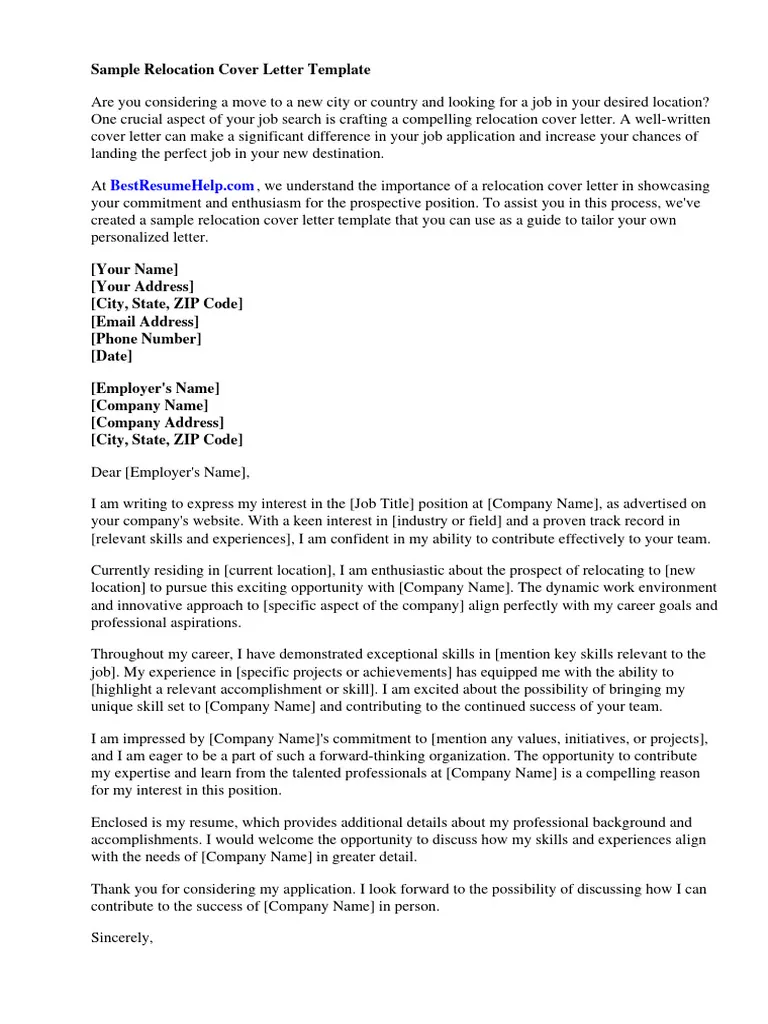
A well-structured job relocation cover letter typically includes several key sections. Begin with your contact information, the date, and the hiring manager’s contact information. Then, move on to a compelling opening paragraph that grabs the reader’s attention. In the body paragraphs, elaborate on your skills, experiences, and your interest in the role and the company. Make sure to address your relocation plans and any relevant details. Finally, end with a strong closing paragraph that reiterates your enthusiasm and includes a call to action. Each section plays a vital role in showcasing your suitability for the job.
Opening Paragraph
Your opening paragraph is your first and possibly only chance to make a great impression. Start with a strong hook that grabs the reader’s attention and immediately conveys your interest in the role. Mention the specific position you’re applying for and how you found it. Then, briefly state why you’re a good fit for the job, highlighting your most relevant skills and experiences. Clearly mention your intention to relocate to the area. Avoid generic openings; personalize your introduction to make it more engaging. Consider mentioning a specific detail about the company or the role to show you’ve done your research. The opening paragraph sets the tone for the rest of the letter, so make it count.
Body Paragraphs
The body paragraphs are where you elaborate on your qualifications and address the key requirements of the job. Use these paragraphs to showcase your skills, experiences, and achievements. Provide specific examples of how you’ve excelled in previous roles, using the STAR method (Situation, Task, Action, Result) to tell compelling stories. Tailor your examples to the job description, highlighting skills and experiences that align with the company’s needs. Discuss your accomplishments and quantify them whenever possible. This shows the hiring manager the value you can bring to the organization. The body paragraphs give you a great chance to illustrate how you fit into the company, and why they should hire you.
Closing Paragraph

Your closing paragraph should leave a lasting impression. Reiterate your enthusiasm for the opportunity and summarize why you’re a strong candidate. Express your gratitude for the reader’s time and consideration. Include a clear call to action, such as expressing your interest in an interview and providing your contact information. Avoid generic closings; personalize your message to show your genuine interest. A strong closing paragraph reinforces your desire to join the company and encourages the hiring manager to take the next step.
Tailoring Your Letter to the Job
Never send a generic cover letter. Tailor each letter to the specific job and company. Carefully review the job description and identify the key requirements and desired qualifications. Customize your letter to highlight the skills and experiences that align with these requirements. Use the same keywords and phrases that are used in the job description. Show how your skills and experiences meet those needs. Research the company’s values and culture, and align your letter to show that you share those values. Tailoring your letter demonstrates your genuine interest and increases your chances of standing out from the crowd.
Keywords to Include
Keywords are crucial for both applicant tracking systems (ATS) and human readers. Identify the key skills, qualifications, and industry terms mentioned in the job description. Incorporate these keywords naturally throughout your cover letter. Use a mix of hard skills and soft skills. Ensure you are writing naturally, not keyword stuffing. Keywords help your application get noticed by both systems and hiring managers. Highlighting key terms is also an excellent way of making sure the hiring manager realizes that you understand the requirements of the job.
Quantifying Your Achievements

Quantifying your achievements makes your cover letter more compelling and demonstrates your value to potential employers. Instead of saying ‘Improved customer satisfaction,’ write ‘Increased customer satisfaction by 20% through implementing a new feedback system.’ Use numbers, percentages, and other metrics to show your impact in previous roles. This provides tangible evidence of your skills and experiences. Quantifying your achievements allows the hiring manager to understand your impact and helps them to see how you can contribute to their company’s success.
Addressing Potential Concerns
Relocating for a job raises questions, address these proactively in your cover letter. Be upfront about your relocation plans and provide details about your timeline. If you have specific reasons for moving, briefly mention them. If you’re concerned about travel expenses, indicate that you’re willing to cover them or discuss them. By addressing potential concerns head-on, you demonstrate your commitment and show that you’ve thought through the logistics of relocating. This will help the hiring manager feel more comfortable moving forward with your application and will increase your chances of getting hired. Be honest, direct and concise, but do not disclose unnecessary details.
Discussing Relocation Plans
Clearly state your relocation plans in your cover letter. Specify when you plan to move to the new location and when you would be available to start work. Be realistic about your timeline. Mention whether you have already started making arrangements, such as securing housing or researching neighborhoods. If you’re flexible with your start date, indicate your flexibility. Provide any relevant details, such as whether you have family members involved in your decision or specific interests you have in the city. The more information you can provide, the more assured a hiring manager will feel about your commitment to the move. Remember, your goal is to remove any doubts and convey confidence in your plan.
Proofreading and Editing Your Cover Letter

Proofreading and editing your job relocation cover letter is essential for presenting a professional image. Before submitting your letter, carefully proofread it for any grammatical errors, typos, and inconsistencies. Read it aloud to catch any awkward phrasing or sentences. Use spell-check and grammar-check tools, but don’t rely on them entirely. Ask a friend or family member to review your letter for a second opinion. A well-written and error-free cover letter shows that you pay attention to detail and care about your application. It is one of the most important steps on your letter, so do not skip this one, is a great way to increase your chances of getting the job.