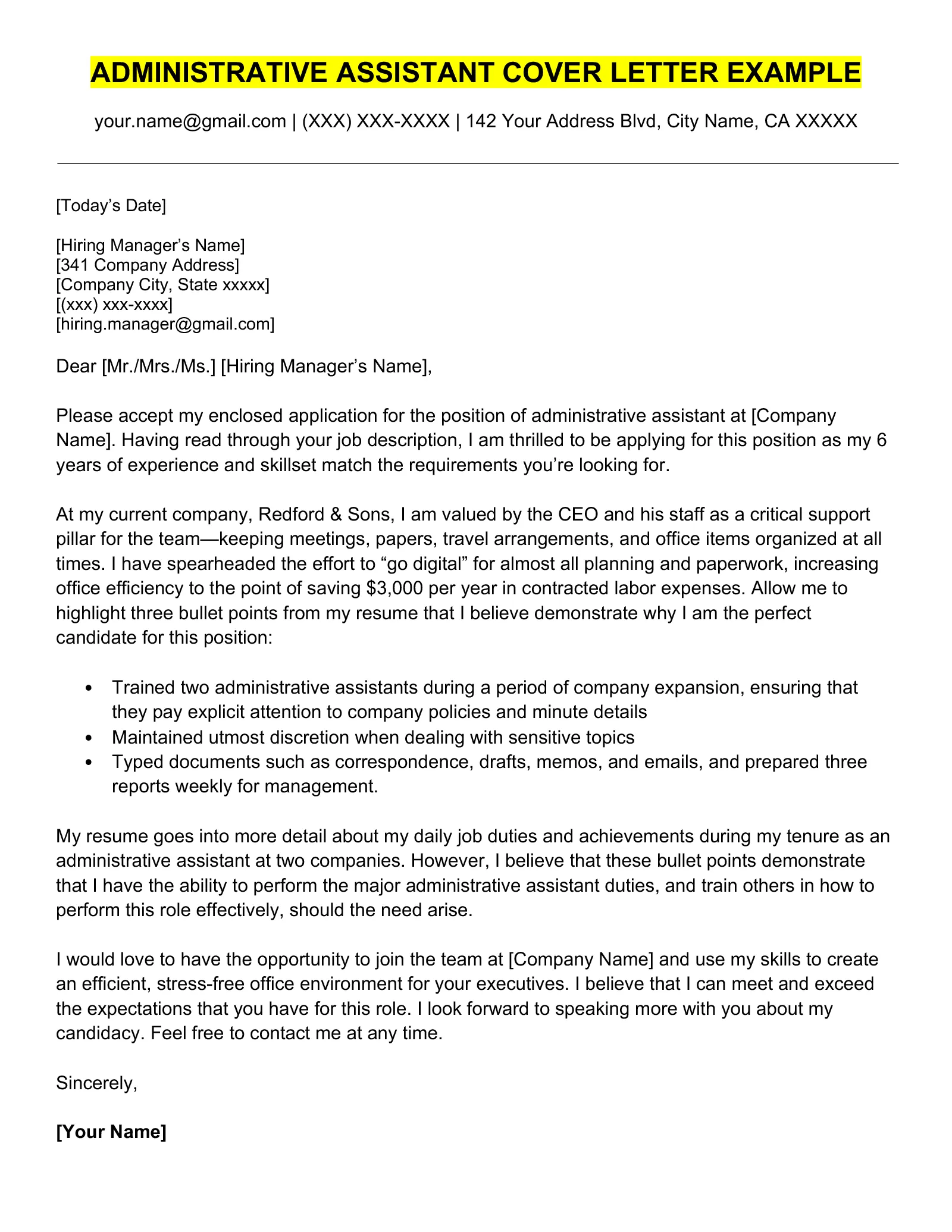
Understanding the Purpose of an Admin Assistant Cover Letter
A great administrative assistant cover letter is more than just a formality; it’s your first opportunity to make a strong impression. It’s your chance to introduce yourself to a potential employer and showcase your personality, skills, and experience in a way that your resume alone cannot. The primary purpose of the cover letter is to persuade the hiring manager that you are the best candidate for the administrative assistant position. It should highlight your key qualifications, demonstrate your understanding of the job requirements, and express your enthusiasm for the opportunity. It provides context to your resume, allowing you to elaborate on specific accomplishments and explain how your skills align with the company’s needs. By crafting a compelling cover letter, you increase your chances of getting noticed and securing an interview.
Key Components of a Great Admin Assistant Cover Letter
A well-structured administrative assistant cover letter includes several key components that work together to present you as a strong candidate. Firstly, start with a professional heading that includes your contact information, the date, and the hiring manager’s details if available. Next, write a compelling introduction that grabs the reader’s attention and states the position you’re applying for. The body of the letter should then highlight your relevant skills and experience, providing specific examples to support your claims. Use action verbs to describe your accomplishments and quantify your achievements whenever possible. Tailor your letter to the specific job requirements and the company’s culture. Finally, conclude with a strong closing that reiterates your interest in the position and includes a call to action, such as requesting an interview. Proofread the entire letter carefully to eliminate any errors and ensure a professional tone.
Your Contact Information & Introduction

The opening section of your administrative assistant cover letter sets the tone for the rest of your application. Begin with your contact information, including your full name, phone number, email address, and LinkedIn profile URL if you have one. Ensure your email address is professional. Next, include the date and the hiring manager’s name and title, if you know it. If you don’t know the hiring manager’s name, use a general greeting like “Dear Hiring Manager.” The introduction should clearly state the position you’re applying for and how you learned about the opportunity. Briefly mention your key qualifications or a compelling reason why you’re interested in the role. Your introduction should be concise and engaging, encouraging the reader to continue reading. It is also important to make sure the font of your cover letter and resume are aligned.
Highlighting Your Skills & Experience
The body of your cover letter is where you showcase your skills and experience, proving that you are a good fit for the administrative assistant role. Focus on the skills and experience most relevant to the job description. This is not a regurgitation of your resume; instead, it should expand on key experiences and achievements. Provide specific examples to demonstrate how you’ve successfully used your skills in the past. Quantify your accomplishments whenever possible to show the impact you’ve made in previous roles. For instance, instead of saying “Managed office calendars,” you could say “Managed the calendars for a team of 10, resulting in a 15% reduction in scheduling conflicts.” Tailor your letter to match the specific requirements outlined in the job posting, using the same keywords and phrases. This will demonstrate that you’ve carefully read the job description and understand the employer’s needs. Make sure to include soft skills like communication, organization, and problem-solving.
Demonstrating Relevant Skills
Administrative assistant roles require a diverse range of skills. Highlight the skills that align with the job description’s requirements. These typically include strong organizational skills, proficiency in Microsoft Office Suite (Word, Excel, PowerPoint, Outlook), excellent communication skills (both written and verbal), attention to detail, and the ability to multitask. If the job requires specific software knowledge, such as CRM systems or project management tools, be sure to mention your experience with them. Provide concrete examples of how you’ve used these skills effectively in previous roles. For example, describe how you used your organizational skills to streamline a filing system or your communication skills to handle customer inquiries efficiently. Don’t just list your skills; demonstrate them through your experiences. The more specific you are, the more credible you will appear.
Showcasing Your Experience

When showcasing your experience, provide a brief overview of your relevant work history. Focus on the responsibilities and accomplishments that align with the requirements of the administrative assistant position. Describe your roles and responsibilities in previous positions, emphasizing tasks such as managing calendars, scheduling meetings, handling correspondence, and providing administrative support to a team or individual. Go beyond simply listing your duties; instead, explain how you performed them effectively. For example, detail how you improved office efficiency, reduced errors, or enhanced communication within a team. Use action verbs to describe your accomplishments. For instance, instead of saying “Responsible for managing travel arrangements,” write “Coordinated all travel arrangements for the executive team, resulting in cost savings of 10%.” Provide enough detail to give the reader a clear understanding of your capabilities.
Quantifying Your Achievements
Quantifying your achievements adds significant weight to your cover letter. Whenever possible, use numbers and data to illustrate the impact you’ve made in previous roles. For example, instead of saying “Improved office efficiency,” write “Improved office efficiency by 20% by implementing a new filing system.” Instead of saying “Managed customer inquiries,” try “Successfully resolved an average of 50 customer inquiries per day.” These specific examples provide concrete evidence of your abilities and highlight your value as a candidate. Using numbers helps demonstrate your contributions and makes your accomplishments more credible and memorable. Think about the results you achieved in your previous roles. Did you reduce costs, improve productivity, or enhance customer satisfaction? Quantify these achievements to make your cover letter more impactful.
Tailoring Your Cover Letter
Tailoring your cover letter is crucial for making a strong impression on the hiring manager. Avoid using a generic cover letter; instead, personalize each application to match the specific job requirements and the company’s culture. Research the company and the role to understand their needs and values. Use the job description as a guide to identify the key skills and qualifications they are seeking. Then, highlight your relevant skills and experiences, using keywords and phrases from the job description. Show how your background aligns with the company’s needs. For instance, if the job description emphasizes teamwork, provide examples of your collaborative experiences. Mention the company by name and express your enthusiasm for the opportunity, showing that you are genuinely interested in working there. This level of personalization demonstrates your commitment and makes you stand out from other applicants.
Researching the Company

Before writing your cover letter, take the time to research the company you are applying to. Visit their website, read about their mission, values, and recent news or projects. Learn about their products, services, and target market. This research will help you tailor your cover letter to demonstrate your understanding of the company’s needs and culture. Use the information you gather to explain why you are interested in working for this specific organization. Mentioning the company by name and referring to specific initiatives or values can show that you have taken the time to understand their business. This demonstrates your genuine interest and increases your chances of making a positive impression. Showing you’re not just applying for a job but that you want to work there specifically can be a great advantage.
Matching Skills to Job Requirements
The most effective cover letters directly address the requirements outlined in the job description. Carefully review the job posting and identify the key skills and qualifications the employer is seeking. Then, in your cover letter, explicitly highlight your relevant skills and experiences. Use the same keywords and phrases from the job description to demonstrate that you possess the required competencies. Provide specific examples to support your claims. For instance, if the job description mentions proficiency in Microsoft Excel, describe your experience using Excel to manage data, create reports, or perform analysis. Show how your skills and experiences align with the specific needs of the role. By matching your qualifications to the job requirements, you increase the likelihood that your application will be noticed and considered seriously.
Writing a Compelling Closing
The closing of your cover letter is your final opportunity to leave a lasting impression. Reiterate your interest in the position and express your enthusiasm for the opportunity. Thank the hiring manager for their time and consideration. Include a clear call to action, such as requesting an interview or expressing your availability to discuss your qualifications further. Make sure your tone is positive and professional. Avoid generic phrases or clichés. Instead, personalize your closing to reflect your genuine interest in the role and the company. For instance, you might say, “I am eager to learn more about this opportunity and discuss how my skills and experience can contribute to your team. Thank you for your consideration, and I look forward to hearing from you soon.” A well-crafted closing reinforces your interest and encourages the reader to take the next step.
Proofreading and Formatting

Proofreading and formatting your cover letter is crucial for ensuring that it presents you in a professional light. Before submitting your application, carefully proofread the entire document for any grammatical errors, spelling mistakes, or typos. Read it aloud to catch any awkward phrasing or sentence structures. Pay attention to the tone of your letter, ensuring that it is professional, enthusiastic, and tailored to the specific job. Use a clear and easy-to-read font, such as Arial or Times New Roman, and maintain consistent formatting throughout. Ensure that your contact information, headings, and paragraphs are well-organized and visually appealing. Have a friend or colleague review your cover letter for a second opinion. A polished and error-free cover letter demonstrates your attention to detail and professionalism, increasing your chances of success.
Common Mistakes to Avoid
Several common mistakes can undermine your administrative assistant cover letter. Avoid using generic or overly formal language. Instead, use a conversational tone and tailor your letter to the specific job and company. Do not simply rehash your resume; use the cover letter to provide additional context and showcase your personality. Avoid typos and grammatical errors, as they can make you appear unprofessional. Do not write a cover letter that is too long or too short. Aim for a concise and well-written letter that highlights your key qualifications. Avoid negative language or making excuses for any gaps in your employment history. Always proofread your cover letter carefully before submitting it to make sure to catch any errors.
Using Strong Action Verbs
Using strong action verbs is an effective way to make your cover letter more impactful and engaging. Action verbs describe your accomplishments and make your achievements more vivid and memorable. Start each bullet point or sentence describing your experience with a strong action verb. Instead of using passive language, choose active verbs to highlight your abilities. Examples of effective action verbs include “managed,” “coordinated,” “implemented,” “streamlined,” “organized,” “created,” “developed,” “resolved,” and “achieved.” Vary your word choice to avoid repetition and keep the reader engaged. By using strong action verbs, you showcase your skills and make your accomplishments more persuasive, helping you stand out from other applicants.
Formatting for Readability

Formatting your cover letter for readability is essential for ensuring that your application is easy to read and makes a positive impression. Use a clear and professional font, such as Arial or Times New Roman, in a standard size (11 or 12 points). Keep your letter concise and well-organized, with clear headings and paragraphs. Use ample white space between paragraphs and sections to avoid a cluttered appearance. Make sure the margins are standard (1 inch on all sides) for a professional look. Use bullet points to list your key skills or accomplishments. Proofread your formatting to make sure that all elements are properly aligned and consistent. A well-formatted cover letter is easier to read and demonstrates your attention to detail, making a positive impression on the hiring manager.
Getting Feedback on Your Cover Letter
Seeking feedback on your cover letter is a valuable step in the job application process. Ask a trusted friend, family member, or career counselor to review your cover letter. They can provide an objective perspective on your writing style, content, and overall presentation. Ask them to identify any grammatical errors, typos, or areas where your message could be clearer. Also, ask them if your cover letter effectively showcases your skills and experience and if it aligns with the requirements of the job description. Consider getting feedback from multiple sources to gather a range of perspectives. Be open to suggestions and revise your cover letter based on the feedback you receive. A well-reviewed cover letter is more likely to impress the hiring manager.