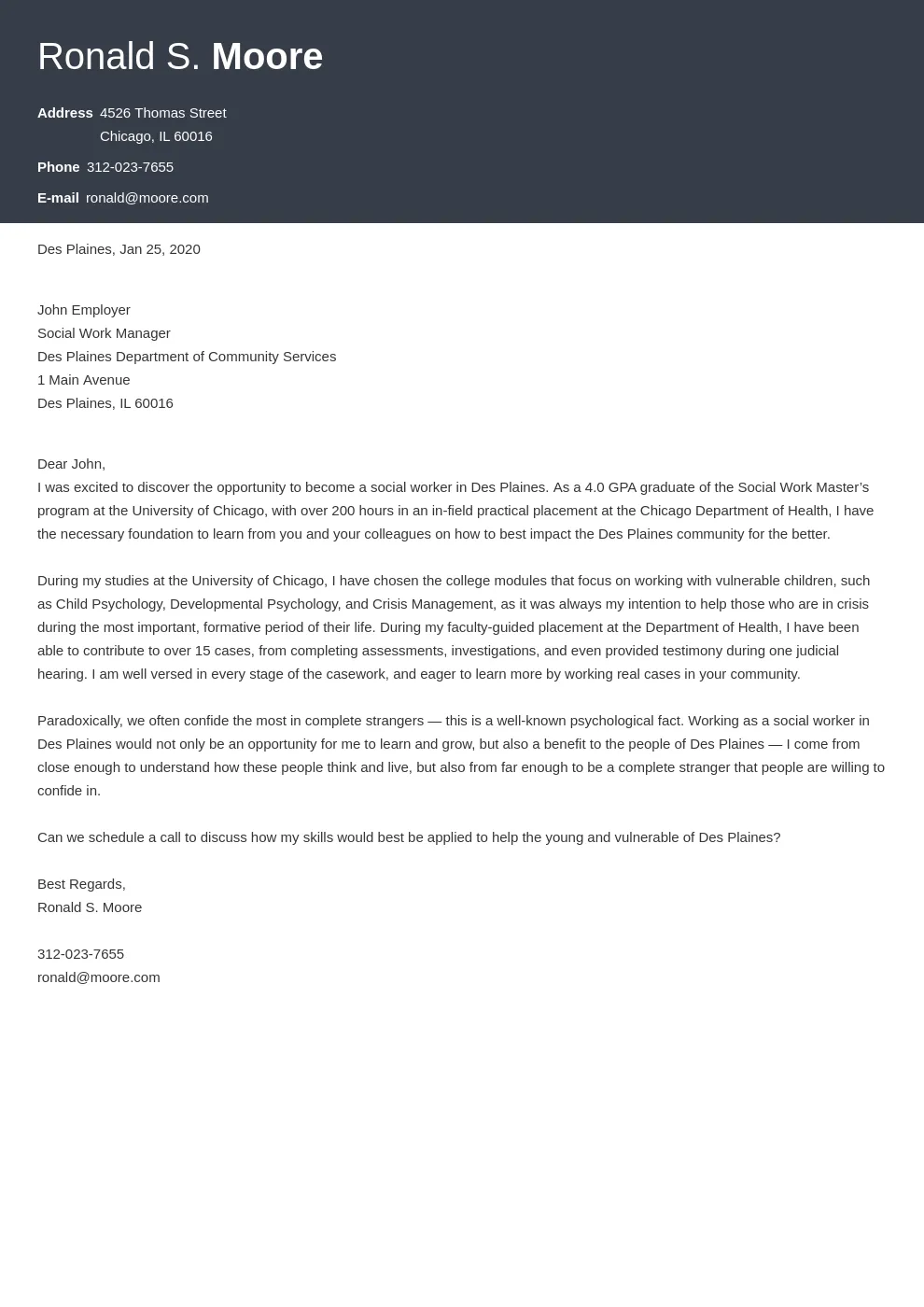
Why a Social Work Cover Letter is Crucial
A well-crafted social work cover letter is more than just a formality; it’s your initial opportunity to make a strong impression and set yourself apart from other applicants. In a field as competitive and demanding as social work, where compassion, empathy, and a genuine commitment to helping others are paramount, your cover letter offers the chance to showcase your personality, your understanding of the role, and your passion for the profession. It provides context to your resume, allowing you to elaborate on experiences, highlight relevant skills, and demonstrate how your unique qualifications align with the specific requirements of the job and the values of the organization. Without a compelling cover letter, your resume might get overlooked, so it’s an essential tool to get your foot in the door and secure an interview. It is a chance to express your interest in the role and organization, demonstrating your research and enthusiasm.
Highlighting Your Skills and Experience
When composing your social work cover letter, the focus should be on demonstrating how your skills and experience align with the job description’s requirements. Start by identifying the key skills and experiences the employer is seeking, such as crisis intervention, case management, advocacy, counseling, or specific software proficiency. Then, provide concrete examples of how you’ve successfully utilized these skills in previous roles. Use the STAR method (Situation, Task, Action, Result) to structure your examples, detailing the specific situation you encountered, the task you were assigned, the actions you took, and the positive results you achieved. This approach not only showcases your abilities but also offers tangible evidence of your competence. For instance, describe a time when you successfully managed a complex case, resolved a conflict, or advocated for a client’s needs. Be specific and quantify your achievements whenever possible, such as the number of clients you assisted or the positive outcomes you facilitated. Remember to tailor your examples to match the job requirements and emphasize the impact you made.
Tailoring Your Cover Letter to the Job

One of the biggest mistakes job seekers make is submitting generic cover letters. To make your cover letter truly impactful, personalize it to each job application. Begin by carefully reading the job description and identifying the specific skills, experiences, and qualifications the employer is seeking. Use these keywords and phrases throughout your cover letter, demonstrating that you understand the role and the organization’s needs. Avoid using a template without modifications. Address the letter to the hiring manager by name, if possible, which shows that you’ve taken the time to research the organization. When you tailor your letter, you are telling the employer that you’re genuinely interested in this specific role, and are not just sending out a generic application. Highlight your achievements in a way that addresses the key concerns of the employer. By showing that you’ve considered the specific challenges and opportunities of the position, you’ll dramatically improve your chances of securing an interview.
Researching the Organization
Before you start writing your cover letter, thoroughly research the organization and the specific role you’re applying for. Visit the organization’s website to learn about its mission, values, and the populations it serves. Look for any recent news or initiatives the organization has undertaken, which can give you valuable insights into its priorities. This research will help you tailor your cover letter, demonstrating your understanding of the organization and showing your genuine interest. In your cover letter, you can mention specific programs or services the organization offers and explain why these align with your career goals. For example, if the organization specializes in mental health services for veterans, you could mention your experience working with veterans or your interest in this specific area. Knowing the organization’s values can also help you better align your skills and experience. This shows that you are not just looking for a job, but that you are enthusiastic about contributing to the organization’s mission.
Formatting Your Social Work Cover Letter
The formatting of your social work cover letter is an important component. A well-formatted cover letter is easy to read, professional, and presents you in a positive light. Start with your contact information (name, address, phone number, and email address) at the top, followed by the date and the hiring manager’s contact information. Use a professional and clean font, such as Times New Roman, Arial, or Calibri, and maintain a consistent font size (typically 11 or 12 points). Use single spacing within paragraphs and double spacing between paragraphs to enhance readability. Break up large blocks of text with short paragraphs and bullet points when appropriate. A well-formatted cover letter shows that you pay attention to detail and have respect for the reader’s time. Ensure your letter is free of errors in grammar and spelling. Consider using a standard business letter format to maintain a professional tone.
Contact Information and Salutation

Begin your cover letter with your contact information, including your full name, address, phone number, and professional email address. Make sure your email address is appropriate and professional. Following your contact information, add the date and then the hiring manager’s name and title, and the organization’s address. Always try to address your letter to a specific person, which demonstrates initiative. If you’re unable to find the hiring manager’s name, use a generic salutation like ‘Dear Hiring Manager’. Avoid outdated or overly formal salutations. A well-crafted salutation sets the tone for the rest of your cover letter and shows that you have taken the time to address the person in charge of hiring.
Writing the Body of Your Cover Letter
The body of your social work cover letter is where you make your case. Divide the body into three main sections: an opening paragraph, several middle paragraphs, and a closing paragraph. Each section should serve a specific purpose. In the opening paragraph, state the position you are applying for and how you found the job. Briefly mention your key qualifications and express your enthusiasm for the role and the organization. The middle paragraphs are where you showcase your skills and experience, providing specific examples and quantifiable achievements. Use the STAR method to structure your examples. Tailor your content to align with the job description’s requirements. In the closing paragraph, summarize your key qualifications, reiterate your interest in the position, and include a call to action, such as requesting an interview. Proofread the entire body to make sure it flows well and has no grammatical errors.
Opening Paragraph
The opening paragraph is your chance to grab the reader’s attention and make a strong first impression. Start by clearly stating the specific position you are applying for and how you learned about the opportunity. Indicate your enthusiasm for the role and the organization. Briefly mention your key qualifications and skills. For instance, you might write, ‘I am writing to express my enthusiastic interest in the Social Worker position advertised on Indeed. With five years of experience in crisis intervention and case management, I am confident I can make a significant contribution to your team.’ Keep it concise and focused on the most important aspects of your application. This initial paragraph sets the tone for your letter, so make sure it reflects your professionalism and your genuine interest in the position.
Middle Paragraphs — Showcasing Your Skills

The middle paragraphs are where you provide detailed information to support your candidacy and demonstrate your competence for the role. Use these paragraphs to showcase your skills, experience, and accomplishments. When describing your skills, focus on those mentioned in the job description, and back them up with concrete examples. Utilize the STAR method to tell concise stories about your experiences. Quantify your achievements whenever possible to add more impact, providing numbers to show that you have the experience and skills the role needs. Be specific and avoid general statements. Emphasize how your skills match the job requirements, as you will likely have a better chance to progress to the interview stage. Make it easy for the hiring manager to see why you are a good fit for the role.
Closing Paragraph
The closing paragraph is where you summarize your qualifications, reiterate your enthusiasm, and encourage the hiring manager to take the next step. Briefly restate your key qualifications and highlight your strongest attributes. Reiterate your interest in the position and the organization, mentioning how your career goals align with the company’s mission. End with a clear call to action. For example, you might say, ‘I am eager to discuss my qualifications further in an interview and demonstrate how my skills and experience can benefit your organization.’ Thank the hiring manager for their time and consideration, and include your contact information. Proofread the entire closing paragraph to make sure it is free from errors and conveys your enthusiasm and professionalism.
Proofreading and Editing
Before submitting your cover letter, thoroughly proofread and edit it. Errors in grammar, spelling, and punctuation can undermine your credibility. Read your cover letter several times, slowly and carefully, to catch any mistakes. Use a grammar and spell-checking tool, but don’t rely on it entirely. Sometimes, these tools miss subtle errors. Consider asking a friend, family member, or career counselor to review your letter for clarity, accuracy, and overall impact. They can often spot mistakes that you might miss. Ensure the letter is well-organized, and the formatting is consistent and professional. Remember, your cover letter is a reflection of your attention to detail and professionalism.
Common Mistakes to Avoid

Several common mistakes can hurt your chances of landing an interview. Avoid submitting a generic cover letter that is not tailored to the specific job. Failing to research the organization is another mistake; your cover letter should show that you understand its mission and values. Other errors include using jargon or overly formal language, as well as being negative or making excuses. Don’t include information that isn’t relevant to the job requirements. Ensure your cover letter is free of errors in grammar and spelling. Avoid using clichés, and keep the tone positive and enthusiastic throughout. By avoiding these pitfalls, you can greatly increase your chances of making a positive impression and securing an interview.
Cover Letter Examples for Social Work
Reviewing cover letter examples can provide valuable insights and guidance. Look for examples that align with the specific type of social work position you’re applying for. Search online for templates or examples tailored to social work roles. Pay attention to the structure, language, and tone of the examples. Analyze how other candidates highlight their skills and experiences and tailor your letter to match the job requirements. Remember that while examples can provide inspiration, you should always customize your letter to reflect your unique qualifications and the specific job you’re applying for. Consider seeking advice from a career counselor, who can provide insights on how to write a compelling cover letter.
Examples for Entry-Level Social Work Positions
When applying for entry-level social work positions, you might lack extensive professional experience. Instead, focus on highlighting your relevant coursework, internships, volunteer work, and any other experiences that demonstrate your skills. Emphasize your passion for the field and your commitment to helping others. Mention your knowledge of social work ethics and your ability to work with diverse populations. Highlight any transferable skills, such as communication, empathy, and problem-solving. If you have any specific certifications or licenses, be sure to mention them. Demonstrate your enthusiasm and show how your background and education have prepared you for the role. Here is where you can make use of relevant examples from your studies, volunteer work, and other experiences that have shaped you. Highlight your eagerness to learn and contribute to the organization’s mission.
Examples for Experienced Social Workers

If you’re an experienced social worker, your cover letter is your chance to showcase your accomplishments and expertise. Highlight your years of experience and the types of cases you’ve handled. Include quantifiable results, such as the number of clients you’ve assisted, positive outcomes you’ve achieved, and any awards or recognitions you’ve received. Emphasize your leadership skills, experience in program development, and proficiency in specific areas. Showcase your skills in advocacy, case management, and crisis intervention. Provide concrete examples of how you’ve successfully navigated challenges, resolved conflicts, and improved the lives of your clients. Show your deep understanding of the needs of the population you serve and demonstrate how you can contribute to the organization’s success. Customize your cover letter to show the hiring manager that you can quickly assume the role and contribute to the mission.