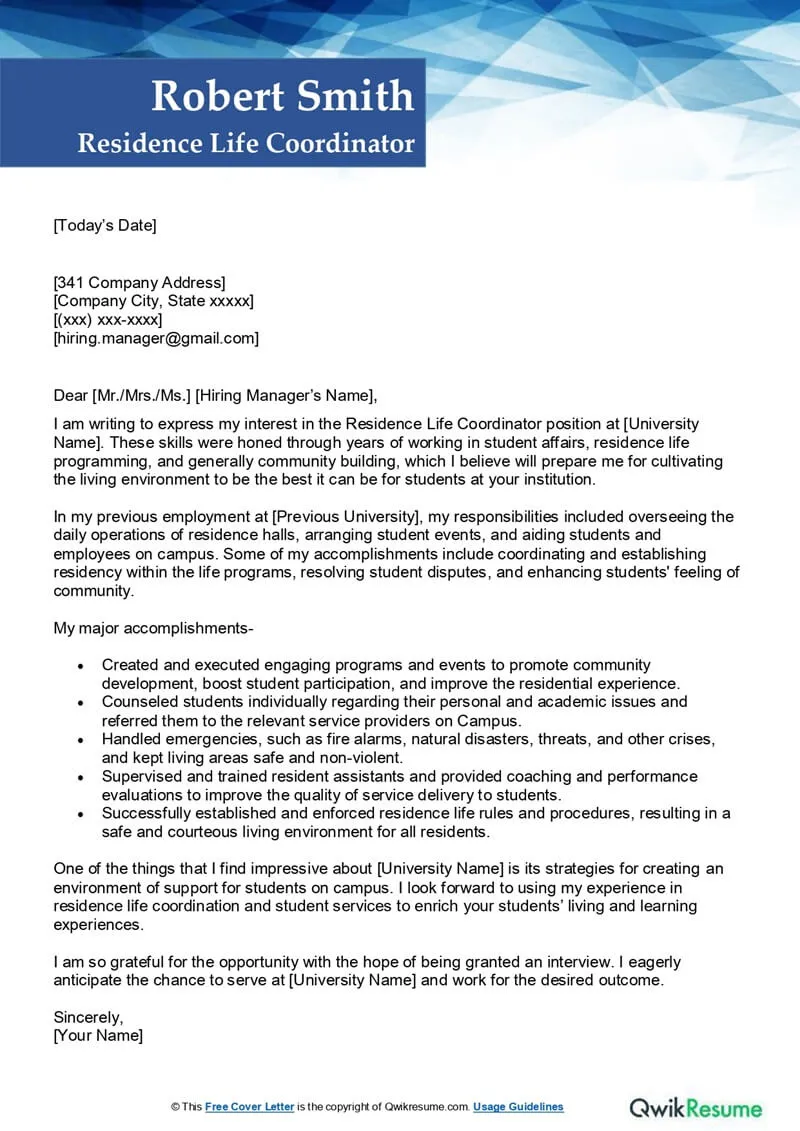
Understanding the Residence Life Cover Letter
A residence life cover letter is your initial chance to make a great impression when applying for a role in student housing. This document goes beyond simply listing your qualifications. It’s your opportunity to demonstrate your knowledge of the field and your enthusiasm for creating a positive living environment. A well-crafted cover letter will highlight your relevant experience, skills, and passion for helping students thrive. Unlike a generic letter, this one is tailored to the specifics of the job and the institution, showing the hiring committee that you understand the role’s demands and the university’s values. It’s a critical step in the application process, allowing you to differentiate yourself from other applicants. Your cover letter should focus on demonstrating your personality, motivations, and how your unique qualifications fit the specific residence life position. Explain why you are the right fit.
Purpose of a Residence Life Cover Letter
The primary purpose of a residence life cover letter is to persuade the hiring committee that you are the ideal candidate for the position. It acts as a bridge between your resume, which outlines your experiences, and the potential role you’re seeking. The cover letter lets you explain why you are drawn to residence life and this specific institution, and how your skills and experiences perfectly align with the job description. It demonstrates your communication skills, attention to detail, and understanding of the values and mission of the residential community. The cover letter showcases your ability to create a positive, inclusive environment, support student development, and manage sensitive situations professionally. Your motivations and suitability are essential, making this cover letter a crucial tool to get an interview and, hopefully, the job.
Key Components of a Strong Cover Letter

A successful residence life cover letter is built from several key elements, working together to create a compelling narrative. These include a well-formatted header with your contact details, an engaging greeting and introduction, a clear presentation of your qualifications and skills, and a demonstration of your passion and interest in residence life. Moreover, it should acknowledge the job requirements, showcase your understanding of the institution, and be tailored to their specific needs. A professional closing with a call to action, thanking them for their consideration, and reiterating your contact information are also essential. The components must be carefully crafted to showcase your communication skills and articulate why you are the best candidate. Each section has its own specific functions, so make sure you are showing all aspects of yourself in the best possible light and highlighting the most relevant information to the hiring committee.
Header and Contact Information
The header sets the tone for your residence life cover letter, so it is crucial to present it professionally and accurately. Start by including your full name, address, phone number, and professional email address. Ensure that the information is up-to-date and easy to read at a glance. The header should be aligned to the left or center of the page, whichever is your preference, but maintain consistency throughout. Below your contact information, include the date, followed by the hiring manager’s name and title (if you know it) and the institution’s address. If you’re uncertain of the hiring manager’s name, look at the department website or the job posting for information. A well-formatted header shows your attention to detail and professionalism. A clean, organized header, provides an overview of your key contact details and is an important way to present yourself as a serious candidate. Ensure you are presenting your important details clearly in the best possible way.
Greeting and Introduction
Your greeting and introduction are the first impression your cover letter will make. Begin with a formal greeting, such as “Dear Mr./Ms./Mx. [Last Name],” if you know the hiring manager’s name. If not, use “Dear Hiring Committee” or another professional salutation. The introduction should immediately grab the reader’s attention, stating the position you’re applying for and where you found the job posting. Briefly mention why you’re interested in the role, the institution, and what makes you a good fit. It should be concise and engaging, conveying your enthusiasm and clear understanding of the role and the institution’s mission. Avoid generic openings. Instead, tailor your introduction to highlight your specific interest and how your background aligns with the requirements of the position. Your introduction should also hint at the key skills and experiences you’ll discuss in the following sections, enticing the reader to learn more.
Highlighting Your Qualifications

This section is where you highlight your qualifications, skills, and experiences that relate to the role. Don’t just restate your resume; instead, offer context, depth, and specific examples. Start by identifying the essential qualifications from the job description and explain how your background meets those needs. For each skill or experience, provide a specific example of when you successfully used it. Use the STAR method (Situation, Task, Action, Result) to structure your examples. This helps you to illustrate the situation, the task you faced, the actions you took, and the positive results you achieved. By providing clear, concise examples, you show your competence and the impact you’ve made. Make sure your qualifications are relevant to the residence life role, showing your ability to support student development, manage conflicts, and create an inclusive community.
Relevant Skills and Experience
Focus on the skills and experience most relevant to the residence life position to make a strong impression. Identify the key skills such as conflict resolution, communication, leadership, time management, and crisis management. Provide concrete examples of how you’ve demonstrated these skills in the past. If you’re highlighting your communication skills, describe a time you successfully mediated a conflict between residents, detailing the steps you took and the positive outcome. When discussing your leadership experience, describe a project you led, detailing the challenges and the results. When discussing your leadership experience, provide an example of when you led a project or initiative, the challenges you faced, and the results you achieved. Similarly, demonstrate experience in crisis management with a specific example of how you handled an emergency situation, emphasizing your quick thinking, decision-making, and ability to remain calm under pressure. Emphasize not just what you did, but also the positive impact of your actions on the residential community and the students.
Demonstrating Passion and Interest
Demonstrating genuine passion and interest in the role is the key to making your cover letter stand out. Communicate why you’re excited about the position and the institution. Research the institution’s mission, values, and specific initiatives, then explicitly mention how these align with your own beliefs and aspirations. Explain what draws you to residence life – is it the opportunity to support students, build community, or shape a positive living environment? Offer personal anecdotes or experiences that show your commitment to the institution’s values. If you’ve volunteered or worked in a related field, describe how those experiences fueled your passion. Your enthusiasm should be clear, showing that you’re invested in the success of the residential community and the well-being of its students, not just seeking employment. Highlighting passion and enthusiasm is essential for any strong residence life cover letter.
Addressing the Specific Requirements

In your residence life cover letter, it is vital to directly address the requirements of the job description. Carefully review the job posting to identify the skills, qualifications, and experiences that the institution seeks. Then, connect your abilities and experiences to these requirements. For each requirement, provide a clear example of how you meet it. For instance, if the job description emphasizes conflict resolution, offer a specific situation where you mediated a dispute. If they are looking for someone with leadership experience, discuss a project or initiative you led and the positive results. Use keywords from the job posting to demonstrate you understand what the position requires. Be specific and focused, with examples proving your capabilities. This shows the hiring committee how you fit their needs and that you are a strong candidate. Highlighting requirements is essential for standing out from other applicants.
Showcasing Your Understanding
Showcasing your understanding of residence life is critical. Demonstrate your awareness of the role’s responsibilities, including supporting student development, creating an inclusive community, and enforcing policies. Discuss your philosophy on residential living, emphasizing your commitment to fostering a supportive environment. Show that you understand the importance of diversity and inclusion by discussing how you would contribute to creating a welcoming space for all students. If possible, mention any knowledge of student affairs theories or practices. You can also reference professional development courses or training related to residence life. By demonstrating a solid understanding of the field, you’ll show that you are committed to contributing to the success of the residential community. Showing your understanding helps you stand out.
Tailoring Your Cover Letter
Avoid using a generic cover letter template for residence life positions. Tailor your letter to each institution and role. This involves researching the institution’s mission, values, and the specific job requirements. Customize your letter to align with their culture and the responsibilities of the role. Address the hiring manager by name and mention the institution throughout your letter. Show the hiring committee that you have taken the time to understand their needs. Highlighting how your skills and experiences fit their goals demonstrates your interest and dedication. A tailored cover letter shows you’re interested and that you understand the position. This will increase your chances of a positive outcome. Tailor your cover letters to ensure that they are tailored to the position.
Researching the Institution

Thoroughly researching the institution is a critical step in creating a successful residence life cover letter. Visit the institution’s website, paying attention to student affairs, residence life, and their mission and values. Read about their residential programs, initiatives, and the overall student experience. Identify any recent developments or achievements in their residential community. Check social media to understand the campus culture and student life. Understanding the institution’s values and mission helps you tailor your cover letter to your skills and experiences. This research also provides talking points for the interview, showing you have familiarized yourself with the institution, improving your chances of a positive impression.
Using Keywords Effectively
Using keywords from the job description strategically is essential for getting noticed. Carefully review the job posting and identify the key skills, qualifications, and experiences. Incorporate these keywords naturally into your cover letter, particularly when highlighting your qualifications and experience. Instead of simply listing keywords, integrate them into sentences and paragraphs to demonstrate your understanding and relevance. For example, if the description emphasizes ‘conflict resolution,’ use that phrase when describing your experience in mediating disputes. This demonstrates that you’re directly aligned with the job requirements. Using keywords appropriately increases your chances of being considered for a role.
Formatting and Presentation
Your cover letter’s formatting and presentation should be professional, clear, and easy to read. Use a standard font like Times New Roman, Arial, or Calibri, with a font size between 11 and 12 points. Maintain consistent formatting throughout the document, including spacing, margins, and alignment. Use single spacing for the body of your letter with a space between paragraphs. Ensure your letter is well-organized with clear headings and subheadings to guide the reader. Divide the content into logical sections with clear, concise language. Avoid lengthy paragraphs; instead, break up the text. Ensure that your cover letter is visually appealing and free of distracting elements. A well-formatted cover letter shows that you pay attention to detail, increasing your chances of a positive impression. Always make sure to keep the formatting clean and easy to follow.
Proofreading and Editing

Proofreading and editing are among the most critical steps in writing your residence life cover letter. Errors in grammar, spelling, and punctuation can undermine your credibility and create a negative impression. After you finish writing, review it multiple times to catch any mistakes. Use spell and grammar checkers, but don’t rely on them completely. Read your letter aloud to identify awkward phrasing. Ask a friend, family member, or career advisor to review it for any errors you might have missed. Pay close attention to detail, ensuring the hiring manager’s name and the institution are correct. An error-free cover letter shows your attention to detail and respect for the hiring committee. Thorough proofreading can be the difference between getting an interview and having your application rejected. Proofread multiple times to ensure your cover letter is perfect.
Closing and Call to Action
Your closing should be professional and leave a positive impression. Thank the hiring committee for considering your application. Restate your interest in the position and the institution. Include a clear call to action, inviting the hiring manager to contact you for an interview or to discuss your qualifications. Provide your contact information again, including your phone number and email address. Avoid generic closings. Instead, use an enthusiastic closing that shows your interest in the role. For example, “Thank you for considering my application. I’m eager to discuss my qualifications. I look forward to hearing from you soon.” A strong closing reinforces your enthusiasm, making it easier for the hiring manager to take the next step. Ensure your closing is strong.
Expressing Gratitude
Expressing gratitude enhances your residence life cover letter. Thank the hiring committee for their time and consideration in the closing paragraph. Acknowledge the opportunity to apply for the position, and express your appreciation. This demonstrates your professionalism and respect. A simple phrase such as “Thank you for considering my application” is often enough, but you may add a more personal touch. For example, you can acknowledge your appreciation for the opportunity to contribute to their community. Expressing gratitude shows that you value the opportunity, leaving a good impression. Expressing gratitude should be a key element in any strong cover letter.
Contact Information

Providing accurate and accessible contact information is essential for your residence life cover letter. Ensure your contact information is consistent throughout your application, including your resume and any follow-up communications. Include your full name, professional email address, and phone number in the header of your cover letter. Double-check that your email address is professional. During the closing, reiterate your contact information to make it easy for the hiring committee to reach you. Ensure your phone number is correct, and that you’re available to answer calls. Always respond promptly if you are contacted. By providing clear contact information, you facilitate seamless communication and increase your chances of getting a job. Ensure this information is correct, easy to read, and is accessible.
Common Mistakes to Avoid
Avoid common mistakes to make a good impression with your residence life cover letter. A frequent error is submitting a generic cover letter. This letter doesn’t address the specific requirements of the role or the institution. Another mistake is focusing too much on yourself instead of how your skills can help the residential community. Ignoring instructions or formatting guidelines can also negatively impact your application. Proofreading is essential; errors in grammar, spelling, and punctuation undermine your credibility. Failing to tailor your cover letter or research the institution shows a lack of initiative. By avoiding these pitfalls, you’ll increase your chances of getting an interview. Tailor your letter to ensure that it stands out in the best way possible.
Generic Cover Letters
Using a generic cover letter significantly reduces your chances of landing a residence life position. Generic letters aren’t tailored to the job’s requirements or the institution’s culture. They sound impersonal and fail to show genuine interest. Hiring committees can easily spot generic letters and move on. Avoid using a template without modifying it to reflect your skills, experiences, and the institution’s values. Customize your letter to show you’ve invested time in understanding the role. Research the institution and the job requirements, and highlight how your skills align. A customized letter shows interest and professionalism, helping you stand out.
Focusing on Yourself
Focusing too much on your needs rather than how you can benefit the institution and its students is a common error. While it’s important to highlight your skills, your cover letter should primarily emphasize how you can meet the needs of the residence life program. Instead of stating what you want from the role, focus on how your skills will help create a supportive environment. Discuss your commitment to student development, your ability to manage conflicts, and your understanding of the institution’s values. Show that you understand your role in fostering community. Shifting the focus to the institution and students will show you’re thinking beyond your goals, and are ready to contribute to the program’s success. Highlighting your impact is essential.
Ignoring Instructions
Ignoring instructions in the job posting can disqualify your application. Always read the job description and follow all directions, including those for the cover letter. If the posting asks you to submit your cover letter in a specific format, follow those instructions. Disregarding these instructions can show a lack of attention to detail. If the posting specifies a specific length or content to include, adhere to these guidelines. By following all instructions, you show your commitment to the application process, which increases your chances of success. Always review all instructions before submitting your letter.
Example Residence Life Cover Letter
Here is a basic example. Always adjust the letter to match specific requirements, but here is a basic skeleton: [Your Name] [Your Address] [Your Phone Number] [Your Email Address] [Date] [Hiring Manager Name (if known), or “Hiring Committee”] [Institution Name] [Institution Address] Dear [Mr./Ms./Mx. Last Name or Hiring Committee], I am writing to express my keen interest in the Residence Life Coordinator position at [Institution Name], as advertised on [Platform where you saw the ad]. With [Number] years of experience in student affairs and a strong passion for fostering supportive residential communities, I am confident in my ability to contribute to [Institution Name]’s mission of [Mention the Institution’s Mission]. Throughout my previous role at [Previous Institution], I was responsible for [Key Responsibilities]. I have hands-on experience in [Relevant Skills, e.g., conflict resolution, programming, crisis management] and a proven track record of building positive relationships with students and staff. I am particularly drawn to [Institution Name]’s commitment to [Mention specific values or initiatives]. I am very excited at the prospect of contributing to a nurturing and engaging community. My resume, attached for your review, provides further details on my qualifications. Thank you for considering my application. I look forward to the opportunity to discuss my qualifications further. Sincerely, [Your Name]
Additional Tips for Success
To maximize your chances, consider these additional tips. Get feedback from mentors or career advisors on your cover letter. Tailor the letter to each job, highlighting relevant skills and experiences. Use an active voice and concise language. Maintain a positive tone. Proofread carefully for errors. Highlight your accomplishments. Ensure that your cover letter is well-formatted. Research the institution thoroughly. These tips will enhance your letter and increase your chances of getting an interview. These extra steps can showcase your strengths and make a great impression. Make sure you are following each of these tips to showcase yourself.
Follow-Up Strategies
After submitting your cover letter, it’s helpful to implement follow-up strategies. If the job posting gives a response timeline, wait for that period. Send a brief email to the hiring manager, reiterating your interest and mentioning a key skill. This reminds them of your application. Don’t be too persistent. If you haven’t heard back in a reasonable timeframe (e.g., two weeks), a single follow-up email is appropriate. Express continued interest and ask if they need more information. Be professional and patient. Follow-up is important and shows the hiring committee you’re serious. Careful follow-ups show your interest and drive.