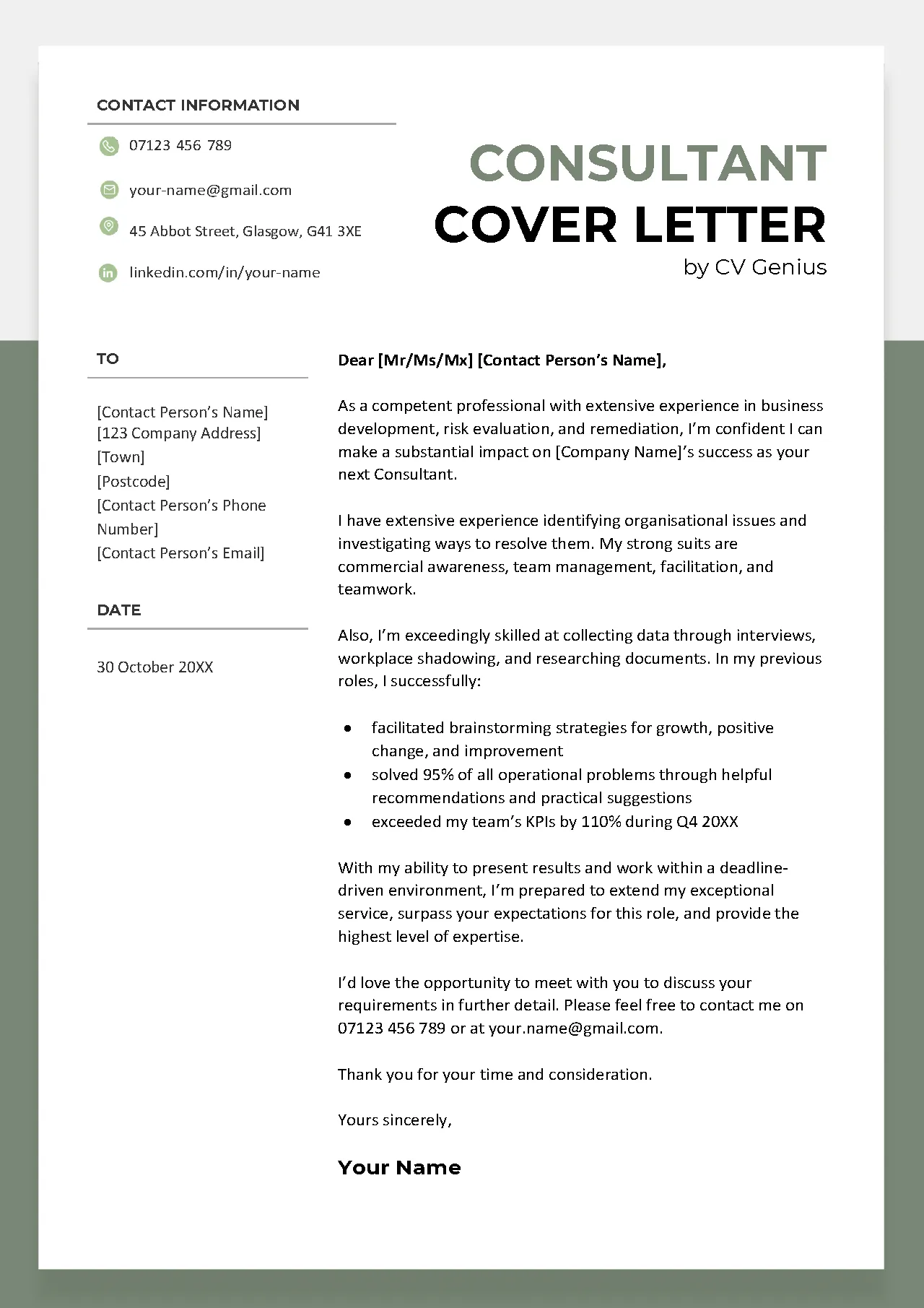
Understanding the Consulting Cover Letter
A consulting cover letter is far more than just a formality; it is your first, and often most crucial, opportunity to make a compelling impression on potential employers. It’s a chance to tell your story, highlight your unique value proposition, and showcase why you are the ideal candidate for the consulting role. Unlike a resume, which is a factual recounting of your experience, the cover letter allows you to provide context, demonstrate your personality, and express your genuine interest in the specific firm and opportunity. This guide will provide a comprehensive overview of the key components, best practices, and common pitfalls to avoid, ensuring your consulting cover letter stands out from the competition.
Why a Consulting Cover Letter Matters
In the highly competitive world of consulting, a well-crafted cover letter can significantly increase your chances of landing an interview. Recruiters and hiring managers often use cover letters to assess your communication skills, attention to detail, and understanding of the consulting industry. It helps them understand your motivations, your alignment with the firm’s values, and your potential fit within the team. A strong cover letter shows that you’ve taken the time to research the firm, understand their needs, and tailor your application accordingly. Ignoring this vital step is a missed opportunity to showcase your passion, skills, and suitability for the role.
Key Components of a Consulting Cover Letter

A successful consulting cover letter is structured logically, providing a clear and concise overview of your qualifications and interest. The structure should be professional, demonstrating your strong communication skills. Each component contributes to a cohesive narrative that showcases your value. Here are the essential components of a successful consulting cover letter.
Header Information
The header of your cover letter provides essential contact information and sets the tone for professionalism. It ensures the recipient can easily identify you and reach out if needed.
Your Name and Contact
Start with your full name, ensuring it matches the name on your resume. Include your phone number and a professional email address. Avoid using nicknames or informal email addresses.
Date

Include the current date, as this indicates when the cover letter was written and demonstrates you’re up-to-date with your application.
Recipient’s Name and Title
Address your cover letter to the hiring manager or the specific person mentioned in the job posting. Use their correct title. Research the specific name, if possible, to personalize your letter. This shows that you care about the role.
Salutation
Use a professional salutation. “Dear Mr./Ms./Mx. [Last Name]” is a safe and respectful approach. If you are unable to find a name, use “Dear Hiring Manager” or “Dear [Company Name] Recruiting Team”.
Body Paragraph 1: Opening and Hook

The opening paragraph should immediately grab the reader’s attention. State the position you are applying for and where you saw the job posting. Briefly mention why you are interested in the role and the company. This is your chance to make a strong first impression and hook the reader’s interest. Expressing your enthusiasm in a clear and concise way can set the stage for the rest of your letter. State your goal to obtain an interview, and make your intention clear.
Body Paragraph 2: Showcasing Your Skills
This is where you demonstrate your relevant skills and experience. Highlight the skills and experiences that align with the job requirements. Explain how your skills and experiences have prepared you for success in the role, drawing concrete examples from your academic or professional experience. Quantify your accomplishments whenever possible to demonstrate the impact of your work and provide a strong basis for your claims. Referencing the job description will help you tailor your response to their needs.
Quantifiable Achievements
Use numbers and data to showcase your achievements. For example, “Increased sales by 15% in one quarter” or “Managed a team of 10 consultants, leading to a 10% improvement in project efficiency.” Such quantifiable achievements add credibility.
Relevant Experience

Provide details about your past roles and projects. Highlight the projects and experiences that have helped you develop key consulting skills, such as problem-solving, analysis, communication, and leadership. This helps you demonstrate your preparedness for the role.
Body Paragraph 3: Demonstrating Consulting Knowledge
In this paragraph, showcase your knowledge of the consulting industry and your understanding of the company’s mission and values. Show your ability to apply your experience to the specific needs of the company. It’s important to show that you know the industry and have done the necessary research to understand the specific role and firm. This will show how committed you are to the role.
Tailoring for Specific Firms
Customizing your cover letter to reflect the company’s values and mission is essential. Address specific challenges the company faces and explain how your skills and experience can help solve them. This demonstrates a deep understanding of the company and the role, setting you apart from generic applicants.
Researching the Company

Thorough research into the company’s recent projects, clients, and industry position will help you write a relevant cover letter. Reference specific projects or initiatives the company is involved in, demonstrating your proactive approach and sincere interest in the role.
Body Paragraph 4: Closing and Call to Action
In the closing paragraph, summarize your interest and qualifications, and reiterate your enthusiasm for the role. Clearly state your desire for an interview and how you can be reached. Thank the reader for their time and consideration. A strong closing statement confirms your interest and motivates the reader to take action.
Formatting and Design Tips
Professional formatting and design enhance the readability and impact of your cover letter. It shows your professionalism and attention to detail. Proper formatting makes your cover letter easy to read and visually appealing.
Font and Readability

Use a clean, professional font such as Times New Roman, Arial, or Calibri. Ensure the font size is between 10 and 12 points. Use appropriate spacing between paragraphs and sections. A well-formatted document is easier to read and more pleasant to the eye.
Length Considerations
Aim for a cover letter that is no more than one page long. Be concise and focus on the most relevant information. A brief, well-written cover letter is more likely to be read in its entirety.
Proofreading and Editing
Carefully proofread your cover letter for any grammatical errors, spelling mistakes, and typos. Use a grammar checker and consider having a friend or mentor review it as well. A polished cover letter shows your attention to detail and your commitment to excellence. Errors and typos can negatively affect your chances of getting the role.
Example Cover Letter Structure

To help illustrate the key components, here’s a basic cover letter structure that you can tailor to suit your own needs and experience: Your Header (Name, Contact, Date), Salutation (Dear Hiring Manager), Opening Paragraph (Introduce yourself, state position applied for, express interest), Body Paragraphs (Highlight your skills, quantify achievements, discuss relevant experiences, demonstrate consulting knowledge, tailor to the firm), Closing Paragraph (Reiterate interest, call to action, thanks), and Closing (Sincerely, [Your Name]). This structure provides a strong foundation to build upon.
Common Mistakes to Avoid
Several common mistakes can undermine your consulting cover letter. To give yourself the best possible chance of success, avoid these pitfalls. Generic cover letters that are not tailored to the specific role and company. Typos and grammatical errors. Lengthy paragraphs. Lack of quantification of achievements. Focusing solely on what you want instead of what you can offer. Ignoring the job description. Failing to research the company and address the specific needs or challenges they face. These common mistakes are easily avoided with careful attention to detail and a commitment to excellence.
Writing a compelling consulting cover letter is an essential step in your job search. By understanding its core components, applying best practices, and avoiding common pitfalls, you can significantly increase your chances of securing an interview. Start by researching the specific role and firm, tailoring your cover letter to reflect their values and needs, and highlighting your relevant skills and experience. With the right approach, your cover letter will become a powerful tool, showcasing your potential and helping you make a lasting impression on potential employers.