Key Elements of a Strong Engineering Cover Letter
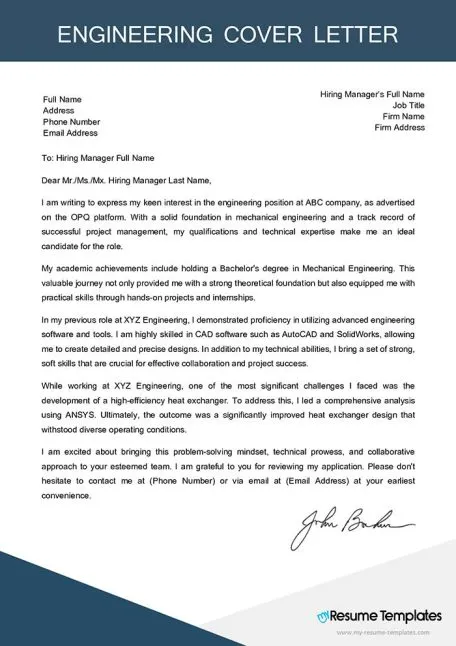
Crafting a compelling engineering cover letter is crucial for making a strong first impression and securing an interview. Unlike a resume, which provides a factual overview of your experience and skills, a cover letter allows you to showcase your personality, enthusiasm, and suitability for a specific role. It’s your opportunity to connect your qualifications to the job description and demonstrate why you are the ideal candidate. By focusing on the key elements of a strong cover letter, you can significantly increase your chances of landing your dream job. This guide provides you with top tips to get a cover letter that will make a good first impression.
Highlighting Your Skills
When writing your engineering cover letter, it’s essential to prominently feature your skills and expertise. Begin by carefully reviewing the job description and identifying the specific skills and qualifications the employer is seeking. Then, in your cover letter, clearly articulate how your skills align with these requirements. Use action verbs to describe your experience and provide concrete examples of how you’ve successfully applied your skills in previous roles. For instance, if the job requires proficiency in CAD software, mention your experience with specific software packages and the projects you’ve completed using them. The more specific you are, the more impactful your cover letter will be, making it easier for the hiring manager to see your value.
Quantifying Achievements

Beyond simply listing your skills, your engineering cover letter should quantify your achievements whenever possible. Instead of stating that you ‘improved efficiency,’ provide specific metrics, such as ‘increased production efficiency by 15%.’ Use numbers and data to demonstrate the impact of your work. This approach not only showcases your accomplishments but also provides tangible evidence of your capabilities. For example, if you’ve designed a system that reduced costs, specify the amount of cost savings achieved. By quantifying your achievements, you create a more compelling narrative that highlights your value to potential employers, setting you apart from other applicants.
Tailoring Your Cover Letter
A generic cover letter is unlikely to capture the attention of a hiring manager. To stand out, it’s crucial to tailor each cover letter to the specific job and company. Research the company, understand its mission, values, and recent projects. Then, in your cover letter, explain why you’re interested in the company and how your skills and experience align with its goals. Address the specific requirements outlined in the job description and use keywords from the posting. Personalize your cover letter to show that you’ve taken the time to understand the company and that you genuinely want to work there. This level of detail demonstrates your enthusiasm and attention to detail, making a lasting impression.
Showcasing Your Personality
While technical skills are essential in engineering, your cover letter is an opportunity to showcase your personality and communication skills. Use a professional but engaging tone and let your enthusiasm for the role shine through. Share a brief anecdote or story that highlights your passion for engineering or a project that demonstrates your problem-solving abilities. Avoid overly formal language and make sure your cover letter reflects your unique perspective and approach. By infusing your personality into your cover letter, you create a more memorable and engaging document that helps the hiring manager get a sense of who you are beyond your qualifications.
Formatting for Impact

The visual appeal of your cover letter matters. Use a clean, professional font, such as Times New Roman, Arial, or Calibri, and maintain consistent formatting throughout the document. Break up large blocks of text with paragraphs and bullet points to improve readability. Ensure your cover letter is easy to scan and navigate. Use headings and subheadings to organize your content logically. Proofread your cover letter carefully to eliminate any grammatical errors or typos, as these can detract from your professionalism. A well-formatted cover letter demonstrates attention to detail and respect for the reader’s time, making it more likely to be read and considered.
Essential Content for Your Cover Letter
Contact Information
Begin your cover letter with your contact information, including your full name, phone number, email address, and LinkedIn profile URL (if applicable). Ensure your contact information is up-to-date and professional. Place your contact information at the top of the document, either left-aligned or centered. This allows the hiring manager to quickly access your details if they want to contact you for an interview. Double-check your email address and phone number for accuracy, as any errors can prevent you from being contacted.
Professional Greeting

Address the hiring manager by name if possible. Research the name of the hiring manager or the person responsible for reviewing applications. A personalized greeting, such as ‘Dear Mr./Ms. [Last Name],’ shows that you’ve taken the time to identify the person reading your application. Avoid generic greetings like ‘To Whom It May Concern.’ If you’re unable to find a specific name, use a professional greeting like ‘Dear Hiring Manager’ or ‘Dear [Company Name] Recruiting Team.’ A personalized greeting sets a professional tone from the start of your letter.
Opening Paragraph
The opening paragraph of your cover letter should immediately capture the reader’s attention and state your purpose for writing. Clearly state the position you’re applying for and where you found the job posting. Briefly highlight your most relevant skills and qualifications and express your enthusiasm for the opportunity. This paragraph should serve as a hook, drawing the reader in and making them want to continue reading. Keep it concise and focused, aiming to make a strong first impression that encourages the hiring manager to learn more about your application.
Body Paragraphs
The body paragraphs are where you elaborate on your skills, experience, and accomplishments. Focus on how your qualifications align with the job requirements and the company’s needs. Provide specific examples of your achievements, quantifying them whenever possible. Use the STAR method (Situation, Task, Action, Result) to structure your stories and demonstrate your problem-solving abilities. Explain the situations you faced, the tasks you undertook, the actions you took, and the results you achieved. Highlight your relevant skills, such as technical expertise, problem-solving skills, teamwork, and communication skills. Use clear and concise language and avoid jargon that may not be familiar to the reader.
Closing Paragraph

In your closing paragraph, reiterate your interest in the position and the company. Reiterate your enthusiasm and reiterate your key qualifications for the role. Express your gratitude for the reader’s time and consideration. Include a call to action, such as stating that you are available for an interview and look forward to hearing from them soon. Provide your contact information one last time, and close with a professional closing, such as ‘Sincerely’ or ‘Best regards,’ followed by your name.
Proofreading and Editing
Ensuring Accuracy and Clarity
Before submitting your cover letter, carefully proofread and edit it to ensure accuracy and clarity. Check for any grammatical errors, spelling mistakes, or typos. Use a grammar checker tool to catch any errors you may have missed. Make sure your sentences are clear, concise, and easy to understand. Avoid overly complex language or jargon that could confuse the reader. Read your cover letter aloud to catch any awkward phrasing or areas where the writing could be improved. Accuracy and clarity are crucial for making a professional impression and demonstrating your attention to detail.
Using a Professional Tone
Maintain a professional tone throughout your cover letter. Use formal language and avoid slang, contractions, and informal expressions. Keep your tone positive and enthusiastic. Show respect for the reader and the company. Tailor your language to match the company’s culture and the tone of the job posting. Reviewing your cover letter again to ensure you have not used any unprofessional language. Your goal is to present yourself as a confident and capable professional.
Seeking Feedback
Before submitting your cover letter, ask a trusted friend, mentor, or career advisor to review it. Ask for feedback on the content, formatting, and overall impression of your cover letter. They can help you identify any areas for improvement, such as unclear language or missing information. Get a fresh perspective to catch mistakes or make suggestions. A second pair of eyes can significantly improve the quality of your cover letter. Revising your cover letter based on the feedback you receive will make it more effective and increase your chances of securing an interview. By seeking feedback and making revisions, you can ensure that your cover letter is polished and presents you in the best possible light.