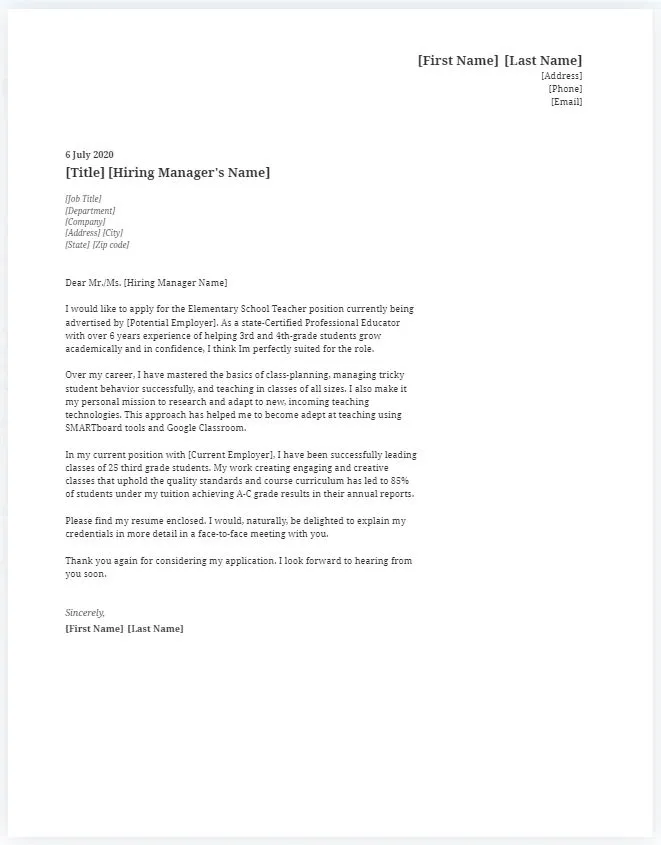
Crafting Your Elementary Teacher Cover Letter
A well-crafted cover letter is a crucial component of your application package when applying for elementary teaching positions. It provides you with an opportunity to go beyond your resume and showcase your personality, passion for teaching, and suitability for the specific role. It’s your first impression on the hiring committee, and a strong cover letter can significantly increase your chances of landing an interview. This guide will provide you with the essential elements and strategies to create a compelling cover letter that highlights your qualifications and helps you stand out from the competition. Remember, your goal is to make the hiring manager want to meet you.
Understanding the Importance of a Cover Letter
A cover letter is more than just a formality; it is a powerful tool that allows you to tell your story and connect with the hiring manager on a personal level. While your resume presents a concise overview of your skills and experience, the cover letter gives you the space to elaborate on these points and demonstrate your unique value proposition. It’s your chance to explain why you are passionate about elementary education, how your skills align with the school’s values, and what you can bring to the classroom. A well-written cover letter can make you memorable and help you stand out from the crowd. It is an opportunity to show genuine interest in the position and the school, which can leave a lasting positive impression.
Highlighting Your Qualifications and Skills

When writing your cover letter, it is essential to highlight the qualifications and skills that make you an effective elementary teacher. Start by reviewing the job description carefully and identify the key requirements and desired attributes. Then, in your cover letter, explicitly state how your skills and experiences align with these requirements. Some essential skills to emphasize include classroom management, lesson planning, differentiated instruction, and creating a positive learning environment. Mention any specific teaching methodologies or technologies you are proficient in. Be specific and provide concrete examples of how you have successfully applied these skills in the classroom. This will demonstrate to the hiring manager that you are not just qualified, but also a great fit for the role.
Remember to quantify your achievements whenever possible. For instance, instead of saying ‘Improved student performance,’ you could say, ‘Improved student reading scores by 15% through the implementation of a new reading intervention program.’ This provides concrete evidence of your capabilities and makes your claims more credible. Additionally, emphasize any specialized skills, certifications, or training relevant to elementary education. This could include certifications in special education, early childhood development, or specific instructional strategies.
Listing Your Relevant Experience
Your cover letter should include a concise overview of your relevant experience. Focus on experiences that directly relate to the elementary teaching position you are applying for. If you have previous teaching experience, highlight your roles, responsibilities, and accomplishments in each position. If you are a recent graduate or have limited experience, emphasize any student teaching experiences, volunteer work, or extracurricular activities that demonstrate your ability to work with children. Describe the age groups you have worked with, the subjects you have taught, and any specific teaching methodologies you have used. For each experience, provide specific examples of how you have made a positive impact on students and the learning environment.
When describing your experiences, use action verbs to create a vivid picture of your accomplishments. For example, instead of ‘Responsible for lesson planning,’ you could say ‘Developed and implemented engaging lesson plans that catered to diverse learning styles.’ The goal is to demonstrate your proactive approach and the results you have achieved. Furthermore, tailor your description to match the specific requirements of the job posting. This demonstrates that you have carefully considered the needs of the school and are prepared to meet their expectations.
Tailoring Your Cover Letter
A generic cover letter is a surefire way to get your application tossed in the ’no’ pile. To truly stand out, you must tailor each cover letter to the specific school and position. This means more than just changing the recipient’s name; it requires a thorough understanding of the school’s values, mission, and any specific needs or priorities outlined in the job description. Research the school’s website, read any available information about their programs, and, if possible, talk to current teachers or administrators. This will help you understand the school’s culture and tailor your cover letter accordingly. Show how your skills and experiences align with the school’s specific needs.
In your letter, explicitly mention how you can contribute to the school’s unique goals and challenges. This shows the hiring manager that you are genuinely interested in their school and that you have taken the time to understand their needs. Include specific examples of how you can contribute to the school community. Addressing the specific requirements of the job posting is crucial, and it shows you have carefully read and understood the role. The ability to tailor your cover letter is a key skill in the job search process, and it demonstrates your commitment to the specific opportunity.
Researching the School and Position

Before you start writing, dedicate time to research the school and the specific teaching position. This research is essential for tailoring your cover letter and demonstrating your genuine interest in the opportunity. Visit the school’s website, review their mission statement, and explore their programs and initiatives. Look for information about the school’s values, culture, and any specific focus areas, such as STEM, arts integration, or differentiated instruction. Pay close attention to the job description. Identify the key responsibilities, required skills, and any specific qualifications the school is seeking. This information will help you align your skills and experiences with the school’s needs.
If possible, try to learn more about the school’s teaching staff. Researching the school and position will give you insights to make the cover letter more convincing. Understanding the school’s context is crucial for showing the hiring committee that you are prepared to be successful in the school. This is a vital step in crafting an effective cover letter, as it allows you to demonstrate your genuine interest in the school and your ability to meet its specific requirements.
Showcasing Your Passion for Teaching
Elementary teaching is more than just a job; it’s a calling. Your cover letter is the perfect place to showcase your passion for teaching and your dedication to helping young children learn and grow. Share your genuine enthusiasm for working with children. Discuss what you love most about teaching, what inspires you, and what motivates you to create a positive and engaging learning environment. Be specific about the age groups you enjoy working with and the subjects you are passionate about teaching. Use anecdotes and stories to illustrate your passion. Share a memorable experience that demonstrates your commitment to student success.
Your passion should be evident throughout your cover letter. If you are excited about a particular teaching method or believe in the importance of a specific educational philosophy, mention it. When it comes to elementary education, enthusiasm is contagious. Displaying your passion can capture the attention of hiring managers. This can make your cover letter more impactful.
Demonstrating Your Classroom Management Skills
Classroom management is a critical skill for elementary teachers. Demonstrate your ability to create a positive and effective learning environment. Highlight any specific classroom management techniques you use, such as positive reinforcement, clear expectations, and consistent routines. Provide examples of how you have successfully managed a classroom. Mention your ability to handle different student behaviors, and create a supportive and inclusive classroom culture. When describing your classroom management skills, focus on creating a structured and nurturing environment where all students feel safe and supported.
Consider mentioning any professional development or training you have received in classroom management strategies. You could also discuss your ability to collaborate with parents and communicate effectively with them about student progress and behavior. Effective classroom management skills are vital. It’s important for the hiring manager to know that you understand this and can ensure a productive learning environment.
Emphasizing Your Educational Philosophy

Your cover letter is a chance to articulate your educational philosophy and explain how you approach teaching. Discuss your beliefs about education, student learning, and the role of the teacher. Do you believe in a student-centered approach, differentiated instruction, or a project-based learning environment? Share your beliefs on what makes a positive and enriching learning environment for children. Explain how your teaching philosophy aligns with the school’s values and mission statement. Providing insight into your educational philosophy will help hiring managers understand your approach. This helps to determine if you are a good fit for their school.
If you have experience implementing specific educational philosophies, such as Montessori or Waldorf, mention it and explain why you are passionate about it. This helps you stand out from the other candidates. Your educational philosophy is what drives your teaching practice.
Reviewing Examples
Reviewing examples of successful elementary teacher cover letters can provide valuable guidance and inspiration. By studying these examples, you can see how other teachers have effectively highlighted their qualifications, experiences, and passion for teaching. Pay attention to the structure, language, and tone used in the examples. Note how they tailor their letters to the specific requirements of the job and the school’s values. Using examples to guide you can help to create a great cover letter.
Analyze the examples and consider how you can adapt the best elements to your own cover letter. However, avoid copying the examples. Instead, use them as a springboard for your own writing. Reviewing cover letter examples is a great way to get inspired. It also allows you to see how other teachers have successfully presented themselves.
Key Elements of a Successful Cover Letter
Several key elements are essential for crafting a successful elementary teacher cover letter. The cover letter must be well-organized and easy to read. Ensure that your contact information, including your name, address, phone number, and email address, is prominently displayed at the top of the letter. Use a professional font and format, and ensure the letter is free of grammatical errors and typos. The tone of your letter should be positive and enthusiastic, reflecting your passion for teaching. The letter should also be tailored to the specific school and position. It highlights your qualifications, skills, and relevant experiences.
Including a clear call to action is also important. You should state your availability for an interview and express your enthusiasm for the opportunity. Proofread your letter carefully before sending it. These elements are important for making a good first impression.
Header and Contact Information

The header of your cover letter should include your contact information. Make sure your name, address, phone number, and email address are clearly visible at the top of the letter. It’s important to use a professional-looking email address. If you have a LinkedIn profile, you may also include the link to your profile in the header. Your contact information makes it easy for the hiring manager to contact you.
Ensure that all the contact information is up-to-date and accurate. Double-check your email address and phone number. Your contact information is the first thing the hiring manager sees. This is also how they will contact you. Make sure everything is correct to avoid any issues when applying.
Greeting and Introduction
Start your cover letter with a professional greeting, such as ‘Dear [Hiring Manager name]’ or ‘Dear [Principal’s name].’ If you do not know the name of the hiring manager, use a generic greeting like ‘Dear Hiring Committee.’ In your introduction, state the specific position you are applying for and how you learned about the opportunity. Briefly mention your key qualifications or the aspect of the job that excites you the most. Your introduction is your first chance to grab the reader’s attention and make a positive impression.
Avoid generic or cliché introductions. Be direct and concise in your opening. Start with a strong statement. State your enthusiasm for the opportunity. A good introduction sets the stage for the rest of your letter. This shows that you are an ideal candidate for the position.
Body Paragraphs
The body of your cover letter should consist of several paragraphs. Highlight your relevant qualifications, skills, and experiences. Use specific examples and quantifiable results to demonstrate your accomplishments. Tailor the body paragraphs to the specific requirements of the job description. You should align your skills and experience with the school’s needs and mission. Provide clear evidence of how you have successfully met similar challenges in the past. You can show that you can make a valuable contribution to the school. Use a formal and professional tone throughout your cover letter.
Divide your body into sections. Organize your content and highlight your skills and qualifications. Make sure to mention things that make you unique, and highlight your experience. You can discuss your teaching philosophy and your approach to classroom management. Mention your previous teaching experience, including roles and responsibilities, and the ages of children that you have taught. Use action verbs to describe your accomplishments.
Highlighting Achievements and Impact

Instead of merely listing your responsibilities, highlight your achievements and the impact you have made in previous teaching roles. This is where you can use data and specific examples to prove your value. For instance, instead of writing ‘Responsible for lesson planning,’ you can say ‘Developed and implemented lesson plans that increased student engagement by 20%.’ Quantify your achievements whenever possible. Use metrics to provide evidence of your impact. The goal is to show the hiring manager what you can do for the school.
Think about the impact you have had on student learning. What specific improvements did you bring about in your previous roles? Consider student test scores, attendance rates, or parent satisfaction. Sharing your achievements makes you a more attractive candidate. It can set you apart from other candidates. Be specific and provide detailed examples.
Closing and Call to Action
End your cover letter with a strong closing and a clear call to action. Thank the hiring manager for their time and consideration. Reiterate your enthusiasm for the opportunity. State your availability for an interview and express your desire to learn more about the position. Close with a professional sign-off, such as ‘Sincerely’ or ‘Best regards,’ followed by your typed name. Make sure that your closing reinforces your interest in the role. Also, make it easy for the hiring manager to take the next step.
Make sure to make it easy for them to contact you. This means including your contact information in your closing. If you have any references, you can offer to provide them upon request. Your call to action is crucial because it encourages the hiring manager to reach out. It ensures that the hiring manager is aware of your interest.
Ensuring Proper Formatting and Tone
The format and tone of your cover letter are just as important as the content. Use a professional font, such as Times New Roman, Arial, or Calibri, and maintain a consistent font size (typically 11 or 12 points). Use single spacing for the body of the letter. Ensure proper formatting, including adequate margins and spacing between paragraphs. Maintain a professional and enthusiastic tone throughout your cover letter. Avoid using slang, informal language, or overly casual expressions. The tone should reflect your professionalism and your genuine passion for teaching.
Use language that is clear and concise. Make sure it aligns with the job. Check grammar and spelling. Proofread the entire letter before submitting. The goal is to present yourself as a polished and professional candidate. The tone of the cover letter should be positive and engaging.
Proofreading and Editing

Before submitting your cover letter, proofread it carefully for any errors in grammar, spelling, or punctuation. Errors can make your cover letter appear unprofessional and may lead the hiring manager to question your attention to detail. Take the time to read your cover letter aloud, as this can help you catch any awkward phrasing or mistakes. Use grammar and spelling checkers, but do not rely on them entirely. Have a friend, colleague, or career counselor review your cover letter for feedback. They can provide an objective perspective and help you identify any areas for improvement. Make sure your cover letter is perfect. Proofreading is essential for the best possible outcome.
Paying attention to the small details is just as important. You must make sure that your cover letter is of high quality. Proofreading and editing are essential steps. It’s important to make sure that you are presenting yourself in the best light. A polished, error-free cover letter can significantly increase your chances of landing an interview.
Common Mistakes to Avoid
Several common mistakes can undermine your cover letter and reduce your chances of getting an interview. Avoid using generic language that could apply to any teaching position. It is very important to make your cover letter unique. Don’t copy and paste generic cover letters. This is an easy way to show a lack of enthusiasm and care for the specific position. Similarly, avoid focusing solely on your duties. This does not show the hiring manager that you are the best candidate for the job.
Also, avoid ignoring the school’s specific needs. Be sure that you tailor your letter to the needs of the school. Overusing jargon, or the same phrases as everyone else is another common mistake. Make sure your cover letter stands out from the other candidates. Knowing the common mistakes to avoid will help you write a good cover letter.
Generic Language and Lack of Personalization
One of the biggest mistakes you can make is using generic language and failing to personalize your cover letter. Hiring managers can easily spot cover letters that have been mass-produced or that lack genuine enthusiasm. You must avoid using generic phrases that could apply to any teaching position. Make sure that you mention specific details. If you do not personalize your letter, you risk showing a lack of genuine interest in the role. Instead, tailor your cover letter. Mention the specific school and role.
If you lack personalization, you are hurting your chances of getting hired. Customize your cover letter. It will show that you have put in the extra effort. The best way to impress the hiring manager is to show you care about the position. Take the time to research the school and the specific needs of the role. Use the job description. This allows you to demonstrate your genuine interest and unique value.
Focusing Solely on Duties
When writing your cover letter, do not focus solely on describing your previous duties. While it is important to mention your responsibilities, the main goal of your cover letter is to showcase your accomplishments and demonstrate your value. Simply listing your duties will not make you stand out from the other applicants. Highlight your skills and experiences and describe how you made a positive impact on students, the learning environment, or the school community. Provide specific examples and quantifiable results to support your claims. This will show the hiring manager that you are a results-oriented teacher. Focus on the value you bring to the role.
A good cover letter is not just a list of what you did, but what you achieved. Focus on the results of your work. Include specific examples. Show the hiring manager that you are not just qualified, but also a high-performing teacher. Mention how your students have grown with you. Make sure you show your accomplishments. This sets you apart from others.
Ignoring School’s Specific Needs
Another common mistake is ignoring the specific needs and priorities of the school. It’s vital that you demonstrate that you have researched the school. The school is looking for a candidate who understands their mission and values. Make it clear in your cover letter. Use the job description. You should also address any specific initiatives or programs that the school is involved in. You can mention how your skills and experiences align with the school’s goals. This allows you to demonstrate your genuine interest. You show that you are a great fit for the school. If you tailor your letter to the school, you are far more likely to get an interview.
Also, avoid assuming that the school’s needs are the same as any other school. Do not use a generic cover letter. If you tailor your cover letter, you will show that you are more likely to succeed in the specific role. Highlight what the school is doing. You must demonstrate your knowledge of the school. You must express that you are interested in joining the school.
Overusing Jargon
While it’s important to use correct terminology, avoid overusing educational jargon. Using too much jargon can make your cover letter difficult to understand. Using jargon can also make it seem like you are not genuine. Hiring managers want to get a good sense of your communication skills. The goal is to write clear and concise language. The hiring manager will understand it. Keep your language easy to understand. Make sure that the hiring manager can easily read your cover letter. Make sure they can understand it.
Avoid using technical terms or phrases that might not be familiar to the hiring manager. The best thing to do is explain your ideas clearly and concisely. A simple writing style will make the reader engage with your words. You will have a much higher chance of getting hired. You should write in a way that’s easy to read and easy to understand.
Using examples
You can improve the effectiveness of your cover letter by adding examples. Here are a few examples of how you can improve your cover letter:
Cover Letter Example 1 [Skills Focus]
Dear [Hiring Manager name],
I am writing to express my interest in the Elementary Teacher position at [School Name]. With my [Number] years of experience in elementary education and my strong commitment to fostering a positive and engaging learning environment, I am confident that I possess the skills and dedication necessary to excel in this role.
In my previous role as a teacher at [Previous School Name], I was responsible for developing and implementing differentiated lesson plans that catered to the diverse learning needs of my students. I consistently used [Specific teaching methods]. The key to the school was a safe and encouraging learning environment. As a result, I observed an increase in student engagement by 20% and a 15% improvement in reading comprehension scores.
I am eager to contribute my expertise and passion for teaching to [School Name]. I am a highly motivated and enthusiastic educator, committed to making a positive impact on the lives of my students.
Sincerely, [Your Name]
Cover Letter Example 2 [Experience Focus]
Dear [Hiring Manager name],
I am writing to express my interest in the Elementary Teacher position at [School Name]. I have a strong background in elementary education. I have a proven record of fostering a positive and engaging learning environment for young learners.
During my five years of experience teaching at [Previous School Name], I successfully managed a classroom of [Number] students, creating a supportive and inclusive atmosphere where every child felt valued and empowered. I was particularly successful in implementing innovative teaching strategies, such as [Mention specific strategies], which resulted in a significant improvement in student performance. I have experience in multiple subjects, like reading, math, science, social studies, and art.
I am eager to contribute my experience and expertise to [School Name]. I am a dedicated educator who is enthusiastic about creating a positive impact on the lives of my students.
Sincerely, [Your Name]
Cover Letter Example 3 [Passion Focus]
Dear [Hiring Manager name],
I am writing to express my strong interest in the Elementary Teacher position at [School Name]. I have been passionate about elementary education since I was a child, and I am now eager to share my passion for teaching with students at [School Name].
My commitment to creating an inspiring and positive learning environment is what drives me. During my time at [Previous School Name], I developed and implemented engaging lesson plans. The lesson plans had a focus on the diverse learning needs of all the students. I was able to increase student engagement. This, in turn, helped them to improve their learning outcomes. Through various projects, the students improved by 15% in reading comprehension.
I am enthusiastic to contribute my skills and enthusiasm for teaching to [School Name]. I am highly motivated. I am also passionate about educating children and making a positive impact on their lives.
Sincerely, [Your Name]