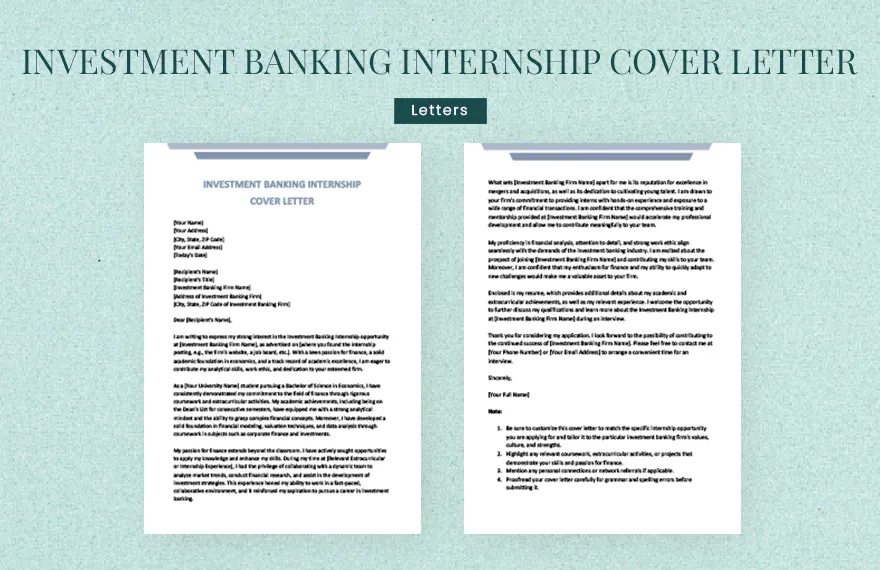
The Power of a Strong Cover Letter for IB Internships
Securing an investment banking internship is highly competitive, demanding not only exceptional academic performance but also a compelling cover letter. Your cover letter is your first impression, a crucial opportunity to demonstrate your suitability for the role and capture the attention of hiring managers. A well-crafted cover letter serves as a bridge, connecting your skills and experiences with the specific requirements of the internship and the firm. It’s more than just a formality; it’s a strategic tool designed to showcase your understanding of the industry, your passion for investment banking, and your potential to contribute to the team. Ignoring this opportunity is a significant misstep. A strong cover letter can be the differentiating factor that lands you an interview, while a weak one can quickly lead to your application being overlooked. Mastering the art of the investment banking internship cover letter is therefore paramount to your success.
Tip 1 Highlight Relevant Skills and Experiences
The first step in crafting a winning cover letter is to effectively highlight the skills and experiences that align with the requirements of the internship. Investment banking firms seek candidates with a strong foundation in finance, accounting, and economics. Emphasize your coursework, projects, and any relevant certifications, such as the CFA or FRM. Moreover, showcase your understanding of financial modeling, valuation, and other key concepts. However, it’s not just about technical skills. Investment banking requires excellent analytical, problem-solving, and communication skills. Provide specific examples of how you’ve utilized these skills in previous roles, academic projects, or extracurricular activities. Tailor this section of your cover letter to reflect the specific requirements mentioned in the job description, demonstrating to the hiring manager that you understand what they are looking for.
Showcasing Your Financial Acumen

In investment banking, financial acumen is fundamental. Demonstrate your understanding of financial statements, valuation techniques (e.g., DCF, multiples analysis), and market dynamics. If you’ve worked on projects involving financial analysis, clearly describe your role, the methodologies used, and the results achieved. For instance, if you’ve built a financial model, explain the key assumptions, the sensitivity analysis performed, and the insights derived. Even if your experience is academic, you can showcase your financial acumen by discussing your participation in case studies, financial modeling competitions, or investment clubs. Your goal is to convince the recruiter that you can think critically about financial data and make informed judgments.
Demonstrating Leadership and Teamwork
Investment banking is a team-oriented environment. Highlight your leadership skills by describing instances where you’ve taken initiative, motivated others, or managed a team. Did you lead a project, organize an event, or captain a sports team? Detail your responsibilities and the outcomes achieved. Teamwork is equally crucial. Provide examples of your ability to collaborate effectively, resolve conflicts, and contribute to a shared goal. Mention any collaborative projects or group assignments where you worked well with others. Moreover, showcase your communication skills. Investment bankers must be able to clearly convey complex information both verbally and in writing. Mention presentations you’ve given, reports you’ve written, or any public speaking experience. The ability to work effectively in teams is a critical factor in the evaluation of internship candidates.
Tip 2 Tailor Your Letter to the Specific Firm
Generic cover letters are easily spotted and often discarded. Tailoring your cover letter to the specific investment banking firm is essential. This shows that you’ve done your research and that you’re genuinely interested in the firm and the internship. Begin by addressing the letter to the appropriate hiring manager or recruiter, if possible. Research the firm’s recent deals, areas of focus, and company culture. Use this information to customize your letter, referencing specific initiatives, values, or projects that resonate with you. The goal is to demonstrate that you understand the firm’s business and why you are a good fit. Avoid using the same generic content for all applications; personalization is key to showing genuine interest and making your application stand out.
Researching the Company Culture

Before writing your cover letter, thoroughly research the company’s culture. Visit the firm’s website, read news articles, and explore social media profiles (e.g., LinkedIn, Twitter). Look for information on the firm’s values, its approach to clients, and its internal culture. Does the firm emphasize teamwork, innovation, or a particular sector? Does it support diversity and inclusion initiatives? Understanding the company culture allows you to tailor your cover letter to demonstrate how your skills and personality align with the firm’s values. For instance, if the firm values innovation, you could highlight your creativity and your ability to come up with innovative solutions. Your goal is to demonstrate that you’re not just a skilled candidate, but also a good cultural fit.
Referencing Specific Deals or Initiatives
To demonstrate your genuine interest, reference specific deals or initiatives undertaken by the firm. This shows that you’ve been following their work and that you’re not just applying to any investment bank. Mention a recent deal that caught your attention and explain why it interests you. Discuss the firm’s role, the industry, and the strategic implications of the deal. You can also refer to the firm’s community involvement or sustainability initiatives if they align with your values. By demonstrating that you’ve taken the time to learn about the firm’s recent activities, you show that you are proactive and genuinely interested in working there. This kind of specificity can significantly enhance your cover letter and set you apart from other applicants.
Tip 3 Quantify Your Achievements
Using numbers to quantify your achievements makes your cover letter more impactful and credible. Instead of simply stating that you have strong analytical skills, provide specific data to support your claim. For instance, if you analyzed financial statements, mention the number of statements you reviewed or the percentage improvement in accuracy you achieved. If you were involved in a project, provide metrics such as the project’s budget, the number of team members involved, or the project’s outcome. Quantifying your achievements adds weight to your claims and demonstrates the value you can bring to the firm. It provides concrete evidence of your skills and accomplishments. This approach is particularly important in the competitive field of investment banking.
Using Numbers to Showcase Impact

Numbers can powerfully illustrate your impact. If you improved efficiency, state by what percentage. If you saved money, specify the amount. If you increased sales, quantify the growth. Consider these examples: ‘Increased sales by 15% through targeted marketing efforts,’ or ‘Improved the efficiency of the financial modeling process by 20%, reducing processing time by 10 hours per week.’ Avoid vague statements like ‘improved performance.’ Instead, show the concrete outcomes of your actions. Think about the key metrics that are relevant to the role and the firm, and then use numbers to demonstrate your ability to deliver results. By quantifying your achievements, you transform your cover letter into a persuasive document that highlights your value and potential.
Providing Context and Results
Whenever you use numbers, provide sufficient context to explain the situation and the results you achieved. For example, if you improved a process, briefly describe the process before your involvement and then explain the changes you made. Then, present the results in a clear and concise manner. Focus on the impact of your actions. What did you achieve, and why does it matter? Did you help the team meet a deadline, save money, or improve accuracy? Briefly state the results and explain their significance. Frame your achievements in a way that makes them easy for the reader to understand and appreciate. Show the recruiter not just what you did, but also the value you added. A well-structured and quantified approach will significantly enhance your cover letter.
Tip 4 Showcase Your Passion and Enthusiasm
Investment banking firms seek candidates who are genuinely passionate about the industry. Your cover letter should convey your enthusiasm for investment banking and your understanding of the industry. The best cover letters go beyond simply stating that you’re interested; they show your passion through your choice of words, your knowledge of the firm, and your career goals. Expressing your genuine interest in investment banking will show the hiring manager that you are not only qualified, but also truly invested in a career in this field, which is a huge plus when selecting interns. Demonstrating your enthusiasm is critical to making a memorable impression.
Expressing Genuine Interest in IB

Express your genuine interest in investment banking, not just a general interest in finance. Explain what specifically attracts you to the field. Is it the opportunity to work on complex deals, the fast-paced environment, or the chance to learn from industry leaders? Share your insights into why you are drawn to the industry and the specific aspects that excite you. You can mention any specific areas of investment banking that you find particularly interesting, such as mergers and acquisitions, equity research, or capital markets. Show that you understand the responsibilities and challenges associated with the role. Be specific, authentic, and use your own voice to convey your passion. Let your personality shine through. This will make your cover letter more engaging and memorable.
Mentioning Career Goals and Aspirations
Clearly state your career goals and aspirations. How does this internship fit into your long-term plans? Where do you see yourself in 5 or 10 years? Mention your aspirations for a career in investment banking and how this internship will help you achieve your goals. Discuss your learning objectives for the internship. What skills or experiences are you hoping to gain? Demonstrate that you have a clear understanding of your career trajectory. This shows that you are not just looking for any internship; you are looking to start your career. Be specific about what you want to achieve, and show your genuine commitment to building a successful career in investment banking. This forward-thinking approach makes a strong impression.
Tip 5 Proofread and Perfect Your Cover Letter
A cover letter riddled with errors reflects poorly on your attention to detail and your professionalism. It is essential to proofread your cover letter meticulously before submitting it. Carefully check for any grammatical errors, spelling mistakes, and typos. Read your letter aloud to ensure that the language flows naturally. Ask a friend, family member, or career counselor to review your letter and provide feedback. Multiple sets of eyes can catch errors you might have missed. Attention to detail is paramount in investment banking, where accuracy is essential. A well-proofread cover letter demonstrates your commitment to quality and helps you make a positive impression. Proofreading is a simple yet crucial step that can significantly improve your chances of success.
Checking for Grammatical Errors

Grammatical errors can damage your credibility and undermine the message you’re trying to convey. Carefully review your cover letter for any grammatical errors. Pay particular attention to subject-verb agreement, correct tense usage, and proper punctuation. Check for any misused words or phrases that could change the meaning of your sentences. Use a grammar checker tool to identify potential errors, but remember that these tools are not foolproof, and they cannot replace a careful human review. Read your letter aloud, slowly, to ensure that each sentence is clear and grammatically correct. Errors can be a distraction for recruiters and can make them question your professionalism and attention to detail. A grammatically sound letter shows that you’re serious about this opportunity.
Ensuring a Professional Tone
Maintain a professional and respectful tone throughout your cover letter. Use formal language and avoid slang, contractions, and overly casual expressions. Address the hiring manager appropriately, using their title and name. Keep the tone positive and enthusiastic, but avoid being overly familiar or presumptuous. The overall tone of your cover letter should reflect the professional standards of the investment banking industry. Demonstrate respect for the firm and the hiring manager, and use language that is clear, concise, and professional. This will reinforce your image of a capable and professional candidate who is ready to enter the investment banking world. Your cover letter is a direct representation of your professionalism.
Conclusion
Writing a compelling cover letter for an investment banking internship requires careful planning and execution. By highlighting relevant skills, tailoring your letter to the specific firm, quantifying your achievements, showcasing your passion, and proofreading meticulously, you can significantly increase your chances of securing an interview. Remember that your cover letter is your first opportunity to impress the hiring manager, so make it count. Use these tips to create a cover letter that stands out, and good luck with your applications. Your effort will be rewarded with opportunities in this competitive field. Focus on presenting yourself in the best possible light to make a memorable impression. Successfully navigating the internship application process is an excellent first step in your investment banking journey.