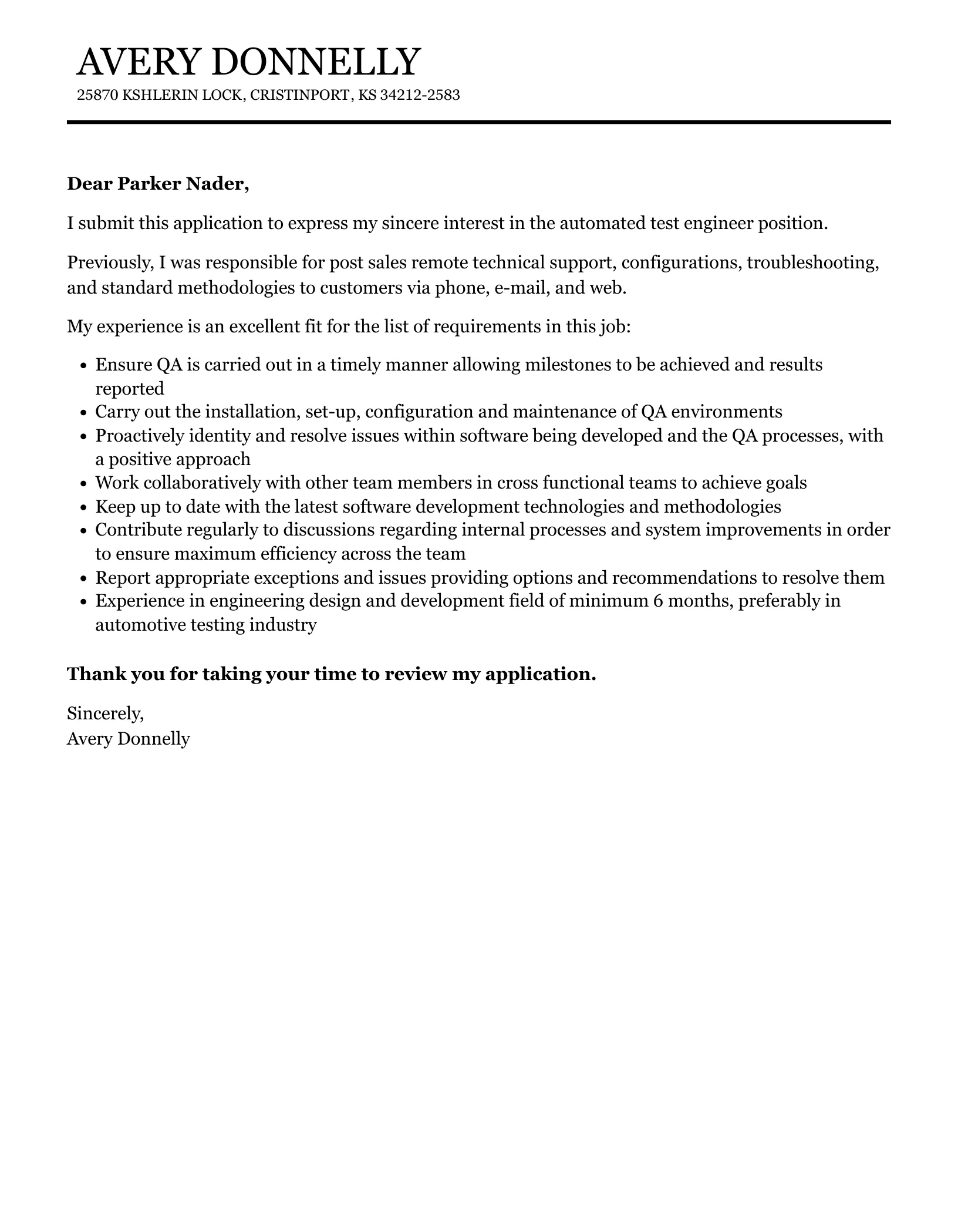
What is a Cover Letter for Test Engineer Job?
A cover letter for a Test Engineer job is a crucial document that accompanies your resume when applying for a position. It serves as an introduction and allows you to highlight your skills, experience, and qualifications in a way that a resume cannot. A well-crafted cover letter demonstrates your interest in the specific role and company, showcasing your personality and writing abilities. It provides an opportunity to explain your career goals and why you are the ideal candidate. Think of it as your first impression, setting the tone for the rest of your application and increasing your chances of securing an interview. A strong cover letter is tailored to the specific job description, illustrating how your skills align with the company’s needs.
Essential Components of a Test Engineer Cover Letter
To create a compelling cover letter, you need to incorporate several key components. These elements work together to present a complete and persuasive case for your candidacy. Each section plays a vital role in conveying your qualifications and enthusiasm. This structure ensures you cover all the important aspects of your application. Ignoring any of these could result in a less effective cover letter. A comprehensive cover letter provides a clear and concise picture of your professional profile, making it easier for the hiring manager to assess your suitability for the position.
Contact Information & Date

Start your cover letter with your contact information, including your name, address, phone number, and email address. Place this information at the top of the letter. Following this, include the date you are writing the letter. This sets a professional tone and provides the recruiter with immediate access to your contact details. Ensure the information is accurate, as this is how the employer will reach you. This initial section establishes a professional foundation for your application.
Hiring Manager’s Name & Title (If Known)
If possible, address your cover letter to a specific person, such as the hiring manager or the recruiter. Researching the hiring manager’s name shows initiative and attention to detail. If the name is unavailable, use a professional salutation, such as ‘Dear Hiring Manager’. This personal touch immediately captures the reader’s attention and shows that you have put effort into your application. Addressing the hiring manager by name makes your letter feel more personal and less generic.
The Perfect Salutation
Choose a professional salutation, such as ‘Dear Mr./Ms. [Last Name]’ if you know the hiring manager’s name. If you do not know the hiring manager’s name, use ‘Dear Hiring Manager’ or ‘Dear [Company Name] Hiring Team’. Avoid informal greetings. The salutation sets the tone for your letter. The right salutation ensures your letter starts in a respectful and professional manner. A well-chosen salutation helps you make a positive first impression on the hiring manager.
Highlighting Your Skills and Experience

The core of your cover letter should highlight your skills and experience. This is where you demonstrate how your abilities align with the job requirements. The focus should be on the most relevant aspects of your background, providing clear examples of how you meet the employer’s needs. This section is your opportunity to showcase why you are the perfect fit for the Test Engineer role, so it should be written with precision and conviction. Make sure you align your skills and experience with the key requirements outlined in the job description to show that you are the perfect candidate.
Tailoring Your Cover Letter to the Job Description
Customize your cover letter to match the job description. Carefully read the job posting and identify the key skills, qualifications, and experiences that the employer seeks. Use these keywords and phrases in your cover letter to demonstrate that you meet their specific requirements. Explain how your skills align with the job, providing specific examples from your work experience. Showing how your skills directly address the needs of the company is key. A tailored cover letter demonstrates your attention to detail and your genuine interest in the specific role.
Emphasizing Technical Skills
Test Engineers require a range of technical skills. In your cover letter, highlight skills relevant to the role, such as experience with testing methodologies, programming languages (e.g., Python, Java), and testing tools (e.g., Selenium, JUnit). Provide specific examples of how you have used these skills in previous roles. Mention any certifications or training that support your technical abilities. Demonstrating these skills will help you stand out from other candidates. Technical skills are essential for the test engineer role. Make sure you showcase these skills in a clear and effective manner.
Showcasing Relevant Experience

Detail your relevant work experience in this section. Focus on roles where you have performed similar duties to those described in the job posting. Describe the responsibilities you held and the projects you contributed to. Quantify your accomplishments whenever possible. Include specific examples that illustrate your ability to perform the tasks the job requires. Provide a clear and concise overview of your work history. Highlighting your experience provides concrete evidence of your qualifications for the Test Engineer role.
Quantifying Achievements
Use quantifiable metrics to demonstrate your accomplishments. For example, state how you improved test coverage, reduced defects, or increased testing efficiency in previous roles. Using numbers and percentages makes your achievements more impactful and easier to understand. Quantifiable achievements make your application stronger and more persuasive. The more quantifiable data you provide, the more likely you are to impress the hiring manager.
Demonstrating Problem-Solving Abilities
Test Engineers frequently encounter problems. Illustrate your ability to solve technical challenges. Describe a situation where you identified a problem, implemented a solution, and achieved a positive outcome. Explain your approach and the steps you took to resolve the issue. Highlighting problem-solving skills demonstrates your capacity to handle difficult situations. Providing real-world examples will show you are capable of dealing with challenges that can arise in a test engineer role.
Expressing Enthusiasm & Company Research

Show genuine enthusiasm for the role and the company. Demonstrate that you have researched the company and understand its mission, values, and products. Tailor your letter to show how your skills and experiences align with the company’s specific needs. Expressing enthusiasm shows that you are genuinely interested in the role. Researching the company shows that you are serious about the job. This combination can significantly boost your chances of success. Your goal should be to impress the hiring manager.
Expressing Interest in the Role & Company
Clearly state your interest in the specific Test Engineer role. Explain what attracts you to the position and the company. Mention specific aspects of the job that excite you, and explain how your skills and career goals align with the role. Demonstrating your interest conveys your commitment to the job. Showing genuine interest makes a positive impression. Be specific about why you are interested. Your passion will show the hiring manager that you are a good fit.
Mentioning Company Values
Refer to the company’s values and explain how your own values align with the company’s mission. This shows that you have taken the time to understand the company’s culture and that you are a good fit. Mentioning the company values suggests that you would fit well into their workplace environment. A good cultural fit is just as important as professional skills, and referencing company values will help you stand out.
Adding a Compelling Call to Action

End your cover letter with a clear call to action. State that you are eager to discuss your qualifications further and express your availability for an interview. Thank the hiring manager for their time and consideration. A strong call to action shows that you are keen to move forward. Clearly state your next step. A concise call to action will help get the attention of the hiring manager and help you get an interview.
Professional Closing and Signature
Use a professional closing, such as ‘Sincerely’, ‘Best regards’, or ‘Thank you’. Follow this with your typed name. If you are submitting a hard copy, include your handwritten signature above your typed name. This professional touch adds credibility to your cover letter. It shows that you are committed to the job. Ensuring your closing and signature is professional rounds off the cover letter with polish and precision.
Proofreading and Formatting Tips for Your Cover Letter
A well-formatted and error-free cover letter significantly improves your chances of making a positive impression. Ensure that your letter is easy to read. Formatting and proofreading are essential for making your cover letter look professional. Clean formatting will help you impress the hiring manager and make your letter much easier to read. A polished document reflects your professionalism.
Formatting your Cover Letter for Readability

Use a clear, professional font such as Arial or Times New Roman. Maintain consistent formatting throughout the document. Use single spacing within paragraphs and double spacing between paragraphs. Keep your letter concise, ideally no more than one page. Use clear headings and bullet points to break up text and improve readability. Proper formatting makes your cover letter easier to read. Adhering to these guidelines will make your document much easier to assess. This will ensure that the hiring manager can quickly understand your key qualifications. Use this to create a clear layout for your cover letter.
Proofreading for Errors
Thoroughly proofread your cover letter for any spelling or grammatical errors. Errors can undermine your credibility, so take your time to review every sentence. Use a grammar checker and have someone else review your letter as a second set of eyes. Proofreading is essential for making a positive first impression. Even minor errors can damage your application. Proofread carefully to avoid any errors. Take the time to double-check everything.
Tools to Help Write a Cover Letter
Several tools can assist you in writing and formatting your cover letter. Utilize grammar and spell-checking software to catch errors. Many online resources offer cover letter templates and examples tailored to different professions. Use these resources to customize your letter. Consider using a cover letter builder. Leveraging these resources can improve your application. These tools can streamline the writing process. They can assist you by pointing out errors and making sure that you present your skills in the best light.
Final Thoughts
A well-crafted cover letter is a powerful tool for Test Engineers seeking employment. By following these steps, you can create a cover letter that effectively highlights your skills, experience, and enthusiasm for the role. Remember to tailor your letter to each job application, proofread carefully, and showcase your unique qualifications. A strong cover letter is your chance to stand out and impress potential employers. Writing a great cover letter requires preparation. It is an investment that will improve your chances of landing an interview. Use these insights to create a cover letter that will help you get the job.