Crafting a Compelling Cover Letter Email How-To Guide
In the competitive landscape of job applications, a well-crafted cover letter email can be the key to unlocking your dream career. This comprehensive guide provides a step-by-step approach to creating a cover letter email that grabs attention, showcases your skills, and increases your chances of landing an interview. From understanding the fundamental importance of the cover letter email to mastering the art of subject lines and formatting, you’ll discover all the essential elements needed to make a lasting impression on potential employers. Whether you’re a seasoned professional or just starting your job search, this guide offers invaluable insights and practical advice for crafting a cover letter email that stands out from the crowd.
Understanding the Importance of a Cover Letter Email
A cover letter email serves as your first point of contact with a potential employer, and it’s your opportunity to make a positive and memorable impression. More than just a formality, it’s a crucial tool that can significantly impact your chances of getting noticed. By thoughtfully crafting a cover letter email, you can demonstrate your professionalism, highlight your unique qualifications, and express your genuine interest in the position. This is an opportunity to go beyond what your resume states. In a world where every detail matters, a well-executed cover letter email can be the deciding factor between receiving an invitation for an interview and being overlooked.
Why a Cover Letter Email is Essential

A cover letter email is essential because it provides context and personality to your application. It allows you to tell a story about why you are the ideal candidate. It allows you to go beyond a list of qualifications and skills. It gives you the chance to express enthusiasm. Hiring managers are looking for candidates who are a good fit for the company culture. Also, cover letter emails allow you to address any gaps or weaknesses. If there is a reason for a gap in your work history, the cover letter email is the ideal place to address the situation head-on. Finally, a well-written cover letter email highlights the aspects of your background and experiences that are the most relevant for the job.
Differences between Cover Letter and Email
The cover letter and the email that accompanies it are different, but they work together. The cover letter is a formal document attached to the email, providing a detailed overview of your qualifications and experiences. The email itself acts as the introduction and often includes a brief summary of your key skills and your enthusiasm for the role. The email should be concise. Think of the email as the teaser trailer and the cover letter as the main movie. The cover letter email is an opportunity to build a connection with the hiring manager, and it sets the tone for the entire application. A clear, concise, and engaging email can greatly increase the likelihood that the recipient will open and read your attached cover letter.
Structuring Your Cover Letter Email
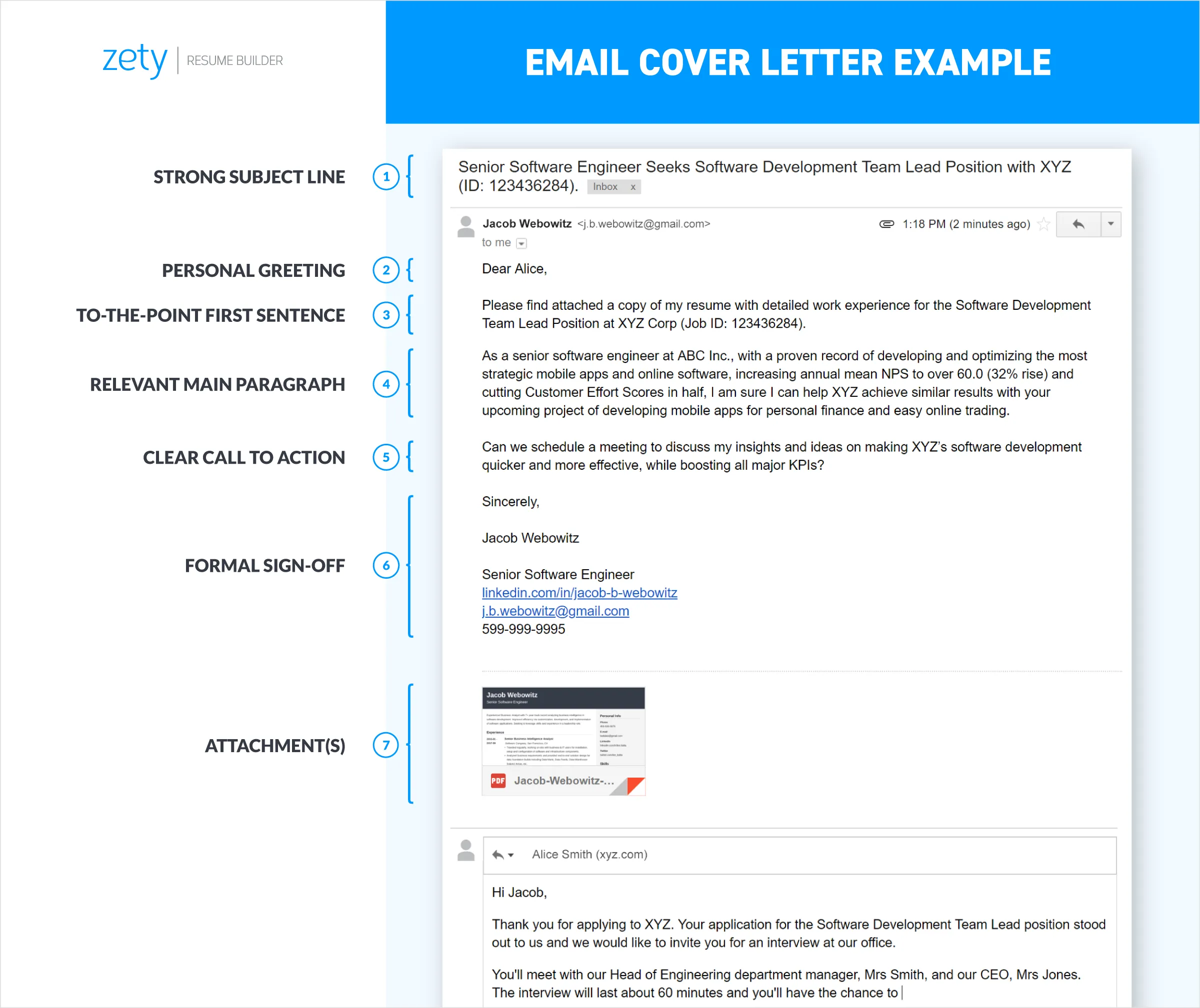
Creating a well-structured cover letter email is crucial to keeping the reader engaged and ensuring that your key points are clearly conveyed. The email should be well-organized, and it should be easy to read. A well-structured email should start with an effective subject line, a compelling opening, a brief summary of your qualifications, a clear call to action, and a professional closing. Keep the body of the email concise, focusing on the information that is most relevant to the specific job. Use short paragraphs, and ensure that each paragraph has a clear message. Proofread the email for any errors. By following this structure, you can create an email that is easy to read and greatly increase your chances of landing an interview.
Subject Line Best Practices

The subject line is the first thing a potential employer sees, so it’s critical to make it count. It must be compelling and relevant to the job you are applying for. When writing the subject line, be specific, and include the job title, and the company name if possible. Avoid generic subject lines like ‘Job Application’. Instead, use phrases like ‘Application for Marketing Manager - [Your Name]’ or ‘Marketing Position - [Job ID]’. Ensure your subject line is clear and professional. Be concise and use keywords to capture the attention of the hiring manager. A well-crafted subject line can significantly increase the likelihood that your email is opened and read.
Opening Paragraph Strategies
The opening paragraph sets the tone for your entire email, and it should immediately grab the reader’s attention. Start by stating the position you are applying for and how you found it. Briefly express your enthusiasm. If you are applying because someone referred you, then mention their name. This helps make a personal connection. Tailor your opening to the specific job and company. Avoid generic statements. The introduction must be direct and professional. Your goal is to make the reader want to learn more about you and read the attached cover letter. Ensure that you are clear about your intent and expectations.
Highlighting Your Key Skills and Experiences
The body of your email should briefly highlight the skills and experiences that are most relevant to the job. Instead of repeating your resume, focus on a few key accomplishments and how they align with the job description. Use action verbs to demonstrate your ability. Provide specific examples of your skills in action, and mention any unique qualifications that make you a strong candidate. Quantify your accomplishments to demonstrate the impact you have had in past roles. Avoid generic phrases. Tailor the content to match the requirements outlined in the job description. Remember to keep your email concise and focused.
Quantifying Your Achievements

Quantifying your achievements is crucial in a cover letter email, and it helps employers understand the tangible impact you have made in past roles. Whenever possible, use numbers and data to showcase your successes. Instead of saying you “improved sales”, say you “increased sales by 20% in one quarter.” If you “managed projects”, then state the number of projects and the outcome. Using measurable results makes your claims more credible and demonstrates your ability to deliver results. Quantifying your achievements helps you stand out from other applicants and demonstrates your value to the company. Focus on the most significant and relevant achievements. This makes a lasting impression on the hiring manager.
Tailoring Your Email to the Job Description
Tailoring your cover letter email to the job description is a vital step in the application process. Begin by carefully reviewing the job description. Identify the key skills, qualifications, and experiences that the employer is looking for. Align your email with these requirements. Emphasize the aspects of your background and experiences that match the job. Use the same keywords and phrases that are used in the job description to ensure your application is scanned and recognized by applicant tracking systems. This strategy demonstrates that you have understood the job requirements and that you are a strong fit for the role. Be sure you don’t just make the same claims as the job description. Use those elements in your own words.
Closing Your Cover Letter Email
The closing paragraph of your cover letter email should leave a lasting positive impression and encourage the employer to take the next step. Reiterate your interest in the position. Thank the hiring manager for their time and consideration. Include a clear call to action, such as, ‘I look forward to hearing from you soon’ or ‘I am available for an interview at your earliest convenience.’ Provide your contact information, including your phone number and email address. End with a professional closing, such as ‘Sincerely’ or ‘Best regards’. Ensure that your email is well-written, and that it is free of errors. The closing paragraph should be concise and professional.
Proofreading and Formatting Your Email

Proofreading and formatting your cover letter email are essential to ensure that your application makes a positive and professional impression. Errors, regardless of how small, can undermine your credibility. A well-formatted email is easy to read and visually appealing. Take the time to proofread your email carefully and to ensure it is properly formatted. This attention to detail shows that you are serious about the job.
Key Elements to Proofread
When proofreading your cover letter email, pay close attention to several key elements. Check for spelling and grammar errors. Use a spellchecker, but don’t rely on it entirely. Review your punctuation. Ensure that all your sentences are complete and grammatically correct. Check your formatting. Ensure that the text is aligned correctly. Use clear and professional fonts. Verify that all your contact information is accurate. Make sure to double-check the name and title of the person you are addressing. Proofread your email multiple times. Ask someone else to review your email for a fresh perspective.
Formatting Tips for Professionalism
Professional formatting is key to making your cover letter email visually appealing and easy to read. Use a professional font, such as Arial or Times New Roman. Use a font size of 10-12 points. Use a clear and consistent layout. Use single spacing between lines within paragraphs. Use double spacing between paragraphs. Avoid using excessive bolding, italics, or underlining. Make sure to use proper capitalization. Always use a professional email signature that includes your name, contact information, and links to your online profiles. Following these formatting tips will help create a polished and professional cover letter email.
Best Cover Letter Email Examples

To truly understand how to write a compelling cover letter email, it’s beneficial to review various examples that showcase different approaches. The following examples are designed to guide you and demonstrate effective writing techniques that can be adapted to your situation.
Example 1 Addressing a Specific Recruiter
Subject Application for Marketing Manager Position
Dear Ms. Smith,
I am writing to express my keen interest in the Marketing Manager position at [Company Name], as advertised on [Platform]. Having closely followed [Company Name]’s innovative marketing campaigns, I am impressed by your approach to [specific aspect].
In my previous role at [Previous Company], I successfully [achievement], resulting in [quantifiable result]. My expertise lies in [key skills]. I am particularly adept at [specific skill].
Attached you will find my resume, which provides further details on my qualifications and experience. I am eager to discuss how my skills can contribute to the success of [Company Name].
Thank you for your time and consideration. I look forward to hearing from you soon.
Sincerely, [Your Name]
Example 2 Application for a Job
Subject Application for Software Engineer Role
Dear Hiring Manager,
I am writing to express my strong interest in the Software Engineer position at [Company Name], as advertised on [Platform]. I am a highly motivated and experienced software engineer with a proven track record of developing high-quality, scalable software solutions.
During my time at [Previous Company], I was instrumental in the development of [project], which resulted in [positive outcome]. I possess expertise in [technical skills]. I thrive in collaborative environments and am dedicated to delivering projects on time and within budget.
Please find my resume attached. I am eager to learn more about this opportunity and discuss how my skills align with your needs.
Thank you for your consideration.
Best regards, [Your Name]
Example 3 Sending a Cover Letter Email Unsolicited

Subject: Inquiry Regarding Potential Opportunities
Dear [Hiring Manager Name],
I hope this email finds you well. My name is [Your Name], and I am a [Your Profession] with a strong passion for [Your Field]. I am reaching out to [Company Name] to express my interest in potential opportunities.
With [Number] years of experience in [Field], I have developed a solid understanding of [Key skills]. I have a successful history of [achievements]. I am particularly interested in [specific area] and believe that my experience and skills align with [Company Name]’s mission and values.
Please find my resume attached for your review. I am eager to learn more about opportunities within [Company Name] and would welcome the chance to discuss how I can contribute to your team.
Thank you for your time and consideration.
Sincerely, [Your Name]
Conclusion
Crafting a compelling cover letter email is a crucial step in any job application process. By understanding the importance of a well-structured email, highlighting key skills, and following best practices for formatting and proofreading, you can significantly increase your chances of landing an interview. Remember to tailor your email to each specific job. Use the provided examples as a guide. By following these tips and advice, you will be on the right path toward securing the job of your dreams.