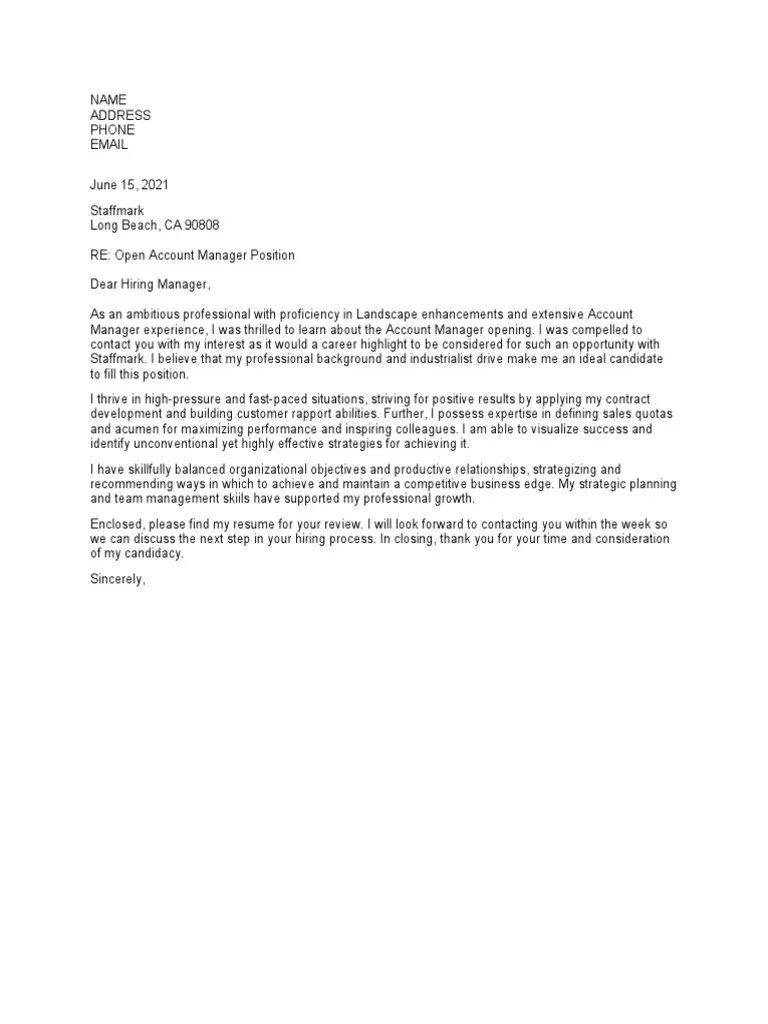
Account Manager Cover Letter Overview
Applying for an Account Manager position requires more than just a resume; a well-crafted cover letter can significantly increase your chances of landing an interview. This guide provides a comprehensive overview of how to write a compelling cover letter that highlights your skills, experience, and enthusiasm for the role. A strong cover letter serves as your first introduction to a potential employer, allowing you to showcase your personality and qualifications in a way that a resume alone cannot. This guide will walk you through the essential components, providing practical tips and examples to help you create a cover letter that stands out.
Understanding the Purpose of a Cover Letter
The primary purpose of a cover letter is to introduce yourself to the hiring manager and express your interest in the specific position. It’s an opportunity to explain why you are the perfect fit for the role and the company. Your cover letter should complement your resume, providing additional context and highlighting the skills and experiences most relevant to the job requirements. It should demonstrate your understanding of the company, the industry, and the challenges and opportunities the role presents. The cover letter is your chance to make a strong first impression and set yourself apart from other candidates. It is also a place to show your writing and communication skills.
Why is a Cover Letter Important?

A cover letter is important because it allows you to personalize your application and demonstrate your genuine interest in the position and the company. It showcases your communication skills and provides an opportunity to explain any gaps in your resume or career changes. Many employers value cover letters because they indicate that you have taken the time to understand the role and the organization, and are willing to go the extra mile. A well-written cover letter can also help you address specific qualifications and tailor your application to the employer’s needs, making you a more attractive candidate.
Key Components of an Account Manager Cover Letter
An effective account manager cover letter consists of several key components that work together to create a cohesive and compelling narrative. These elements include proper header information, a personalized greeting, a captivating opening paragraph, detailed body paragraphs highlighting relevant skills and experience, and a strong closing paragraph with a call to action. Each part plays a vital role in conveying your qualifications and enthusiasm for the position, ensuring that your cover letter captures the reader’s attention and leaves a lasting impression.
Header Information
The header of your cover letter should include your contact information and the date. This information should be clearly presented and easy to read. Include your full name, phone number, email address, and LinkedIn profile URL (optional but recommended). This ensures the hiring manager has all the necessary details to contact you quickly. The header is the first thing the reader sees, so it is essential to present a professional image. Ensure your contact information is up-to-date and professional.
Your Contact Information

At the top of your cover letter, clearly list your contact information. This typically includes your full name, phone number, and email address. Make sure the email address is professional (e.g., firstname.lastname@email.com). If you have a LinkedIn profile, consider including the URL, as it can provide additional context and information about your professional background. Double-check all the information to ensure it is accurate and up-to-date, so the hiring manager can easily reach you.
Date and Recipient Information
After your contact information, include the date and the recipient’s information. Begin with the current date. Then, include the hiring manager’s name, title, and the company’s address if available. Always address the letter to a specific person whenever possible; research the hiring manager’s name on LinkedIn or the company website. Personalizing the letter shows you have taken the initiative to learn about the organization and the role. If you cannot find the hiring manager’s name, use a professional greeting like ‘Dear Hiring Manager’.
Greeting the Hiring Manager
Start your cover letter with a professional greeting. If you know the hiring manager’s name, use ‘Dear Mr./Ms./Mx. [Last Name]’. If you are unsure of the hiring manager’s name, use a general greeting like ‘Dear Hiring Manager’. Avoid generic greetings such as ‘To Whom It May Concern,’ which can come across as impersonal. Addressing the hiring manager by name is a simple way to personalize your cover letter and demonstrate your attention to detail.
Crafting a Compelling Opening Paragraph

The opening paragraph should immediately grab the hiring manager’s attention and convey your enthusiasm for the role. State the position you are applying for and where you saw the job posting. Briefly explain why you are interested in the position and the company. Highlight your key qualifications or skills that align with the job requirements. Aim to create a positive and engaging tone that encourages the reader to continue reading. The opening paragraph is the first opportunity to make a strong impression, so make it count.
Highlighting Relevant Skills and Experience
The body of your cover letter is where you showcase your relevant skills and experience. Use specific examples to demonstrate how your past experiences align with the job requirements. Focus on skills such as communication, relationship building, problem-solving, and account management. Explain how you have successfully managed accounts, met sales targets, and built strong client relationships. Use the job description as a guide to identify the key skills and experiences the employer is seeking and then tailor your examples to match them.
Quantifying Achievements with Data
Whenever possible, quantify your achievements with data and metrics. Provide specific examples of your successes, such as the percentage increase in client retention rates, the amount of revenue generated through your account management efforts, or the number of new clients acquired. Using numbers gives the hiring manager tangible evidence of your abilities and the value you can bring to the company. For example, instead of saying ‘Increased client satisfaction,’ say ‘Increased client satisfaction by 15% within one year through proactive communication and support.’ This approach makes your accomplishments more impactful and memorable.
Demonstrating Knowledge of the Company

Show the hiring manager that you have researched the company and understand its mission, values, and products/services. Explain how your skills and experience align with the company’s goals and what contributions you can make. Mention any specific projects or initiatives that resonate with you. Tailoring your letter to the company demonstrates that you have taken the time to understand its needs and are genuinely interested in joining the team. You can find this information on the company website, news articles, and social media platforms.
Showcasing Account Management Expertise
Account managers need to demonstrate their expertise in client relationship management, sales, and problem-solving. In your cover letter, highlight your experience in these areas. Provide specific examples of how you have built and maintained strong client relationships, resolved complex issues, and exceeded sales targets. Showcase your ability to understand client needs, anticipate potential problems, and provide solutions that benefit both the client and the company. Use keywords from the job description to emphasize your skills and show that you are a good fit for the role.
Tailoring Your Letter to the Job Description
Carefully review the job description and identify the key requirements and qualifications the employer is seeking. Tailor your cover letter to address each of these points specifically. Use keywords from the job description and provide examples of how your skills and experience match these requirements. This demonstrates that you have read the job posting thoroughly and understand what the employer is looking for. Avoid sending a generic cover letter; personalization is crucial for making a positive impression and increasing your chances of getting an interview.
Emphasizing Your Communication and Relationship-Building Skills

Account managers must have excellent communication and relationship-building skills. In your cover letter, highlight your ability to communicate effectively with clients, build rapport, and maintain strong relationships. Give specific examples of how you have successfully managed client relationships, resolved conflicts, and built trust. Demonstrate your ability to actively listen to clients’ needs, understand their perspectives, and provide appropriate solutions. Highlight experiences where you have collaborated with cross-functional teams to meet client needs and achieve positive outcomes.
Closing the Letter with a Strong Call to Action
End your cover letter with a strong call to action. Express your interest in the position and reiterate your enthusiasm for the company. State that you are available for an interview and are eager to discuss how you can contribute to their success. Include your contact information one last time, making it easy for the hiring manager to reach you. Thank the hiring manager for their time and consideration, showing your appreciation for the opportunity.
Proofreading and Formatting for Professionalism
Before submitting your cover letter, thoroughly proofread it for any grammatical errors, spelling mistakes, and typos. Errors can detract from your credibility and make a negative impression. Use a grammar checker and ask someone else to review your letter. Ensure your cover letter is formatted professionally. Use a clear, readable font, such as Arial or Times New Roman, and maintain consistent formatting throughout the document. Proper formatting makes your letter easier to read and reflects your attention to detail.
Formatting Guidelines

Follow these formatting guidelines to ensure your cover letter looks professional. Use a standard font size (11 or 12 points) and a legible font style (Arial, Times New Roman, or Calibri). Set margins to one inch on all sides. Use single-spacing for the body of the letter and double-spacing between paragraphs. Keep the letter concise, ideally within one page. Use clear headings and bullet points to break up text and improve readability. Save your cover letter as a PDF to preserve the formatting.
Common Mistakes to Avoid
Avoid these common mistakes to ensure your cover letter makes a positive impression. Using generic language, focusing too much on yourself, and neglecting proofreading are three major pitfalls. Generic language fails to capture the reader’s attention and may make your application appear insincere. Over-emphasizing your needs instead of the employer’s needs is a common mistake. Neglecting proofreading will leave a poor impression of your attention to detail. Addressing these issues will allow you to showcase yourself in the best light.
Using Generic Language
Avoid using generic phrases and clichés that fail to convey your unique skills and experience. Instead of saying ‘I am a team player,’ provide a specific example of how you have collaborated with others to achieve a common goal. Avoid phrases like ‘hard-working,’ ‘detail-oriented,’ or ‘results-driven’ without providing concrete evidence to back up your claims. Use precise and descriptive language that highlights your accomplishments and demonstrates your understanding of the job requirements. Focus on the specific tasks, achievements, and skills relevant to the position.
Focusing Too Much on Yourself
Your cover letter should focus on how you can contribute to the company’s success, not just on your needs and interests. While it is important to express your enthusiasm, emphasize how your skills and experience align with the company’s goals and how you can help them achieve their objectives. Avoid phrases such as ‘I want this job because…’ and instead focus on how you can add value to the company. Show how your expertise and experience can solve problems, achieve targets, and make a positive impact on the organization.
Neglecting Proofreading
Always proofread your cover letter carefully for any grammatical errors, spelling mistakes, and typos. Errors can create a negative impression of your attention to detail and professionalism. Use a grammar checker to identify potential mistakes and ask a friend or family member to review your letter. A second pair of eyes can often catch errors that you might miss. Ensure your cover letter is flawless, so you make the best possible first impression on the hiring manager.
Account Manager Cover Letter Examples
Reviewing examples of successful account manager cover letters can provide valuable insights into how to structure your letter and highlight your skills and experience effectively. Analyze the language used, the format, and how achievements are presented. Use these examples as a guide to create a cover letter that showcases your qualifications and enthusiasm for the role. Tailor the examples to match your specific experience and the job description, making sure the letter reflects your unique value proposition.
Example 1 Entry-Level Account Manager
For an entry-level account manager position, focus on showcasing your relevant skills and experiences, even if you lack direct account management experience. Highlight your communication, problem-solving, and relationship-building skills. Mention any internships, volunteer work, or academic projects that demonstrate your ability to work with clients and manage projects. Quantify your achievements whenever possible, even if it’s in a non-professional setting. Demonstrate your willingness to learn and your enthusiasm for the role.
Example 2 Experienced Account Manager
If you have experience as an account manager, focus on quantifying your achievements and demonstrating your success in previous roles. Provide specific examples of how you have increased client retention, generated revenue, and improved client satisfaction. Highlight your ability to build and maintain strong client relationships, resolve complex issues, and exceed sales targets. Showcase your expertise in the industry and your understanding of client needs. Tailor your examples to match the job description, emphasizing the skills and experiences most relevant to the role.
Example 3 Account Manager with Specific Industry Experience
If the job requires industry-specific experience, emphasize your knowledge and expertise in that area. Highlight your experience with relevant clients, projects, and technologies. Showcase your understanding of the industry’s challenges and opportunities. Mention any industry-specific certifications or training. Tailor your cover letter to the industry, using relevant keywords and examples. This shows the hiring manager that you are not only qualified but also have a strong understanding of the specific needs of the industry.
Additional Tips for a Winning Cover Letter
In addition to the key components and examples, consider these additional tips to make your cover letter stand out. Researching the company and the hiring manager, using keywords from the job description, and following up after submission are important aspects. Personalizing your cover letter and demonstrating your genuine interest can make a significant difference in your application.
Researching the Company and Hiring Manager
Before writing your cover letter, research the company and the hiring manager. Visit the company website, review their social media profiles, and read recent news articles to learn about their mission, values, and recent projects. If possible, research the hiring manager on LinkedIn to understand their background and interests. Tailoring your letter to the company and the hiring manager demonstrates your genuine interest and attention to detail. Use the information you gather to personalize your letter and show how your skills and experience align with the company’s goals.
Using Keywords from the Job Description
Carefully review the job description and identify the key skills and keywords the employer is seeking. Incorporate these keywords naturally into your cover letter. This will help your application get noticed by applicant tracking systems (ATS) and demonstrate to the hiring manager that you are a good fit for the role. Be sure to use the keywords in context and avoid keyword stuffing. This ensures that your cover letter remains readable and engaging while highlighting your relevant skills and experience.
Following Up After Submission
After submitting your cover letter and resume, follow up with the hiring manager. Send a brief email or make a phone call within a week or two to reiterate your interest in the position and inquire about the status of your application. This demonstrates your initiative and enthusiasm. Keep your follow-up communication concise and professional. Thank the hiring manager for their time and consideration, and reiterate your eagerness to discuss how you can contribute to their company’s success.